
Featured Guides / Setting Up a Kamidana at Home | Placement, Enshrinement, and Recommended Altar Fittings
Setting Up a Kamidana at Home | Placement, Enshrinement, and Recommended Altar Fittings
A photo guide for anyone newly welcoming a kamidana (home Shinto altar) into their home: how to choose a miyagata (altar shrine), where to place it, how to arrange the altar fittings, and the daily worship etiquette. We also introduce recommended altar fittings that are easy to find.
Welcoming a Kamidana into Your Home
A small altar for enshrining, with sincerity, the o-fuda (sacred paper talisman) you received at a shrine — rather than simply leaving it on a shelf. This is what is called a “kamidana” (home Shinto altar). Having a kamidana at home naturally creates a habit of pressing your hands together in prayer morning and evening, and lets you feel closer, in your everyday life, to your connection with your ujigami (local guardian deity) or a shrine you hold dear.
This article walks step by step through how to choose a miyagata (the altar shrine itself), where to place it, how to arrange the altar fittings, and the daily worship etiquette — for anyone newly welcoming a kamidana into their home. We also introduce altar fittings that are actually easy to get hold of, as a reference for choosing your own. For a more detailed explanation of how to arrange your o-fuda and where to place them, please also see our How to Enshrine a Kamidana page.
Choosing a Miyagata (Altar Shrine)
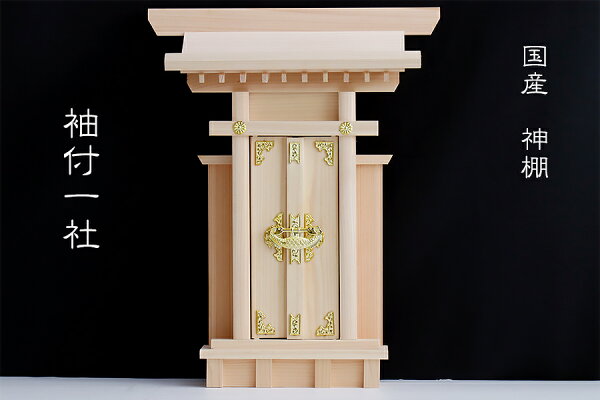
There are several types of miyagata, differing in the number of doors. If you have only a single o-fuda, or if this is your first time enshrining a kamidana, a simple “issha-zukuri” (single-door style) with one door is often chosen. If you would like to enshrine multiple o-fuda side by side, choosing a “sansha-zukuri” (three-door style) with three doors lined up makes the relative rank of each o-fuda visually easy to understand.
PR | Rakuten
Tono Cypress Sode-tsuki Daijingu (single-door style)A simple single-door miyagata made from domestic Tono cypress, easy to choose for first-time buyers. Multiple o-fuda are stacked together inside, making it space-saving and well suited to rental housing too.
¥2,940 (+ ¥500 shipping)
View on Rakuten →
PR | Rakuten
Domestic Cypress Yaneshigai Sansha Kamidana (three-door style)A three-door style miyagata that lets you enshrine multiple o-fuda side by side. Its "yane-shigai" design varies the height of the roofline, and although it is made of domestic cypress it remains lightweight and compact.
¥7,480 (free shipping)
View on Rakuten →Where to Place Your Kamidana
The basic rule is to place the kamidana in a bright, clean room where the family gathers, such as the living room, positioned higher than eye level, and facing south or east. Avoid placing it directly above a frequently used door, or near a toilet or washroom. For more detailed placement notes and illustrations, see our How to Enshrine a Kamidana page.
Assembling Altar Fittings for a Beautiful Enshrinement
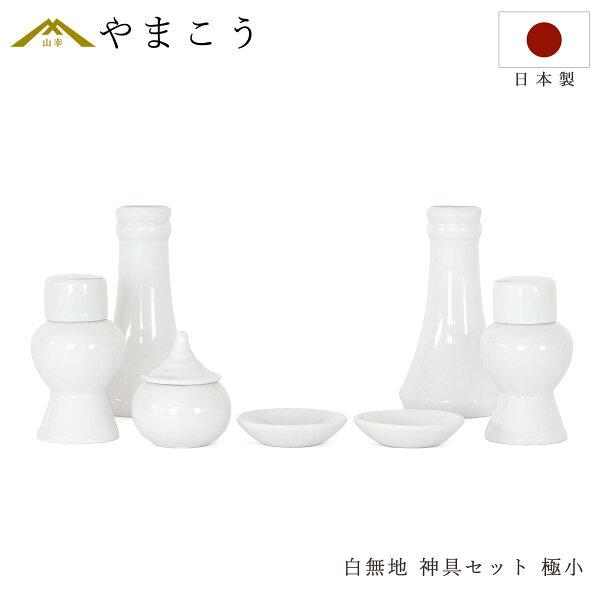
The basic offerings for a kamidana are rice, salt, and water, ideally replaced with fresh ones every day. The set of vessels for presenting these offerings is called “shingu” (altar fittings). Choosing a set that includes a sakaki-tate (sacred sakaki branch stand), heishi (sake vessels), mizutama (water vessel), and plates lets even first-timers gather a complete set all at once.
PR | Rakuten
Plain White 7-Piece Altar Fittings Set (sakaki stand, heishi, mizutama, plates)A 7-piece altar fittings set comprising a sakaki-tate, a pair of heishi (for sacred sake), a mizutama, and plates, all in a plain white finish that suits any room. Everything you need to offer rice, salt, water, and sakaki is included in one set.
¥2,944 (+ ¥500 shipping)
View on Rakuten →Sakaki (a type of evergreen sacred to Shinto) is placed on both sides of the kamidana. Ideally, the branches should be replaced with fresh ones about twice a month (on the 1st and 15th), but for those who find frequent upkeep difficult, or who would like to cut down on the trouble of changing the water, an artificial version that never wilts is also a popular choice.

PR | Rakuten
Artificial Sakaki (never-wilting sakaki), pair, approx. 32cmMade from realistic silk-flower material, this sakaki never wilts. With no water to change, it is popular with households that are often away, and in rental housing as well.
¥1,200 (free shipping)
View on Rakuten →Setting a Sacred Space with a Shimenawa
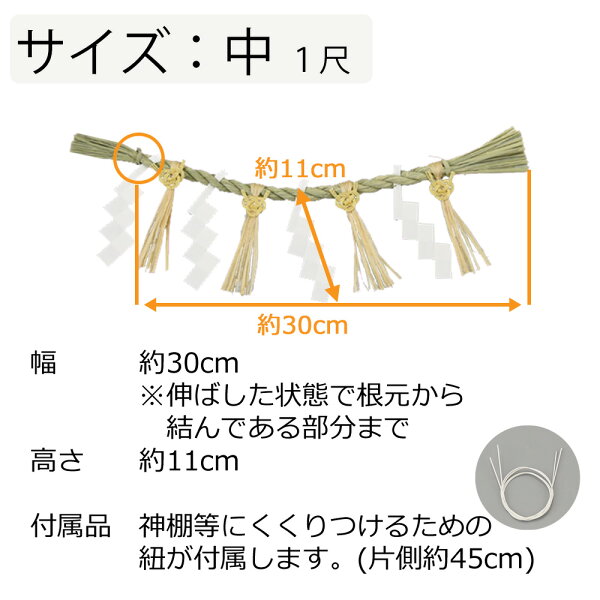
Hanging a shimenawa (sacred straw rope) in front of the kamidana serves as a “kekkai,” marking that space as sacred. It is not essential, but displaying one alongside the miyagata and altar fittings gives the whole altar a more complete, well-arranged feel.
PR | Rakuten
Shimenawa (sacred rope) altar fitting with gohei, modern designA shimenawa fitted with gohei (paper streamers), designed to blend well with modern-style kamidana. Choose from four lengths: 8-sun, 1-shaku, 1.5-shaku, and 2-shaku.
From ¥1,430 (+ ¥770 shipping)
View on Rakuten →Daily Worship Etiquette
Each morning, after refreshing the offerings, stand in front of the kamidana and follow the “two bows, two claps, one bow” ritual, greeting the start of the day and expressing your everyday gratitude. What matters most is not getting the etiquette exactly right, but the sincere feeling of pressing your hands together in prayer to the kami each day. For a detailed look at the types of offerings and how often to replace your o-fuda, see our How to Enshrine a Kamidana page.
In Summary
A kamidana is never a large or elaborate installation — with just a miyagata and the basic altar fittings, any household can begin enshrining one without difficulty. It may be a good idea to start with a single-door miyagata and a minimal set of altar fittings, and gradually build things up to suit your lifestyle. For more on the meaning and types of o-fuda themselves, please also see our Guide to Shrine Amulets and Talismans.