History
Aoi Aso Shrine stands in Kamiaoi-machi, Hitoyoshi, Kumamoto Prefecture, and is affectionately called “Aoi-san” by locals. The official site does not appear to give a reading in kana, but Japanese Wikipedia and a guide site read it “Aoi Aso Jinja.” According to the official site, the three enshrined deities are Takeiwatatsu no Mikoto (a grandson of Emperor Jimmu), Asotsuhime no Mikoto (his consort) and Kuninomiyatsuko Hayamikatama no Mikoto (their child), divided spirits of three of the twelve deities enshrined at Aso Shrine at the foot of Mount Aso. They are described as deities who opened up the fields of Aso and are thought to have watched over the settlement of the Hitoyoshi-Kuma region.
The official site gives the founding as 806 (Daido 1). The divided spirits are said to have been enshrined on Choyo no Sekku (September 9), and the site states that there are 523 shrines nationwide that enshrine divided spirits of Aso Shrine, most of them in Kyushu. It also mentions an old building plaque noting that the surrounding terrain suited the enshrinement of a deity, and a landscape resembling the feng-shui “Shijin-soo” ideal (a river to the east, a pond to the south, a road to the west and mountains to the north).
The present shrine buildings were constructed between 1610 (Keicho 15) and 1613 (Keicho 18) by Nagatsune, the 20th head of the Sagara clan. Per the official site, the main hall, offering hall and corridor date to 1610, the worship hall to 1611 and the gate to 1613, and it notes that having all of the buildings built at the same time is rare even nationwide.
Highlights
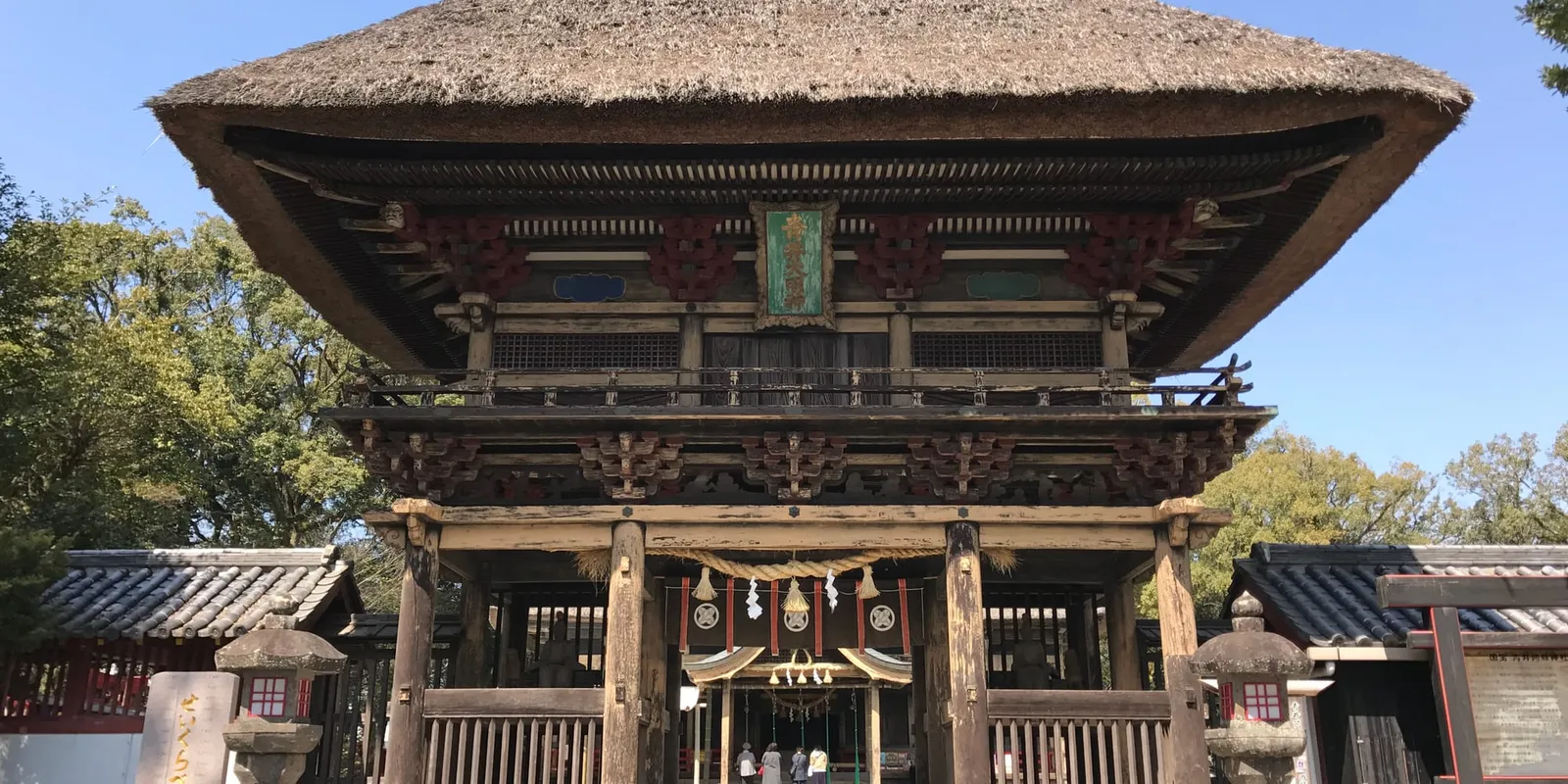
The main attraction is the group of five buildings designated National Treasures in 2008 (June 9, per the official site): the main hall, corridor, offering hall, worship hall and two-story gate (Romon). The official site describes it as the 37th shrine to be designated nationwide and the first thatched-roof shrine or temple building to be so designated. It was also the first National Treasure in Kumamoto Prefecture, and the buildings underwent a full dismantling repair in 1956 under the supervision of the Agency for Cultural Affairs.
The buildings are lacquered mainly in black, with red lacquer on the finer joinery and richly colored carvings. The official site calls the steeply pitched thatched roof with its high ridge the greatest feature, in the style generally called Momoyama. The Romon is 12 meters tall and is described as a harmony of Zen-style and Momoyama-style architecture. Eight divine face carvings with “a” and “un” expressions, in yin-yang pairs, are fitted at the roof’s four corners; this “Hitoyoshi style” is said to have no counterpart elsewhere in Japan. A pair of male and female dragons is painted on the ceiling, and the shrine buildings carry eight dragon carvings in all, as well as six of the “Twenty-four Paragons of Filial Piety” tales.
Next to the shrine stands the Bunkaen, the former residence of the Aoi family of chief priests. According to the official site, the family served for 58 generations from 806 until the Meiji era, and the residence returned to the shrine on April 12, 2010. The site also states that the Bunkaen is closed for the time being because of damage from the July 2020 heavy rains (please check the current status with the shrine). On those rains, Japanese Wikipedia says the shrine lies in the floodplain of the Kuma River, that a flood depth of 4.3 meters was recorded in 2020 and that the National Treasure worship hall was flooded above floor level. The official site announced that repair of the thatched roofs of the worship hall and Romon, damaged by Typhoon No. 10, began on December 7, 2020.
Visiting Tips
The official site gives no regular visiting hours. One guide site says “the grounds are freely accessible; the amulet counter is open 9:00 AM–4:30 PM, every day,” but official notices have listed goshuin and similar services as 9:00 AM–4:00 PM at New Year and during limited-goshuin periods, so times can change. If you are unsure, please contact the shrine (tel. 0966-22-2274).
The official site has announcements of Okunchi festival, rainy-day and seasonal paper-cut goshuin. The online shop (opened April 1, 2022) also sends goshuin paper by mail, and its price list shows ¥800 for the regular goshuin and ¥700–¥1,500 for design goshuin; the fee at the shrine counter is not stated on the official site. During limited-goshuin periods, writing into goshuin books may not be possible (per the 2024 Okunchi limited goshuin notice).
According to Japanese Wikipedia it is about a 4-minute (300 m) walk from JR Hitoyoshi Station, and about 5 minutes per one guide site (not stated on the official site). Parking is listed only by one guide site, at 30 spaces; there is no official information.
The Romon, worship hall, main hall and the rest form one continuous set of buildings, so it is worth walking through from the gate, comparing the roofs and carvings as you go. The official site also says that the writer Shiba Ryotaro held the Romon in high regard.
Annual Festivals
The official site introduces the following as its three major festivals.
- Okunchi Festival (October): The shrine’s “birthday” festival, running from the 3rd to the 11th with the Shinko-shiki procession on October 9 as its center. The date was changed from the original September 9 (Choyo) by the calendar reform of the Meiji era. A fire-prevention rite is held on the 3rd and Kuma Kagura (a nationally selected intangible folk cultural property) is offered on the 8th; in the procession, the Chirin flag leads lion masks, sacred treasures and a portable shrine through the town. Offerings include red rice, simmered vegetables and tsubon soup, and children have their heads bitten by the lion to pray for good health.
- Nagoshi Festival: A purification rite for sins and impurities, said by the official site to have been begun in 1386 by Maeyori, the 7th Sagara lord. Sins and impurities are transferred to paper figures and purified, the straw ring is passed through three times (left, right, left), and the figures are floated down at a rapid called Haraigawa on the Kuma River. Old records place it on the last day of June.
- Inari Shrine Hatsuuma: Held on the first Horse Day of the second lunar month. According to the official site, the Inari shrine was enshrined in 1759 (Horeki 9), in the time of the 27th Sagara lord, Yoriteru.
Dates can vary by year, so check the “News” section of the official site for the latest.
Nearby Food & Sightseeing
- Aoi no Mori National Treasure Memorial House: A facility displaying the shrine’s sacred treasures and votive swords, whose completion ceremony was held on September 1, 2023. In an April 2024 notice, the official site says a permanent exhibition of portable shrines, hanging Buddhist images, votive swords and more began on April 27, with viewing 9:00 AM–5:00 PM (last entry 4:30 PM) and admission ¥500 for adults and ¥300 for elementary and junior high students (check the official site for current conditions).
- Hitoyoshi Castle Ruins: According to Japanese Wikipedia, the ruins of a hill-and-plain castle built where the Kuma River meets its tributary, the Mune River, and a National Historic Site (designated 1961). It is maintained as Hitoyoshi Castle Park, and the page says the Hitoyoshi Castle History Museum reopened after renovation on July 11, 2025.
- JR Hitoyoshi Station: The nearest station to the shrine (per Japanese Wikipedia and a guide site).
Frequently Asked Questions
- Q. What is the National Treasure at Aoi Aso Shrine?
- A. According to the official site, five buildings (the main hall, corridor, offering hall, worship hall and two-story gate) were designated National Treasures in 2008, together with one building-ceremony plaque and five plaques recording later repairs. The site describes it as the 37th shrine to receive the designation nationwide and the first thatched-roof shrine or temple building to do so. The buildings were constructed between 1610 (Keicho 15) and 1613 (Keicho 18) and are known for their steeply pitched thatched roofs.
- Q. What are the visiting hours?
- A. The official site gives no regular visiting hours. One guide site says "the grounds are freely accessible; the amulet counter is open 9:00 AM–4:30 PM, every day." Official notices have given goshuin and similar services as 9:00 AM–4:00 PM at New Year and during limited-goshuin periods, so times can change. To be sure, contact the shrine (tel. 0966-22-2274).
- Q. Can I get a goshuin at Aoi Aso Shrine?
- A. Yes. The official site has announcements of limited goshuin such as an Okunchi festival goshuin, a rainy-day goshuin and seasonal paper-cut designs. The online shop linked from the official site also sends goshuin paper by mail; its price list shows ¥800 for the regular goshuin and ¥700–¥1,500 for design goshuin. The fee at the shrine counter is not stated on the official site. For the 2024 Okunchi limited goshuin, the shrine said it would be issued from October 1 to 14 and could not be written into goshuin books from October 1 to 11.
- Q. How do I get there, and is there parking?
- A. The official site's access page gives only the address and phone number, with no station or parking information. Japanese Wikipedia says it is about a 4-minute (300 m) walk from JR Hitoyoshi Station, and one guide site says about 5 minutes. One guide site lists 30 parking spaces, with no fee details. Traffic restrictions can be in place during the Okunchi festival, so check the official notices at that time.
- Q. When is the Okunchi festival?
- A. According to the official site, Okunchi is the shrine's main annual festival, marking its "birthday," and runs from October 3 to 11, centered on the Shinko-shiki procession on October 9. A fire-prevention rite is held on the 3rd and Kuma Kagura is offered on the 8th; in the procession, the Chirin flag leads lion masks, sacred treasures and a portable shrine through the town. The 2024 schedule was also October 3 (Thursday) to 11 (Friday). Operations can vary by year, so check the official site for the latest dates.
Plan Your Visit
Before you go, you can book a stay and get your shrine-visit items ready.
Amazon links open Amazon.co.jp (Japan) in English; whether an item ships overseas depends on the product.
※ Contains ads (PR). Links open external sites such as Amazon, Rakuten, Trip.com and Booking.com.