History
Kamishikimi Kumanoza Jinja stands in the Kamishikimi district of Takamori, in Kumamoto Prefecture’s Aso District. Its founding date is unknown, but tradition holds it was established sometime between the late Kamakura and Muromachi periods, when an ancient rock-worship tradition centered on the massive Ugetoiwa boulder behind the shrine merged with Kumano faith brought to the area by mountain ascetics. Takamori is home to four shrines carrying the name “Kumanoza” (including this one and the nearby Kamishikimi and Shikimi shrines), all connected to this same Kumano lineage; this one was historically ranked a village shrine (mura-sha).
The shrine enshrines three deities: Izanagi no Mikoto and Izanami no Mikoto, the primordial creator god and goddess of Japanese mythology, together with Ishikimi Taishogun — worshipped as the ara-mitama, or fierce aspect, of Takeiwatatsu no Mikoto, the deity credited with settling the Aso caldera. The current shrine hall is said to date to 1722, and was restored in 1979.
In the forest behind the main hall, a further 10-minute climb up the mountain leads to Ugetoiwa (穿戸岩), an enormous boulder pierced clean through by a wind tunnel more than 10 meters tall and wide. Legend holds that Takeiwatatsu no Mikoto once fired an arrow from the summit of Mount Aso, and his servant Kihachi, annoyed at having to retrieve it, threw it back at his master. Enraged, Takeiwatatsu no Mikoto pursued Kihachi, who kicked straight through this rock face while fleeing — creating the opening seen today. This boulder and its legend are considered the origin of worship at the site.
Highlights
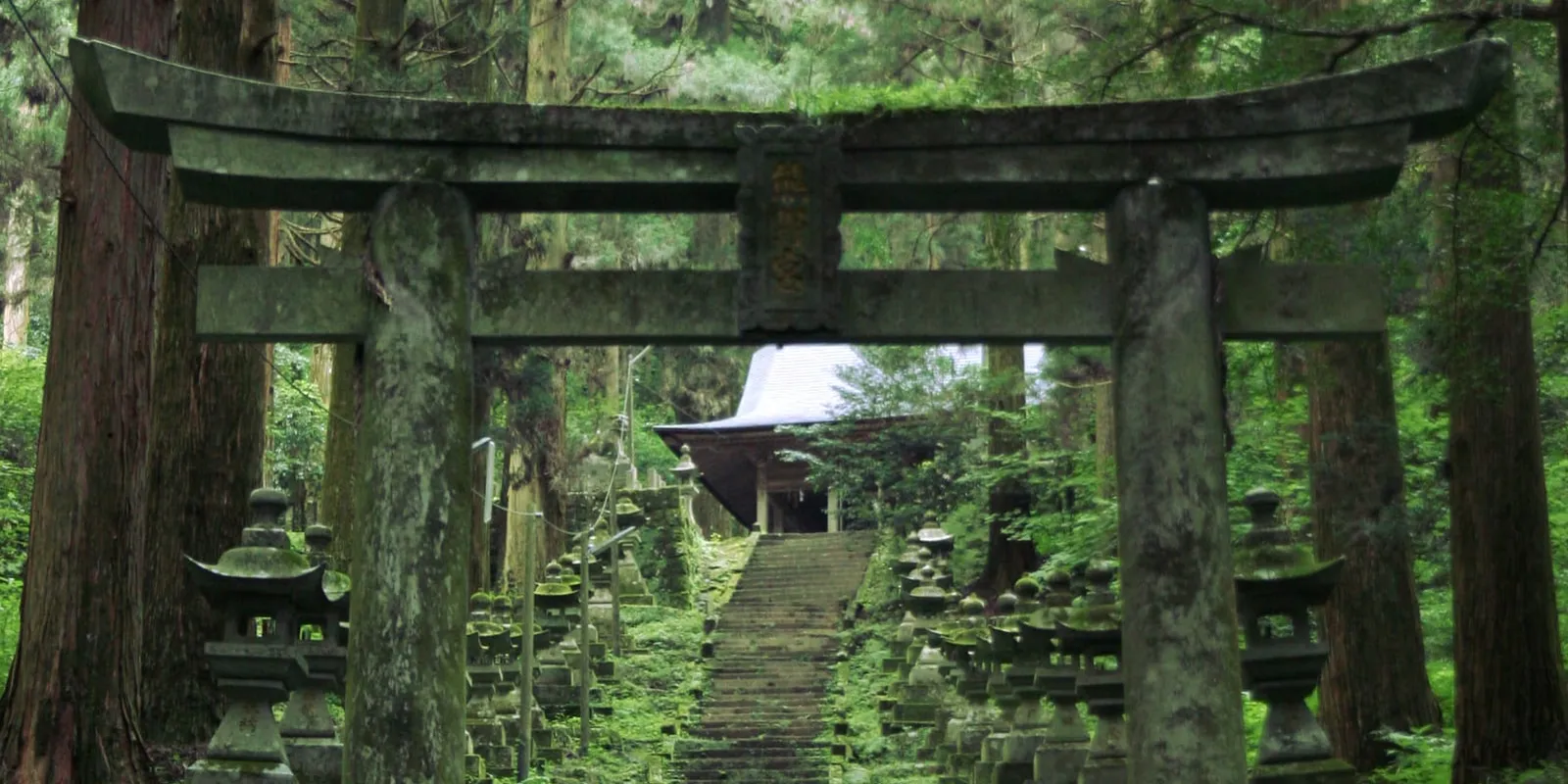
The single biggest highlight is the stone stairway approach beyond the torii. Climbing roughly 250 steps through a forest of cedar and cypress, the path is lined on both sides by around 100 moss-covered stone lanterns, with sunlight filtering down through the canopy to dramatic effect. In recent years the scene has gone viral on social media as an “entrance to another world,” often compared to a scene from a Studio Ghibli film, drawing large numbers of visitors and photographers. It was, in fact, a filming location and inspiration for the animated film “Hotarubi no Mori e” (Into the Forest of Fireflies’ Light, 2011) — not a Ghibli production, despite the comparison. Interestingly, though the lanterns look centuries old, most were actually donated in the 1960s by a local businessman and his friends and family — far newer than they appear.
The small shrine hall at the top of the stairway, said to date to 1722, is easy to miss but well worth seeing, standing quietly amid the surrounding cedar grove. A further 10-minute climb up a forest path behind the hall leads to Ugetoiwa, the legendary pierced boulder. With its wind tunnel measuring more than 10 meters in both directions, the rock — broken through against impossible odds by the fleeing Kihachi — has become a favorite pilgrimage spot for students and job-seekers hoping to overcome their own difficult challenges. (The larger cave opening deeper in the rock is currently off-limits to visitors.)
Visiting Tips
Kamishikimi Kumanoza Jinja has no resident priest, and the grounds can be visited at any time. Goshuin are issued at the Takamori Tourist Information Center, next to Takamori Station, between 9:00 and 17:00 (¥500). The stone stairway is unpaved and quite steep, so sturdy shoes are essential. A restroom is available partway up the stairs, but there is none at the parking area (only vending machines), so plan accordingly. Many visitors say the moss looks even more vivid — and the atmosphere even more otherworldly — on a rainy, overcast, or snowy day.
Annual Festivals
- Summer Grand Festival (mid-July): A festival held by the local shrine parish, drawing worshippers from the surrounding community.
- Exam and victory prayers at Ugetoiwa: During exam season, students and job-seekers visit to pray for success, drawing on the legend of Kihachi breaking through solid rock against all odds.
Nearby Food & Sightseeing
- Takamori Yusui Tunnel Park: A disused railway tunnel turned park, its interior a cool 17°C (63°F) year-round, with an illuminated “water pearl” light display at its far end. Located near Takamori Station, about a 10-minute drive from the shrine.
- Kusakabe Yoshimi Jinja: Another historic shrine in Takamori, known as one of Japan’s three “sagari-miya” (descending shrines) — its main hall sits at the bottom of a stairway of over 100 steps rather than at the top.
- Takamori Tourist Information Center: The tourism hub next to Takamori Station. Since Kamishikimi Kumanoza Jinja is unmanned, this is where its goshuin are issued; rental bicycles and local sightseeing information are also available here.
Frequently Asked Questions
- Q. Who is enshrined at Kamishikimi Kumanoza Jinja?
- A. Three deities: Izanagi no Mikoto and Izanami no Mikoto — the primordial creator god and goddess of Japanese mythology — and Ishikimi Taishogun, worshipped as the fierce spirit (ara-mitama) of Takeiwatatsu no Mikoto, the deity credited with settling the Aso region. The shrine's name reflects its origins as a local branch of Kumano faith.
- Q. What is the Ugetoiwa rock, and what is its legend?
- A. A massive boulder in the forest behind the main hall, pierced by a wind tunnel more than 10 meters tall and wide. According to legend, the servant Kihachi angered the deity Takeiwatatsu no Mikoto by throwing back an arrow he'd been sent to retrieve, and while fleeing the god's pursuit, kicked straight through this rock face to escape — the hole that resulted is Ugetoiwa. Because the boulder was broken through against all odds, it's regarded as a symbol of overcoming any difficult goal, and is visited for exam success and victory in competition.
- Q. Is Kamishikimi Kumanoza Jinja unmanned? Where can I get a goshuin?
- A. Yes, it has no resident priest. Goshuin are issued at the Takamori Tourist Information Center, next to Takamori Station on the Minami-Aso Railway, between 9:00 and 17:00 (¥500).
- Q. How do I get to Kamishikimi Kumanoza Jinja, and is there parking?
- A. It's about 10 minutes by car from Takamori Station on the Minami-Aso Railway, or about 50 minutes from Kumamoto Airport. A free parking area (space for roughly 10 cars) sits at the shrine entrance on Route 265. The approach itself is a steep, unpaved stone stairway, so wear sturdy shoes.
- Q. How many stone steps and moss-covered lanterns are there along the approach?
- A. Past the torii, roughly 250 stone steps climb through a cedar forest, lined on both sides by around 100 moss-covered stone lanterns. Despite their ancient appearance, most were actually donated in the 1960s by a local businessman and his friends and family — much more recent than they look.