History
Gokonomiya Shrine (Gokonomiya Jinja) in Fushimi Ward, Kyoto, has long been the local shrine of the old Fushimi town area, and locals affectionately call it “Gokon-san.” According to the official site, the chief deity is Empress Jingu, called “the greatest guardian deity of safe childbirth in Japan,” and the shrine also enshrines Emperor Chuai and Emperor Ojin together with six other deities: Ube Daimyojin (Takeuchi no Sukune), Takisai no Kami, Kawakami Daimyojin (Toyotamahime), Kora Daimyojin, Wakamiya (Emperor Nintoku) and Shirakiku Daimyojin. Because she is said to have led an expedition to the Korean Peninsula while pregnant, then returned safely and bore and raised Emperor Ojin, she is revered as a deity of safe childbirth and child rearing.
The year of founding is unknown. According to the Gokonomiya Engi, fragrant water welled up in the precinct on the ninth day of the ninth month of 862 (Jogan 4), and Emperor Seiwa bestowed the name “Gokonomiya” on the shrine, as the shrine tells it. The Kashii-gu Hennenki, held by Kashii Shrine, also says that in 823 (Konin 14), following an oracle from Empress Jingu, a shrine building was repaired on this site and a chinquapin tree was planted as the sacred tree (both per the official history).
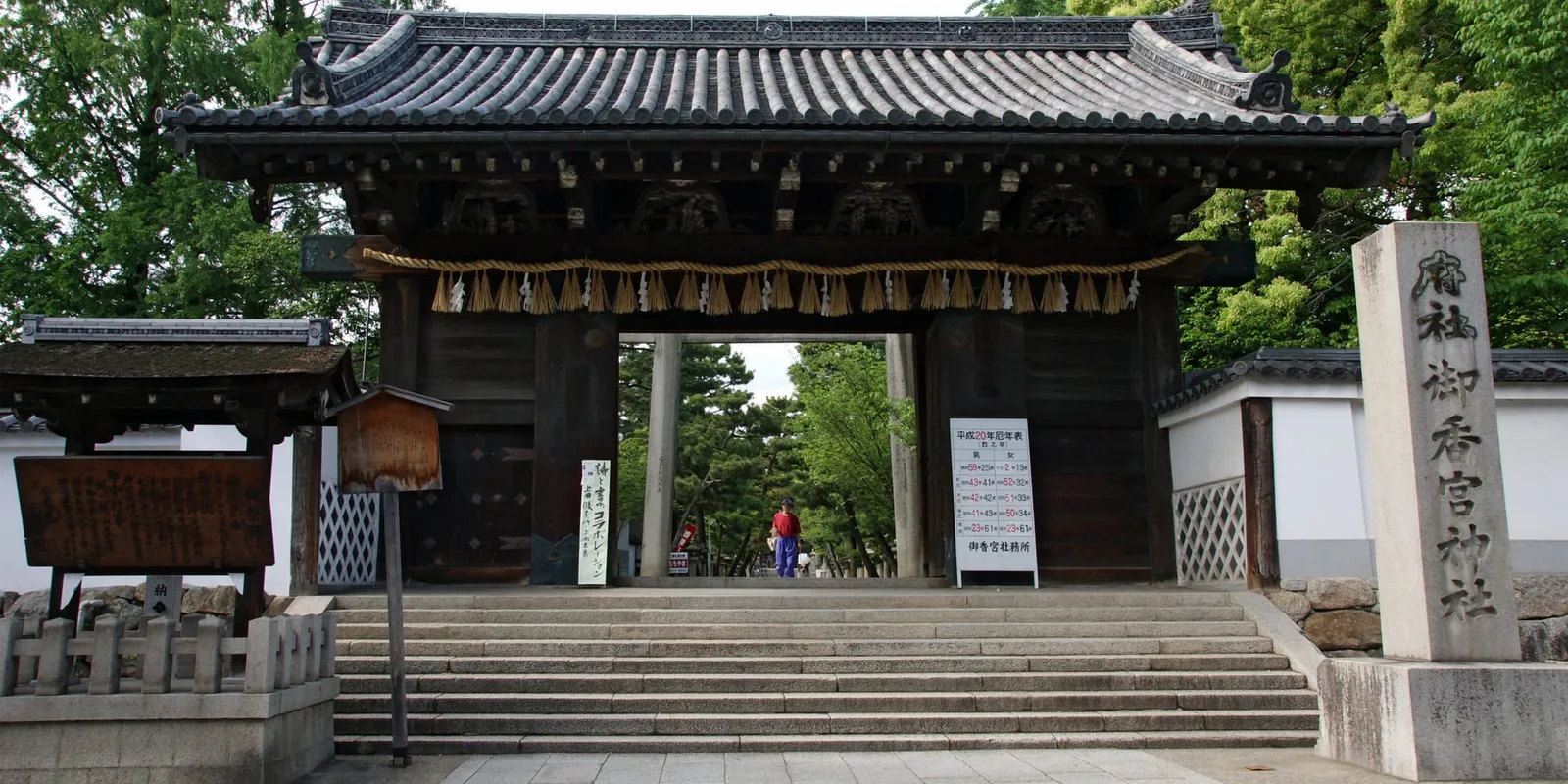
The shrine has deep ties to Fushimi Castle. The official history says that in 1590 Toyotomi Hideyoshi, after destroying the Hojo clan of Odawara, prayed here for victory and presented a sword and a written prayer, and that in 1594, when Fushimi Castle was built, the shrine was enshrined inside the castle as a guardian against the unlucky northeast direction. In 1605 Tokugawa Ieyasu returned the shrine to its original site and built the main hall, and in 1622 Tokugawa Yorifusa, the first lord of the Mito Tokugawa family, received the castle’s main gate and donated it as the shrine’s front gate, it explains. During the Battle of Toba-Fushimi in 1868 it served as the base of the new government forces (Satsuma domain), but is said to have escaped the fighting.
Highlights
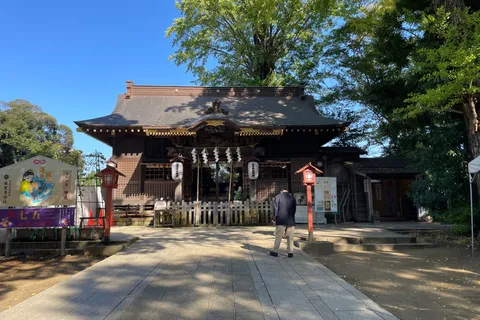
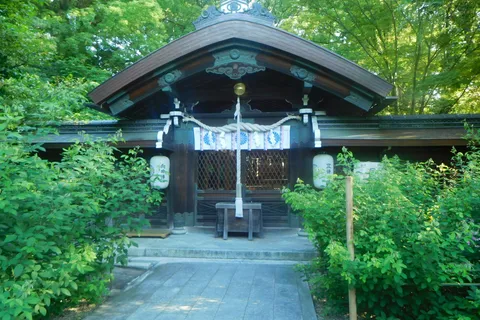
The main hall was built in 1605 on Tokugawa Ieyasu’s orders as a large five-bay “nagare-zukuri” building, with a cypress-bark roof and richly colored carvings. The official site says it was designated an Important Cultural Property in 1985 (Showa 60), and that repairs begun in 1990 restored its vivid colors after about 390 years. The worship hall (haiden) is a “wari-haiden” said to have been donated by Tokugawa Yorinobu in 1625 (Kan’ei 2), and is a Kyoto Prefecture-designated cultural property. The official site highlights the carvings under the front karahafu gable and the tradition that it was granted from Fushimi Castle’s carriage entrance.
The front gate (omote-mon) is a “yakui-mon” gate said to have been donated as Fushimi Castle’s main gate, and is a national Important Cultural Property (designated in 1906 per the official site). The brackets across its front are carved with the Chinese Twenty-Four Paragons of Filial Piety. The “Ishii no Gokosui” spring that gave the shrine its name is counted among the Seven Famous Waters of Fushimi and is one of Japan’s 100 Famous Waters selected by the Ministry of the Environment. According to the official site it dried up after the Meiji era and was restored in 1982.
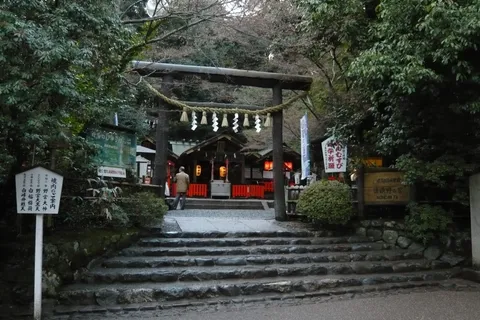
The grounds guide lists a stone garden, Toshogu, Toyokuni-sha, a Noh stage and an ema hall, among others. The Momoyama Tenmangu on the grounds enshrines Sugawara no Michizane and is presented as a place to pray for academic success and exam success (amulets, goshuin and prayers are handled at the Momoyama Tenmangu’s own office). Some guides link the stone garden to Kobori Enshu, but the official site gives no detailed explanation.
Visiting Tips
The shrine office is open 9:00 AM–4:00 PM, and prayer services are accepted 9:00 AM–3:30 PM (official site). Safe-childbirth prayers are accepted every day, and you cannot book a time. On Taian days, weekends, holidays and Dog Days waits can exceed an hour, so allow plenty of time. The offering is ¥8,000, with options that add an Iwata-obi or maternity belt. Prayers for Shichi-Go-San (by advance reservation outside November), first shrine visits and protection from misfortune are also accepted.
Goshuin are given out at the shrine office. The official site does not state the fee for the regular goshuin, but embroidered, gold-foil and paper-cut limited editions are announced from time to time. An official notice dated August 9, 2026 also lists goshuin for “BLEACH: Thousand-Year Blood War” (three types) and asks visitors to check stock beforehand.
If you come by car, you can use the parking lots on the grounds, except during the Shinko-sai festival. The Gokosui spring can be drawn 7:00 AM–7:00 PM. By train, it is about 4 minutes on foot from Kintetsu Momoyama-Goryomae Station and about 6 minutes from Keihan Fushimi-Momoyama Station.
Annual Festivals
The official annual event table lists the events below. Some weekdays in the table do not match the real calendar, so treat the dates as a guide and check the official site for the latest schedule.
- Wakamizu Shinji (January 1, midnight) and Nanakusa Shinji (January 7): Per the official event table. A note says serving of seven-herb rice porridge has been discontinued.
- Omiyumi-hajime Shinji (February 10)
- Annual festival (April 17)
- Chinowa Shinji (July 31): According to the official site, the summer purification rite, which most shrines hold on June 30, is held here on July 31 following old custom. In 2026 it was announced for 3:00 PM in front of the main hall and the large chinowa ring.
- Sacred Noh (Rosoku-no, candlelight Noh) (September 23): A dedication performed on the Noh stage. In 2026 it began at 6:30 PM, and the official site says tickets sold out.
- Shinko-sai (early October; October 3–11 in 2026): The official history describes it as the annual festival of the guardian deity of the nine villages of Fushimi, long known as the “Fushimi Matsuri,” and says it enjoys a reputation as the greatest festival in southern Kyoto (the shrine’s own description). In 2026 a children’s sumo tournament and the Hanagasa Sosangu procession were scheduled for the 3rd, a Hanagasa parade on the 10th and the portable-shrine procession on the 11th, and an unveiling of the Great Lion, repaired for the first time in about 50 years, was also announced. Street stalls are open every day of the festival.
- Ohitaki-sai (November 15)
- Jozo-hatsu Shinji (the Day of the Hare in the middle of December)
- Tsukigama tea gathering (November 15, 2026): A tea gathering hosted by the Gokosui Preservation Society at Kyukoken (¥1,500 per seat, per the official site).
Nearby Food & Sightseeing
- Gokosui: A spring on the grounds that is one of Japan’s 100 Famous Waters. According to the official site, it can be drawn 7:00 AM–7:00 PM and is also used by people in tea ceremony and calligraphy.
- Momoyama Tenmangu: A shrine on the grounds enshrining Sugawara no Michizane. The official site presents it as a place to pray for academic improvement and exam success.
- Stone Garden (Gokonomiya Shrine): A garden near the shrine office. Kyoto Travel Navi (Kyoto City Tourism Association) describes it as a dry landscape garden said to be linked to Kobori Enshu. Several guides say there is an admission fee, but the official site gives no fee or hours, so check before you go.
Frequently Asked Questions
- Q. What are the visiting hours of Gokonomiya Shrine?
- A. According to the official site, the shrine office, which hands out amulets and goshuin, is open 9:00 AM–4:00 PM, and prayer services are accepted 9:00 AM–3:30 PM. The official site gives no opening and closing times for the grounds themselves. The Gokosui spring water can be drawn 7:00 AM–7:00 PM.
- Q. Can I get a goshuin? Are there limited editions?
- A. Yes. They are given out at the shrine office from 9:00 AM to 4:00 PM. The fee for the regular goshuin is not stated on the official site, so please check on site. The official goshuin page lists embroidered, gold-foil and paper-cut goshuin, plus limited-period designs for the Shinko-sai festival and the New Year visit, in limited quantities and periods. The same page also announces, dated August 9, 2026, goshuin for "BLEACH: Thousand-Year Blood War" (three types) and asks visitors to check stock with the shrine office (075-611-0559) beforehand. Availability changes over time.
- Q. How do I get there, and is there parking?
- A. The official site gives about 4 minutes on foot from Momoyama-Goryomae Station (Kintetsu Kyoto Line), about 6 minutes from Fushimi-Momoyama Station (Keihan Main Line), and the "Gokonomiya-mae" stop on Kyoto City Bus route Minami 8, right by the shrine. By car it is about 10 minutes from Daini-Keihan "Fushimi IC" and about 15 minutes from Meishin Expressway "Kyoto-minami IC." There are parking lots on the grounds, but the official site gives no number of spaces or fees, and they are closed during the Shinko-sai festival because of street stalls (October 2–12 in 2026).
- Q. Can I drink the Gokosui spring water? What is Meisui Hyakusen?
- A. According to the official site's grounds guide, the Gokosui is the clear spring that gave the shrine its name. Many people still come to draw it, and it is described as sweet and smooth to drink. It can be drawn 7:00 AM–7:00 PM. The official history says it was restored in 1982 (Showa 57) and, in January 1985 (Showa 60), certified by the then Environment Agency (now the Ministry of the Environment) as one of Japan's "100 Famous Waters" (Meisui Hyakusen). The water temperature is described as about 17 degrees Celsius year-round, and the water as moderately hard.
- Q. How do I request a safe-childbirth prayer, and how much does it cost?
- A. The official site says safe-childbirth prayers are accepted every day from 9:00 AM to 3:30 PM, with no appointment for a particular time; groups are guided in order of arrival. The offering is ¥8,000, plus ¥2,000 with an Iwata-obi belt, plus ¥4,000 with a belly-wrap-type maternity belt, or plus ¥8,000 with a bottom-type maternity belt. On auspicious (Taian) days, weekends, holidays and Dog Days (Inu no Hi), it is very crowded and waits can exceed an hour, according to the site.
Plan Your Visit
Before you go, you can book a stay and get your shrine-visit items ready.
Amazon links open Amazon.co.jp (Japan) in English; whether an item ships overseas depends on the product.
※ Contains ads (PR). Links open external sites such as Amazon, Rakuten, Trip.com and Booking.com.