History
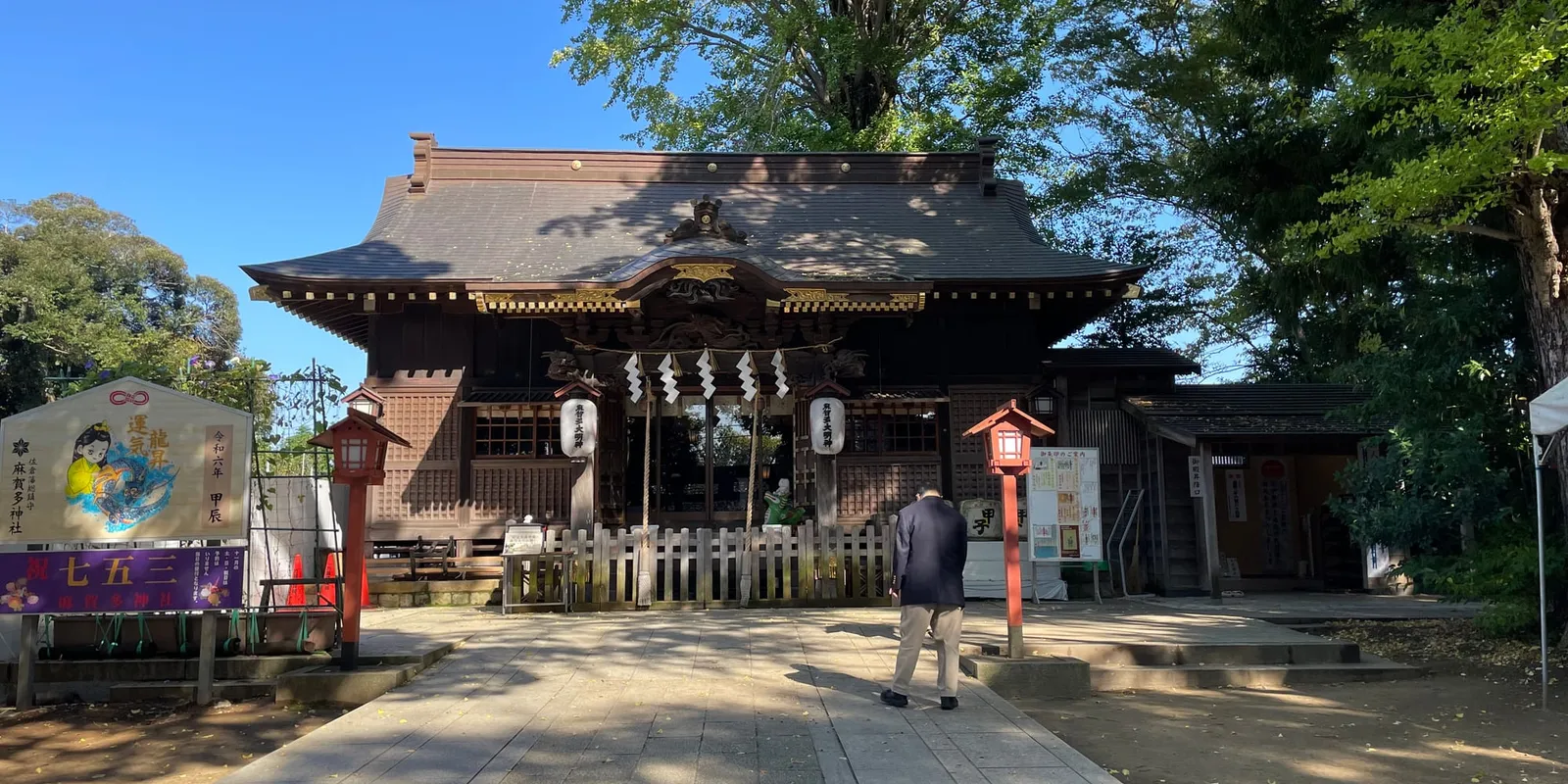
Makata Jinja (Kaburagi, Sakura) is the former chief guardian shrine of the Sakura domain, in Kaburagi-cho, Sakura, Chiba. Locals call it “Makata-sama.” The official site names Wakamusubi no Mikoto (written Wakumusuhi no Kami in the Kojiki) as the enshrined deity. He is described as the parent deity of Toyouke-hime, who is enshrined at the Outer Shrine of Ise, and as a god who watches over the growth and development of people, all things and business.
Several unrelated shrines share the name Makata Jinja. The official site counts 11 in Sakura, 2 in Shisui, 2 in Narita, 2 in Tomisato and 1 in Yachiyo, all in the area from the east to the south of Lake Inba. This page is about the one in Kaburagi-cho in the old castle town of Sakura.
The official site says that the enshrinement is said to date from the dawn of the Sakura region and its date is not certain. It also says the name “Makata Jinja” appears in the Heian-period Engishiki in the Shimosa Province section. By contrast, the Japanese government’s Cultural Heritage Online entry says the founding date is unknown, that it is the Makata Jinja in 台方, Narita that is linked to the small shrine listed in the Engishiki, and that this Kaburagi shrine is said to have been enshrined from the Makata Jinja in Funagata, which serves as its inner shrine. For the origin of the name, the official site gives an oral tradition that it was a shrine tended by the Ō clan, who held the post of provincial governor of Inba; this is the shrine’s own tradition.
When Doi Toshikatsu built Sakura Castle to the west of the shrine in the Edo period, it was revered by successive lords and retainers as the guardian of the castle site and the chief guardian shrine of the domain, with repeated reconstructions and offerings of mirrors and ema. The present main hall was rebuilt in 1843 (Tenpo 14) by the domain lord Hotta Masayoshi (then Masaatsu). In 2003 (Heisei 15) a major renovation was carried out with the support of parishioners, followed by a rite to return the deity to the hall.
Highlights
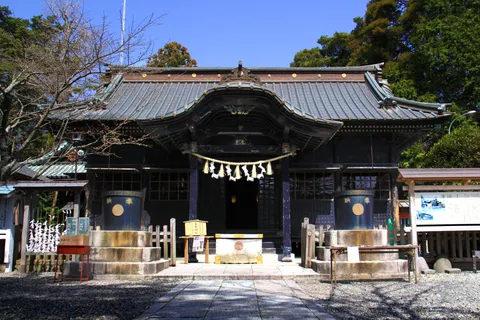
The main hall is a three-bay nagare-zukuri structure with a copper roof, built in 1843 in the late Edo period. As “Kaburagi Makata Shrine Main Hall with two ridge-beam tablets” it was designated a Sakura City Tangible Cultural Property on August 16, 2018. Sakura City describes it as a building that clearly shows the forms and methods of the late Edo period and is valuable for understanding Sakura’s architectural culture.
The official site’s treasure page lists the “Murasaki-susogo dōmaru” armor (a Chiba Prefecture designated cultural property), an item that was a tool of the lord Hotta (written 堀田正愛 in the source), and the cast-metal hanging lantern (a Sakura City designated cultural property) dedicated in 1935 by the metalworker Katori Hotsuma. Hotsuma is said to have lived at the shrine from childhood until he left for Tokyo at 17, and the grounds are designated a Sakura City historic site as “the place where Katori Hotsuma grew up.” The shrine also holds the ema “Fujito no Watashi” (a Sakura City designated cultural property) and other treasures, according to the official site.
The grounds are surrounded by old trees, including a great ginkgo that the official site says is more than 800 years old. The auxiliary shrines are Mitsumine Shrine (enshrining Izanagi and Izanami, and described on the official site as the Fukurokuju of the Sakura Seven Lucky Gods), Inari Shrine (Toyouke-hime) and the minor shrine Hoso Jinja (Sukunabikona, known as the “stroke-a-Ebisu” statue). A 2024 notice on the official site says a new shrine office and mikoshi storehouse was being built, with a permanent display of the large mikoshi and armor planned once it is finished. Check the official site for the current status.
Visiting Tips
Reception at the shrine office is 9:00 AM–5:00 PM (official site). Prayer services are held every 30 minutes from 9:30 AM to 3:30 PM (closed 12:00–1:00 PM), booking by phone is advised, and the offering starts from ¥5,000. The official site lists prayers for safe childbirth, Shichi-Go-San, first shrine visits, protection from misfortune and car purification, among others. For blessings, it names success in love, safe childbirth and child rearing, health, and business development.
For goshuin, the official notices announce goshuin for Inu-no-Hi days and goshuin tied to the autumn festival. The fee and hours for the regular goshuin are not given separately on the official site. Limited editions change with the season, so avoid arriving late in the day.
The official site gives about a 15-minute walk from either JR Sakura Station or Keisei Sakura Station, and about 10 minutes by car from Sakura IC or Yotsukaido IC. It also gives the address as the entrance to Sakura Castle Park. Parking is not mentioned on the official site; the Chiba tourism site lists about 20 free car spaces and none for large buses.
Annual Festivals
- Kitansai and New Year’s visit (from January 1): The official site says about 60,000 people visit over the first three days of the year. The Chiba tourism site says about 70,000, so the figures differ by source.
- Setsubun-sai (February 3): A bowstring-twanging rite (meigen no gi) is performed to ward off misfortune for the year. The official site says the bean-throwing is split into separate venues for the safety of children.
- Kaki Kamiso-sai (May 1): A “change of clothes” ritual for the deity (official site).
- Annual festival (October 14–16; procession etc. on the second Friday–Sunday of October): Known as the Sakura Autumn Festival. The large mikoshi (base beam width about 1.51 m, a Sakura City designated cultural property), described as among the largest used in Chiba Prefecture, is carried by parishioner youths in traditional white robes. Floats and sake stations (omikisho) are brought out from the neighborhoods and other shrines (official site). In 2026 the Chiba tourism site lists it as October 9–11.
- Winter Kamiso-sai (November 1) and Niiname-sai (November 23): Listed in the official site’s list of main annual rites.
- Joya-sai and Oharae (December 31): Listed in the same list. Monthly rites (tsukinami-sai) are held on the 1st of each month.
Festival dates change from year to year, so check the “Festival Guide” on the official site for the latest.
Nearby Food & Sightseeing
- Sakura Castle Park: The park on the site of Sakura Castle, at whose entrance the official site places the shrine. Easy to combine with a visit.
- Former Hotta Residence: A group of buildings in the same Kaburagi-cho, listed in Chiba Prefecture’s inventory as a nationally designated tangible cultural property (buildings, designated 2006). The nearby Former Hotta Masatomo Garden in the same town is a nationally designated place of scenic beauty (2015). Check opening days and hours in advance.
- National Museum of Japanese History: A museum within the Sakura Castle grounds (on the site of the Ninomaru). A fitting finish to a castle-town walk.
Frequently Asked Questions
- Q. What are the visiting hours, and do I need to book a prayer service?
- A. The official site gives reception hours of 9:00 AM–5:00 PM (opening hours for the grounds are not stated). Prayer services run at 9:30 AM–3:30 PM every 30 minutes, closed 12:00–1:00 PM, with an offering from ¥5,000. The official site advises booking by phone (043-484-0392).
- Q. Can I get a goshuin at Makata Jinja?
- A. Yes. The official site's notices announce goshuin for Inu-no-Hi (Dog Days) and goshuin tied to the autumn festival. The fee and hours for the regular goshuin are not given separately on the official site, so use the shrine office reception hours (9:00 AM–5:00 PM) as a guide and arrive early. Limited-edition goshuin change with the season, so check the official site before you go.
- Q. How do I get there, and is there parking?
- A. The official site gives about a 15-minute walk from either JR Sakura Station or Keisei Sakura Station, or about 10 minutes by car from Sakura IC or Yotsukaido IC. The official address is also described as being at the entrance to Sakura Castle Park. Parking is not mentioned on the official site; the official Chiba tourism site (Chiba Kanko Navi) lists about 20 free car spaces and none for large buses. On festival days the Chiba Kanko Navi event page recommends public transport because the surrounding roads are crowded.
- Q. Can I have a childbirth or Shichi-Go-San prayer service here?
- A. Yes. The official site lists prayers for safe childbirth, Shichi-Go-San, first shrine visits (hatsumiyamairi), protection from misfortune and more. In its 2026 notice, the safe-childbirth prayer comes with a shrine talisman, an amulet, a belly-band amulet and an ema, with sessions on Inu-no-Hi days in October and November. Shichi-Go-San prayers are held year-round, and booking ahead reduces waiting time. Details can change, so confirm by phone (043-484-0392).
- Q. What is the autumn festival and the large portable shrine?
- A. According to the official site, the annual festival is held October 14–16 (the procession and related events on the second Friday–Sunday of October). Its large mikoshi is described as among the largest used in Chiba Prefecture (base beam width about 1.51 m) and is a Sakura City designated cultural property; the official site says it was made in 1721 (Kyoho 6) by craftsmen brought from Edo over eight months. The Chiba Kanko Navi event page lists the 2026 festival as October 9–11 (3:00–10:00 PM). Dates vary by year, so check ahead.
Plan Your Visit
Before you go, you can book a stay and get your shrine-visit items ready.
Amazon links open Amazon.co.jp (Japan) in English; whether an item ships overseas depends on the product.
※ Contains ads (PR). Links open external sites such as Amazon, Rakuten, Trip.com and Booking.com.