History
Nonomiya Shrine stands among the bamboo of Sagano and is known as the shrine of the Tale of Genji. A “Nonomiya” was the place where the Saio — an unmarried imperial princess sent to serve at Ise Grand Shrine as the emperor’s deputy — purified herself before leaving for Ise. After a period of purification at the Imperial Palace’s Shosai-in, the Saio entered a Nonomiya built in a pure spot in Sagano, purified herself further, and then set out for Ise. The site of the Nonomiya was decided anew with each emperor’s accession, but the present site is said to have been used first for Princess Jinshi, a daughter of Emperor Saga, in the early Heian period. The shrine’s founding is traditionally dated to Daido 4 (809).
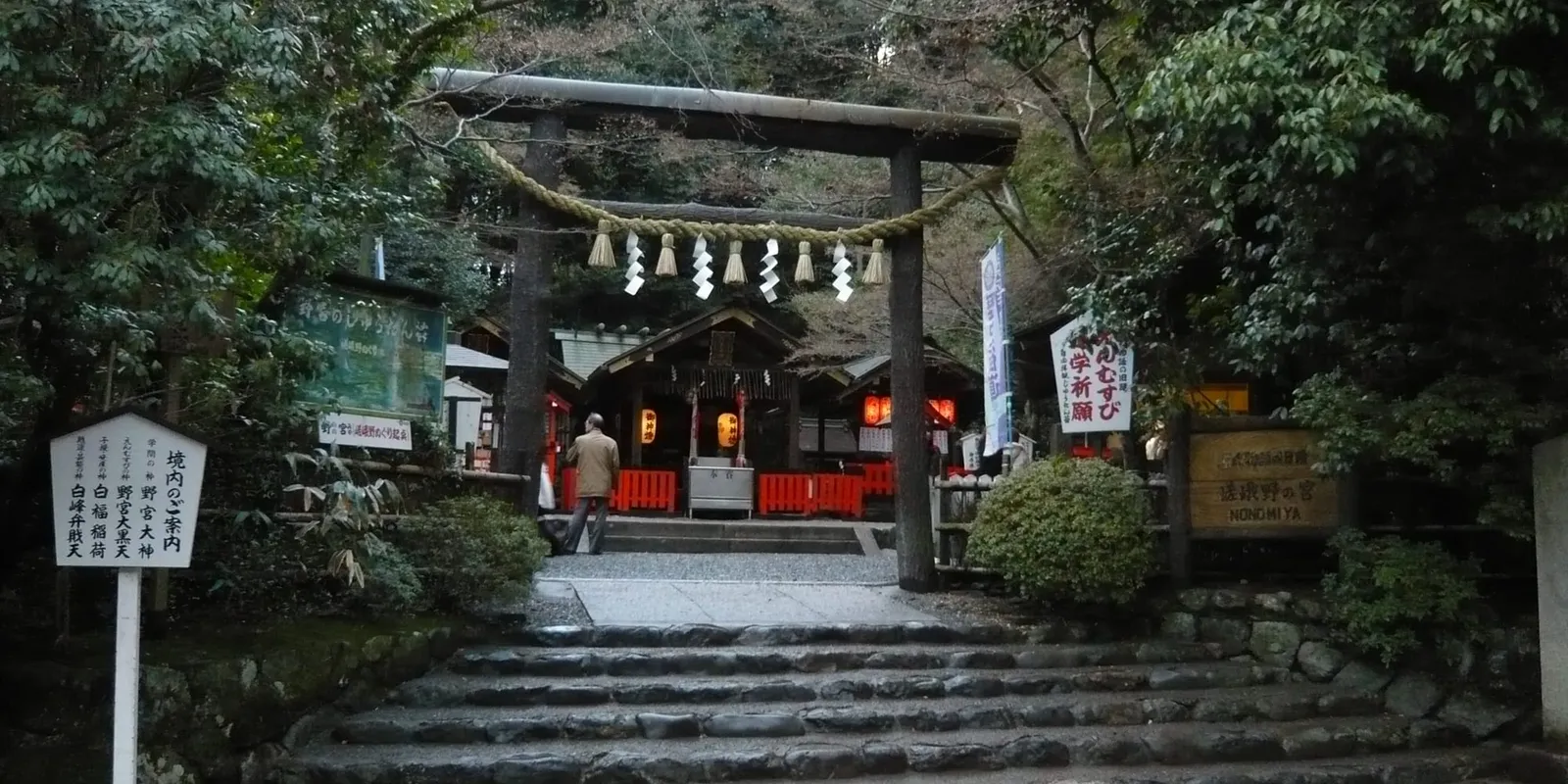
The Saio system came to an end during the Northern and Southern Courts wars, in the reign of Emperor Godaigo. The shrine then continued as a shrine to Amaterasu Omikami, and Emperors Gonara and Nakamikado, among others, issued imperial orders through the Daikaku-ji imperial prince to protect it, a sign of the lasting devotion of the imperial family. The scene of the Nonomiya surrounded by a black-bark torii and a low brushwood fence is described in the “Sakaki” chapter of the Tale of Genji, in which Hikaru Genji visits Lady Rokujo at the Nonomiya as she prepares to go to Ise with her daughter. The shrine is also the subject of the Noh play “Nonomiya.”
Highlights
The “Kuroki Torii” (black-bark torii) at the entrance is made from oak logs with the bark left on, and is said to preserve Japan’s oldest torii style. The fence beside it is a “Koshibagaki” made of kuromoji branches. According to the official website, the site of the Daijosai (the ceremony held after an emperor’s accession) is enclosed by the same kind of black-bark torii and brushwood fence. Its plain, unpeeled texture conveys the atmosphere of a Heian-era place of purification.
The grounds hold a moss garden said to evoke the Arashiyama landscape, known as “Nonomiya Jutan Goke” (the Nonomiya carpet moss), with maples, camellias, and rhododendrons adding color through the seasons. Around the main hall stand subsidiary shrines: Atago Okami (fire protection and victory), Shiramine Benzaiten (the arts), Shirafuku Inari Daimyojin (fertility, safe childbirth, and business), Ooyama Benzaiten (traffic safety and wealth), and Nonomiya Daikokuten (good relationships and marriage). Beside Nonomiya Daikokuten lies the sacred “Okame-ishi” (Turtle Stone); stroking it while praying is said to grant a wish within a year, and it is beloved by visitors seeking love.
Visiting Tips
The usual order is to bow before passing through the torii, purify your hands at the water pavilion (because the water is still, you are asked to skip rinsing your mouth), and pray at the main hall with two bows, clapping, and one bow. Then pray at each subsidiary shrine and make your wishes, and finally stroke the Turtle Stone while praying. Pray for love and marriage at Nonomiya Daikokuten, and for fertility and safe childbirth at Shirafuku Inari Daimyojin.
Entry is free, and the shrine is open 9:00 AM–5:00 PM (last entry 4:30 PM). A stamp-style goshuin (one type) is offered at the shrine office for ¥300. If you would like a formal prayer service, the official website recommends booking in advance because it is a small shrine. There is no dedicated parking, so go on foot: about 10 minutes from Randen Arashiyama Station, about 14 minutes from JR Sagaarashiyama Station, or from the “Nonomiya” bus stop (Kyoto City Bus / Kyoto Bus).
Annual Festivals
- Saigu Gyoretsu (third Sunday of October; October 18 in 2026): A reenactment of the “Saio Gungyo,” the journey of the Saio from the capital to Ise, held together with the shrine’s annual festival. People in Heian-period costume process from Nonomiya Shrine toward Togetsukyo Bridge in Arashiyama, and a purification ritual is held by the Katsura River.
- Saga Matsuri (third and fourth Sundays of May; Shinkosai on May 17 and Kankosai on May 24 in 2026): A festival held jointly with Atago Shrine, centered on the Otabisho (rest site) south of Seiryoji’s Shaka-do hall. At the Kankosai, sword-pole floats and a mikoshi parade through the Saga and Arashiyama area.
- Nagoshi no Oharae (June 30): Purifies the sins and impurities of the first half of the year and prays for a healthy summer (3:00 PM in 2026).
- Tansai-sai (January 1), Setsubun-sai (February 3), Niiname-sai (November 23), and Joya-sai (December 31): Rites marking the turning points of the year.
Nearby Food & Sightseeing
- Arashiyama Bamboo Grove Path: A path surrounded by bamboo that continues from right beside Nonomiya Shrine. A classic Sagano stroll, with Nonomiya Shrine known as the starting point of the “Sagano walk.”
- Tenryu-ji: Arashiyama’s leading Zen temple, within walking distance of the shrine. Pair it with a visit to its gardens and halls.
- Togetsukyo Bridge: The symbol of Arashiyama, spanning the Katsura River. It is also where the Saigu Gyoretsu procession heads, and can be reached on foot from the shrine.
Frequently Asked Questions
- Q. What are the visiting hours and is there an admission fee?
- A. There is no admission fee. According to the Kyoto tourism association, the shrine is open 9:00 AM–5:00 PM (last entry 4:30 PM). Please check with the shrine (075-871-1972) for the latest hours.
- Q. Can I get a goshuin at Nonomiya Shrine?
- A. Yes, at the shrine office (9:00 AM–5:00 PM). It costs ¥300 and is a stamp-style goshuin, one type. Details can change, so it is safest to confirm with the shrine beforehand.
- Q. Is there parking?
- A. There is no dedicated parking, so use a nearby paid lot, or better yet walk from Randen Arashiyama Station or JR Sagaarashiyama Station.
- Q. How do I pray at the Turtle Stone (Okame-ishi)?
- A. After bowing twice, clapping, and bowing once at the main hall, visit the subsidiary shrines in turn, and finish by stroking the Turtle Stone while praying. It is a sacred stone beside Nonomiya Daikokuten, and a wish made while stroking it is said to come true within a year. Pray for love and marriage at Nonomiya Daikokuten, and for fertility and safe childbirth at Shirafuku Inari Daimyojin.
- Q. When is the Saigu Gyoretsu procession held?
- A. It is held on the third Sunday of October every year, which is October 18 (Sunday) in 2026. After a ceremony at Nonomiya Shrine, a procession in Heian-period costume heads toward Togetsukyo Bridge in Arashiyama.
Plan Your Visit
Before you go, you can book a stay and get your shrine-visit items ready.
Amazon links open Amazon.co.jp (Japan) in English; whether an item ships overseas depends on the product.
※ Contains ads (PR). Links open external sites such as Amazon, Rakuten, Trip.com and Booking.com.