History
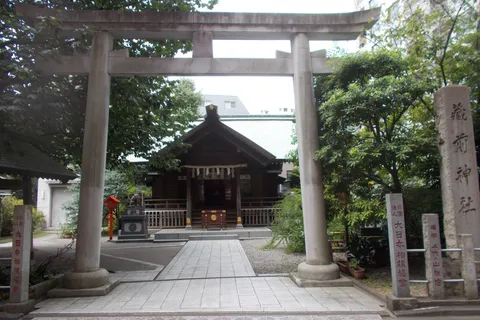
Ikebukuro Hikawa Shrine (Ikebukuro Hikawa Jinja) stands in Ikebukuro-honcho 3-chome, Toshima Ward, Tokyo. According to the summary on the shrine’s official site, it enshrines Takehayasusanoo no Mikoto as its principal deity and has long been revered as the guardian shrine of the former Ikebukuro village and the local tutelary shrine for the northern and eastern parts of Ikebukuro. The date of its founding is uncertain, since no old documents or records survive. It is also said to be a branch of Hikawa Shrine in Saitama City (the Ichinomiya of Musashi Province).
The name Ikebukuro appears in the Muromachi-period land register Odawara-shu Shoryo Yakucho (1559, Eiroku 2) as “Ikebukuro village, Toshima District, Musashi Province.” The 1830 (Tenpo 1) gazetteer Shinpen Musashi Fudokiko also lists “Hikawa shrine, the village’s guardian” under Ikebukuro village. The shrine suffered in the Great Tokyo Air Raids during the Second World War, but was restored through the efforts of its parishioners. The present buildings were completed in 1965 (Showa 40), the second construction since the war.
Pottery fragments thought to date from the late Jomon period, about 3,500 years ago, have been found on the grounds. In the Meiji period a shell mound (the Ikebukuro-mura shell mound) was also found in the area stretching from the grounds to the Yabata River, and the official site says this is the first entry in the Toshima Ward historical chronology.
Highlights
In the Shimo-Itabashi episode of TV Tokyo’s “Shutsubotsu! Ad-machic Tengoku” broadcast on October 7, 2023, Ikebukuro Hikawa Shrine was introduced together with Koyasu Shrine as No. 2 (per the program’s official page, where the heading is a single combined entry, and the information dates from 2023). The page describes it as the guardian shrine of the former Ikebukuro village, founded in the Tensho era (1573–1593), with the Toshima Ward-designated cultural property Ikebukuro Fujizuka on the grounds. Note that the shrine’s own summary says the founding date is uncertain, so the Tensho-era date comes only from the program page.
The main attraction is the Ikebukuro Fujizuka. A fujizuka is a small artificial Mt. Fuji built by members of Fuji-ko (Mt. Fuji worship confraternities) from around the late Edo period, so that people who could not climb Mt. Fuji could gain the same spiritual benefit by climbing the mound. The Ikebukuro Fujizuka was built in June 1912 (Meiji 45) by the Fuji-ko group Ikebukuro Tsuki Sanjushichiya Motoko, and was designated a Toshima Ward historic site in June 1998 (per the Toshima Ward website). It is about 5 m tall (about 13 m east to west and 18 m north to south) and is covered entirely in boku-ishi, a type of lava rock. It has a summit inner shrine, stone markers on the slope representing Komitake Shrine and Eboshi-iwa, as well as Fuji-ko monuments, a tengu statue and a tainai (womb-like passage).
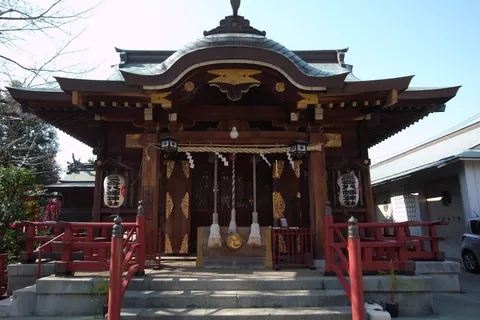
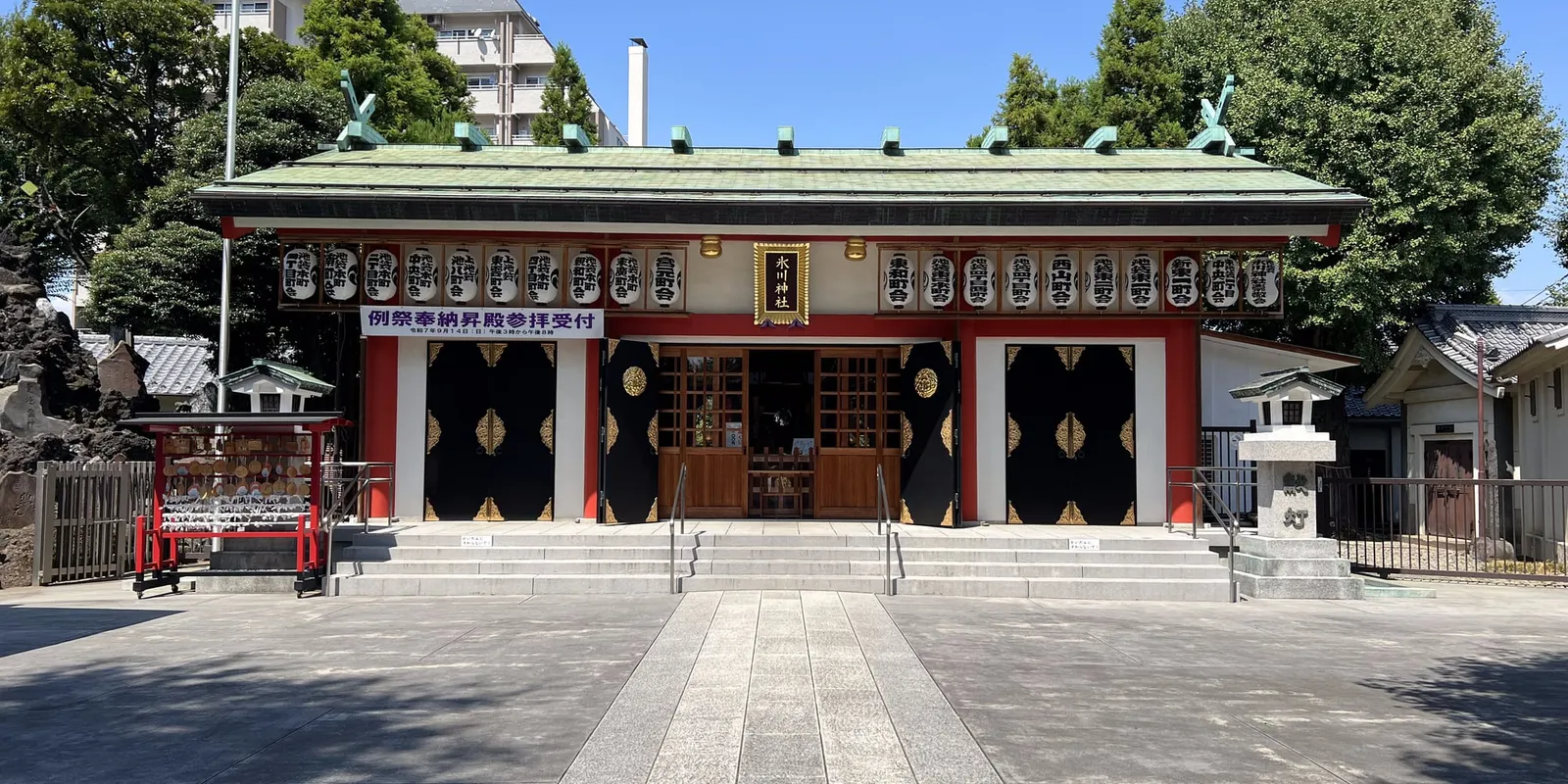
The worship hall has red-lacquered pillars and a green roof, and comes into view beyond the torii. Lanterns bearing the names of parish neighborhood associations hang under the eaves (the photo shows the hall around the festival season).
Visiting Tips
Hours: The gates are open 6:00 AM–5:00 PM and the shrine office is open 9:00 AM–4:00 PM. The office is closed on weekday butsumetsu days, but you can still visit then (it stays open on the 1st, the 15th, weekends and holidays). The closure dates are listed on the “Shrine Office Closed Days” page of the official site.
Prayer services: By reservation only, taking about 15–20 minutes. Requests include household safety, business prosperity, first shrine visits for babies, Shichi-Go-San, car purification, traffic safety, exam success, safe childbirth, finding a good match, protection from misfortune and protection from bad directions. The offering starts at ¥5,000 for individuals and families (from ¥10,000 for first shrine visits and Shichi-Go-San). Casual or light clothing is not accepted for the ceremony, so dress accordingly.
Goshuin: A guide article says it is available at the shrine office for ¥500. However, the official site lists no goshuin hours or fee, so I could not confirm this. The guide also says a pre-written sheet may be given if the priest is out on a prayer service, so calling ahead (03-3971-8280) is a good idea.
Access: About 8 minutes on foot from Shimo-Itabashi Station on the Tobu Tojo Line (per the official site). One guide gives about 20 minutes on foot from Ikebukuro Station; the shrine is well away from the main exits of Ikebukuro Station.
Parking: A few spaces are available on the grounds, but the approach road is closed to vehicles, and on busy days such as New Year the shrine asks visitors to use nearby coin parking. Cars cannot enter the grounds on the September festival days.
Annual Festivals
According to the annual events page of the official site, the main events are as follows. Dates can change from year to year, so please check the official site or the shrine office (03-3971-8280) for the latest details.
- Grand Festival (a weekend in mid-September): The most important festival of the year. The traditional festival date is September 16, with an eve festival (yoimiya) on the 15th, but because of labor shortages the shrine has recently held it on a weekend in mid-September. In 2026 (Reiwa 8) the eve festival was on Saturday, September 19 and the festival on Sunday, September 20. Each of the 19 parish neighborhood associations sets up a temporary shrine for the deity, with mikoshi and festival floats, and stalls line the approach.
- Rice-planting festival (mid-May): A festival welcoming the deity to the rice field and praying for the growth of the rice and a good harvest.
- Summer purification (June 30): A rite to cleanse the sins and impurities of the past six months; a chinowa (grass ring) is set up on the grounds.
- Asama Shrine festival and Ikebukuro Fujizuka mountain-opening (July 1): The day the Ikebukuro Fujizuka can be climbed. In 2026 it ran from noon to 6:00 PM (canceled in rain). A morning-glory market run by parishioner volunteers is also held on June 30 and July 1.
- Niiname-sai harvest festival (November 23): Rice planted at the May rice-planting festival is offered to the deity.
- Year-end purification (December 31)
- Shichi-Go-San prayers (October–November): By reservation; in 2026 reservations opened on August 1.
Nearby Food & Sightseeing
- Koyasu Shrine: A separate shrine at 2-19-20 Itabashi, Itabashi Ward, introduced together with Ikebukuro Hikawa Shrine as No. 2 in the same TV episode. It is in a different ward, so plan to travel between the two by train or similar.
- Itabashi-juku and the old Nakasendo: The area that flourished as a post town on the Nakasendo in the Edo period. The old Nakasendo was also named No. 5 in the October 7, 2023 “Shimo-Itabashi” episode of “Shutsubotsu! Ad-machic Tengoku” (per the program’s official page).
- Nagasaki Fujizuka: A different fujizuka in Takamatsu, Toshima Ward, built in 1862 (Bunkyu 2) and designated a national Important Tangible Folk Cultural Property in 1979 (per the Toshima Ward website). It is separate from the Ikebukuro Fujizuka at this shrine and lies in another part of the ward.
- Ikebukuro-honcho Chuo-dori shopping street: The official site’s driving directions say that about 500 m after entering this shopping street you reach the police box at the entrance to the shrine approach. Note that this is the route for those arriving by car; I could not confirm a walking route.
Frequently Asked Questions
- Q. How is the name read, and which deities are enshrined?
- A. It is read "Ikebukuro Hikawa Jinja." According to the summary on the shrine's official site, the principal deity is Takehayasusanoo no Mikoto, and it also enshrines Takamimusubi no Kami, Amaterasu Omikami, Ukemochi no Kami, Konohanasakuya-hime no Mikoto, Emperor Ojin, Sugawara no Michizane and Yamato Takeru no Mikoto. It is the guardian shrine of the former Ikebukuro village and the local tutelary shrine for the northern and eastern parts of Ikebukuro.
- Q. What are the opening hours, and when is the shrine office open?
- A. Per the official site, the gates are open 6:00 AM–5:00 PM and the shrine office is open 9:00 AM–4:00 PM. The office is closed on weekday butsumetsu days, but you can still visit the shrine then (the office is open on the 1st, the 15th, weekends and holidays even if they are butsumetsu). There is no phone service from December 30 to January 3.
- Q. Can I get a goshuin?
- A. According to a guide article, yes, at the shrine office for ¥500. However, the official site gives no goshuin hours or fee, so I could not confirm this. The guide gives about 9:00 AM–4:30 PM, but the official shrine office hours are 9:00 AM–4:00 PM. The guide also says a pre-written sheet may be given if the priest is out on a prayer service, so calling ahead (03-3971-8280) is a good idea.
- Q. Has the shrine been featured on TV?
- A. Yes. In the Shimo-Itabashi episode of TV Tokyo's "Shutsubotsu! Ad-machic Tengoku" broadcast on October 7, 2023, it was introduced together with Koyasu Shrine as No. 2 (per the program's official page, where the heading is a single combined entry: "Koyasu Shrine & Ikebukuro Hikawa Shrine"). The page mentions the Ikebukuro Fujizuka, a cultural property designated by Toshima Ward, on the grounds. The broadcast was in 2023, so the information is not recent.
- Q. Is it within walking distance of Ikebukuro Station? What is the nearest station?
- A. The nearest station is Shimo-Itabashi on the Tobu Tojo Line, about 8 minutes on foot according to the official site. One guide gives about 20 minutes on foot from Ikebukuro Station, and the shrine is well away from the main exits of Ikebukuro Station, so going via Shimo-Itabashi may be easier to follow.
Plan Your Visit
Before you go, you can book a stay and get your shrine-visit items ready.
Amazon links open Amazon.co.jp (Japan) in English; whether an item ships overseas depends on the product.
※ Contains ads (PR). Links open external sites such as Amazon, Rakuten, Trip.com and Booking.com.