History
Iwakuni Shirohebi Shrine stands in Imazu-cho, Iwakuni, Yamaguchi Prefecture. Built on devotion to and protection of the “Iwakuni White Snake” (Iwakuni no Shirohebi), a National Natural Monument, the shrine enshrines deities invited from Itsukushima Shrine (Miyajima, Hiroshima Prefecture; a UNESCO World Heritage site) and was founded with an enshrinement ceremony on December 16, 2012 (Heisei 24). The official site says the deities’ spirits were brought over from Itsukushima Shrine by boat. The shrine itself is young, but it rests on a long tradition of white snake veneration.
White snakes in Iwakuni are said to have lived in the area for more than 300 years and were believed to protect the rice storehouses of the Kikkawa family, the lords of the Iwakuni domain, from rats. At some point they became identified with Benzaiten, and white snake halls and small shrines were built in many parts of Iwakuni. The shrine was realized through the long-standing care of local people, beginning with those of Imazu, including the founding of the white snake preservation society in 1955 (Showa 30).
The shrine enshrines four deities: the three Munakata goddesses (Tagorihime no Kami, Tagitsuhime no Kami, and Ichikishimahime no Kami) and Ukanomitama no Kami (Uga Benzaiten). The official site explains that the white snakes are not themselves these deities but their messengers.
Highlights
At the white snake viewing house you can see the “Iwakuni White Snake,” a National Natural Monument, up close. It is an albino form of the Japanese rat snake (aodaisho), with a creamy-white body and red eyes, and it was designated a National Natural Monument as the “Iwakuni White Snake” in 1972 (Showa 47). According to the Iwakuni City tourism guide, next to the shrine there is a white snake viewing house run by the Iwakuni White Snake Preservation Society and an outdoor enclosure managed by the city board of education. The white snake museum and indoor viewing area let you see the snakes active all year, even in the hibernation season, while the outdoor enclosure shows them in a near-natural setting.
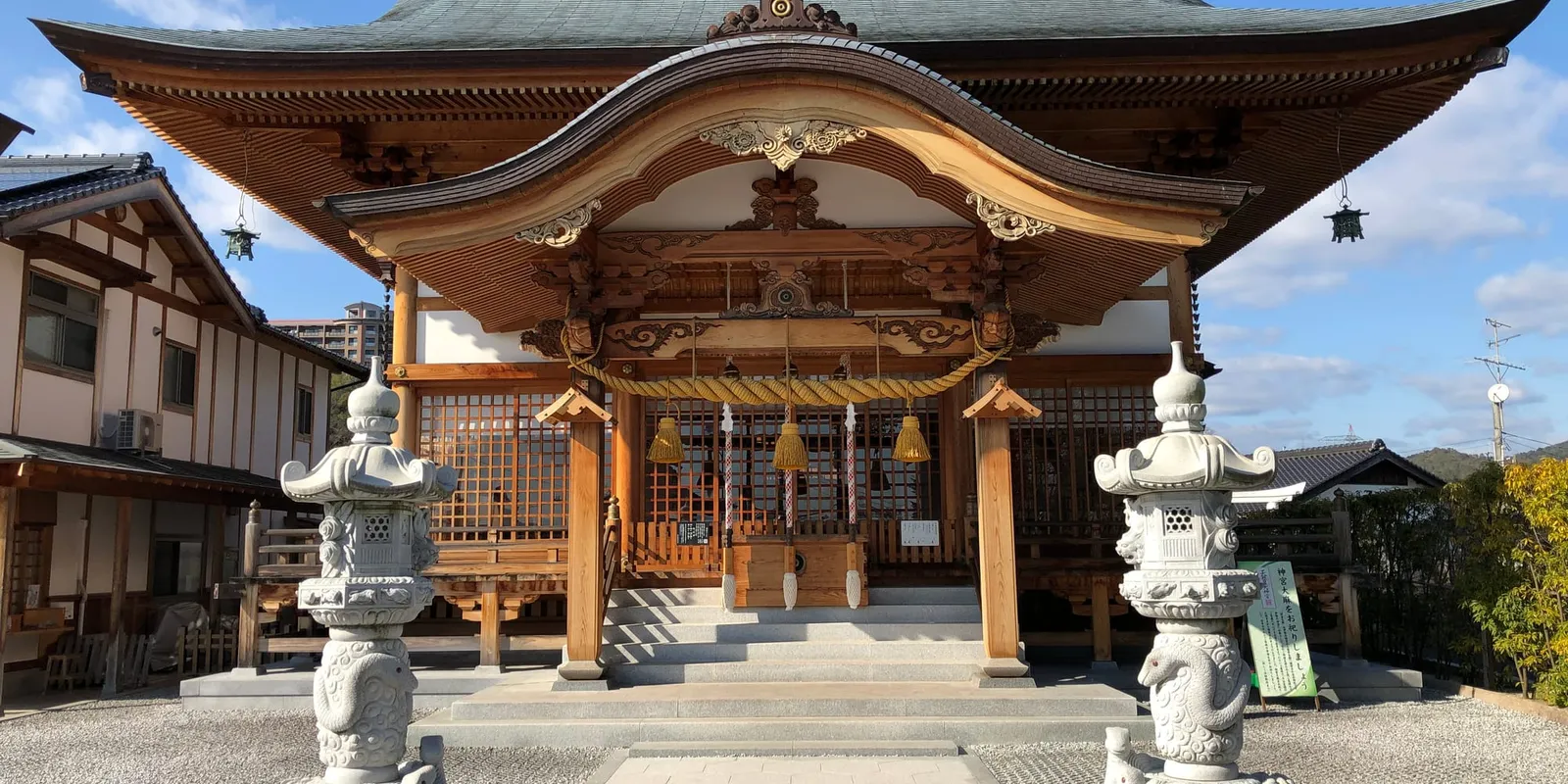
The shrine buildings use cypress from forest once owned by the Kikkawa family (Nishiki-cho, Iwakuni), and snakes and the shrine crest, the “snake’s eye” (janome), appear in many places on the buildings. The main hall carries a white snake carving. The official site credits the hanging lanterns of the worship hall and the purification fountain pavilion to Ogawa Kozo (小川幸造), the deity statue to Sumikawa Kiichi (澄川喜一), and the large ema to Mimasu Masanori (三桝正典). Near the entrance of the west approach are a stone monument inscribed with a poem by Emperor Showa and the sacred tree.
In the grounds, Imazu Tenmangu, enshrining Sugawara no Michizane, stands opposite the worship hall, and Hokan Shirohebi Benzaiten-sha, enshrining Ukanomitama no Kami (Uga Benzaiten), is behind the main building beyond the white snake viewing house.
Visiting Tips
The grounds are open for worship 24 hours a day, but the shrine office, which handles goshuin, amulets, and prayer requests, is open 9:00 AM–5:00 PM (year-round). Several guides mention a voluntary donation of ¥100 for the white snake viewing house, but its hours and fee could not be confirmed on the official site, so it is safest to ask the shrine office (0827-30-3333) before you visit. One guide notes that flash photography is not allowed, so please follow the instructions on site.
Goshuin are issued at the shrine office; a Yamaguchi Prefecture tourism article (information as of December 2023) gives the fee as ¥300. The monthly festival is held twice a month on Snake Days (mi-no-hi) at 9:30 AM, and according to the official site, general visitors can attend in the worship hall.
The official site lists financial luck, good fortune, business prosperity, and traffic safety as the shrine’s benefits, and tourism guides also mention health and longevity. These are matters of belief as presented by the shrine and guides, and no results are guaranteed.
To get there, take an Iwakuni Bus from JR Iwakuni Station or Kintai Bridge to the Tenjinmachi or Imazu stop, then walk about 2 minutes. The shrine says about 20 parking spaces are available nearby.
Annual Festivals
- Monthly Festival (Snake Days, twice a month, from 9:30 AM): A rite held twice a month on Snake Days (mi-no-hi), open to general visitors in the worship hall. The dates change each month, so check the event schedule on the official site.
- Setsubun Festival (February 3): Listed in the annual events on the official site.
- Summer Purification (June 30) and Year-End Purification (December 31): Twice-yearly purification rites, listed in the annual events on the official site.
- Tanabata Festival (July 7): Listed in the annual events on the official site.
- Grand Annual Festival (December 16): The shrine’s main annual festival, on the date of its founding enshrinement ceremony.
- Collection of old amulets and New Year decorations (November 1, 2026–January 9, 2027): According to the official site, the shrine office accepts old amulets, talismans, and New Year decorations during this period.
Nearby Food & Sightseeing
- Kintai Bridge: About 10 minutes from the shrine by car. Iwakuni’s best-known landmark, also listed as a nearby sight in the Iwakuni City tourism guide.
- Kikko Park: A park near Kintai Bridge. The Iwakuni Shirohebi-no-Yakata stands in the park, near the Iwakuni Castle ropeway station.
- Iwakuni Shirohebi-no-Yakata (White Snake House): A separate facility near Kintai Bridge where you can also see the Iwakuni White Snake (not the same as the shrine’s white snake viewing house). Please check its hours and admission fee before visiting.
Frequently Asked Questions
- Q. What are the visiting hours and is there an admission fee?
- A. The grounds are open for worship 24 hours a day, and the shrine office is open 9:00 AM–5:00 PM year-round. Several guides mention a voluntary donation of ¥100 for the neighboring white snake viewing house, but its opening hours could not be confirmed on the official site, so please ask the shrine office (0827-30-3333) before you go.
- Q. Can I get a goshuin?
- A. Yes, at the shrine office. A Yamaguchi Prefecture tourism article (information as of December 2023) gives the fee as ¥300, but please check the shrine office for the current fee and available designs.
- Q. Is there parking?
- A. The official site says there is parking for about 20 cars near the shrine. Temporary parking arrangements may be announced for the New Year visit period, so check the official site for the latest information at that time.
- Q. Can I see the white snakes all year round?
- A. According to the official site, the white snake museum and indoor viewing area let you see the snakes active throughout the year, even in the hibernation season. Guides note that the outdoor enclosure may show snakes hibernating from autumn to spring.
- Q. How do I get there?
- A. Take an Iwakuni Bus from JR Iwakuni Station or Kintai Bridge to the Tenjinmachi or Imazu stop, then walk about 2 minutes. By car, it is about 5 minutes from JR Iwakuni Station, about 10 minutes from Kintai Bridge, and about 20 minutes from Iwakuni IC on the Sanyo Expressway.
Plan Your Visit
Before you go, you can book a stay and get your shrine-visit items ready.
Amazon links open Amazon.co.jp (Japan) in English; whether an item ships overseas depends on the product.
※ Contains ads (PR). Links open external sites such as Amazon, Rakuten, Trip.com and Booking.com.