History
Iwatsuhime Shrine stands at Misaki (Ako Misaki) in Ako, Hyogo. Its name is read “Iwatsuhime-jinja,” as given in the introduction and the furigana of the history on the official site (the Ako Tourism Association and Hyogo Tourism pages give the same reading). The official history describes it as an old shrine whose name is recorded in the Engishiki Jinmyocho, and says that from that time it received special reverence from the imperial court and provincial governors. Ako City also calls it the only Shikinaisha in the city. No founding year is given on the official site.
According to the official site, the principal deity, Iwatsuhime no Okami, is said to have originally been Toyoukebime of the Outer Shrine of Ise, and also the consort deity of the Iwa no Okami (Onamuji no Kami) of Harima’s chief shrine; the deity has long been called “Misaki Myojin” and is regarded as the ancestral deity of the people of Ako (赤穂民族).
On the relocation, Ako City’s page states briefly that the deity, originally on “Gozen-iwa” (Hatcho Rock), was moved to the present site in 1683 (Tenna 3) by Asano Naganori. The official history is somewhat more detailed: the deity had been enshrined on Hatcho Rock, in the sea in front of the shrine at a place called Ozono, and in the Edo period Asano Naonaga, the first lord of the Ako domain, began building a hall at the present site; it was completed and the deity moved there in 1683 (Tenna 3), during the reign of his grandson, the third lord Asano Takumi-no-kami Naganori. The present worship hall was rebuilt on the current site in 1930 (Showa 5), and the main hall was not rebuilt but moved, in its 1683 form, to the north side of the worship hall.
Note that sources differ on the address: the official site and Hyogo Tourism give “Misaki 1,” the Ako Tourism Association gives “Misaki 2,” and Ako City gives “Misaki, Aza Misakiyama, Ako City.”
Highlights
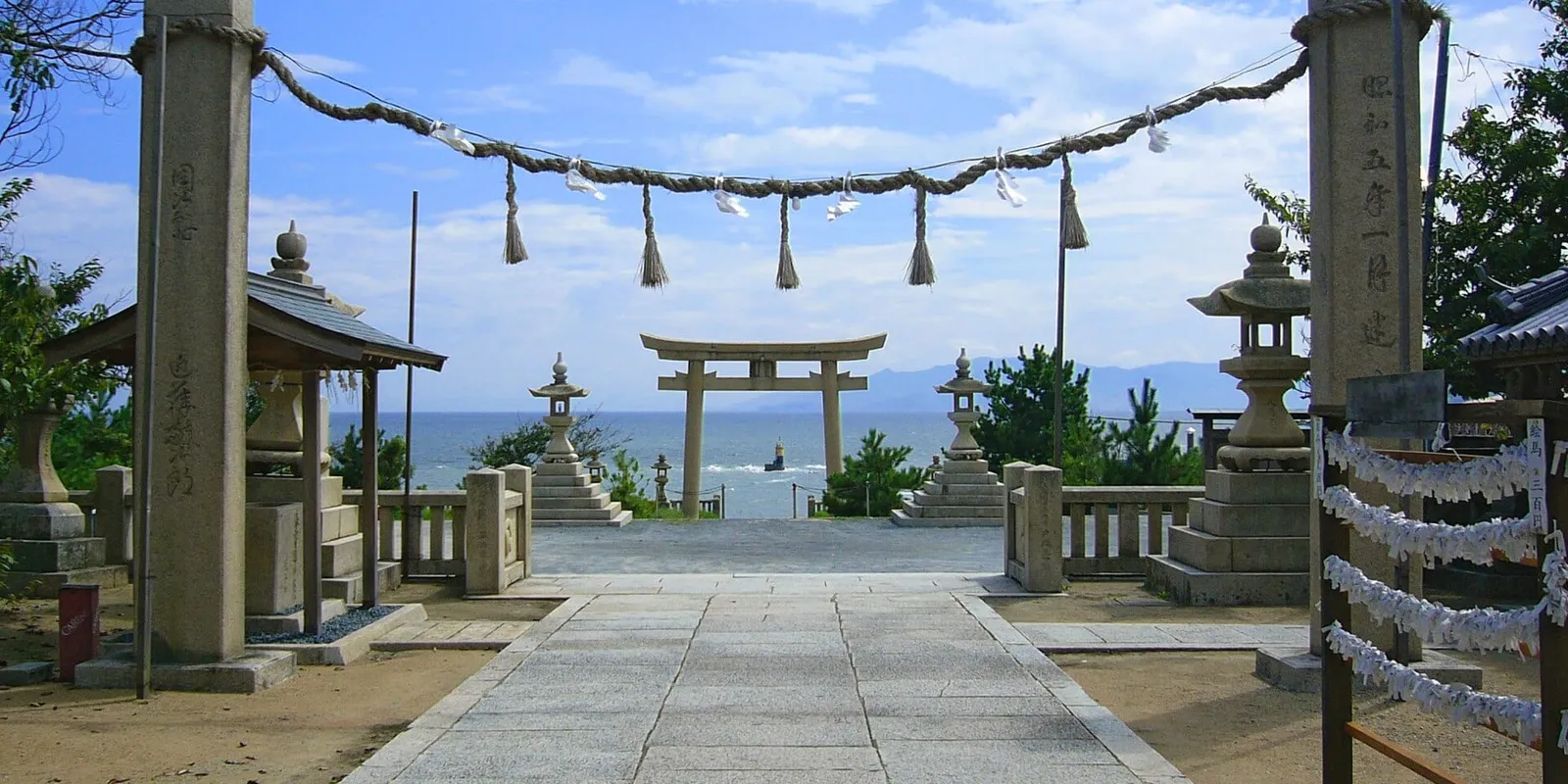
A torii gate facing the Seto Inland Sea stands in front of the grounds. The official site bills it as “a shrine where you can see the sea through the torii,” and the Hyogo Tourism page also mentions the sea view through the gate. The official history describes the surrounding Misaki as a rocky shore where old pines rise over strange rocks, quoting a poem about “the stone pavement of Misaki in Harima.”
The same history says that Admiral Togo Heihachiro and successive commanders-in-chief of the Combined Fleet of the former Japanese navy revered the shrine and visited it leading their fleets, and that sailors and fishermen still come in numbers to pray for safe voyages and good catches. It also introduces the matchmaking “Himemamori,” which many visitors receive. The Hyogo Tourism page adds that the shrine is certified as a “Sacred Place for Lovers” (information from that page only).
Kirakira Zaka, a path running from the grounds toward the sea, is described by the Hyogo Tourism page as a stone path of colorful tiles with hidden heart-shaped stones (information from that page only). According to the official site, there is no restroom in the grounds; the options are the municipal tourist parking lot about 10 m across from the entrance and one partway along Kirakira Zaka.
Visiting Tips
The official site gives shrine office hours of 9:00 AM–12:00 PM and 1:00 PM–4:00 PM; days when the office cannot assist are announced on the shrine’s official Instagram. For worship, it lists the usual steps: purify hands and mouth at the temizuya, bow lightly before the worship hall, then two bows, two claps and one bow, and a final light bow before stepping back.
Prayer services are by phone reservation only, made by the day before, and cover protection from misfortune, household safety, business prosperity, safe childbirth, car purification, first shrine visit for babies, Shichi-Go-San and more. The offering is a flat ¥5,000 and it takes about 20 to 30 minutes. If you come by car, tell them the number of vehicles when you call and they will reserve parking space in the grounds (this may not always be possible).
Among the offerings, the matchmaking “Himemamori” is ¥500, the traffic-safety charm ¥1,000, and health, misfortune-protection and victory charms ¥500 (checked in November 2026). Goshuin are kakioki (pre-written sheets) only: ¥500 for the regular one and ¥800 for each special or limited one. The official site also firmly refuses parking or stopping of vehicles in front of the torii gate (the central line of the approach) and the resale of offerings. Private photography is free, but companies, media and drone shooting are asked to contact the shrine in advance.
It is about 15 minutes by Shinki Bus from Banshu-Ako Station to “Misaki,” then a 1-minute walk. By car, the precinct has fewer than 20 parking spaces, and the official site asks sightseeing visitors to use the municipal tourist parking lot across the road.
Annual Festivals
These are the annual events listed on the “Festivals” page of the official site (dates as written there; they may change).
- Saitansai (January 1): Celebrates reaching the new year safely, with prayers for the imperial family, the nation’s prosperity and the protection of parishioners and devotees.
- Tondo Festival (mid-January, early morning of the second Sunday): Old New Year decorations, old charms and first calligraphy are burned; as the fire weakens and the sun rises, rice cakes are handed out at the shrine.
- Wakoshi Festival (evening of June 30): Also called chinowa-kuguri or Nagoshi no Harae, it purifies half a year’s sins and impurities.
- Summer Festival (Marine Day in July): The original festival day is the 13th. Wind chimes offered by worshippers hang in the worship hall, and a prize lottery is held.
- Autumn Festival and Reisai (second Sunday of October): The original festival day is the 13th. A lion dance goes around parishioners’ homes to drive off misfortune, and children’s festival floats tour the district.
- Shichi-Go-San (during November): Originally on the 15th. Ages are traditionally counted the old way, but visits at full age are also welcome, as the shrine does not set this strictly.
- Shimenawa and shimekazari making (early to mid-December): Made by hand from straw gathered in late October, with the help of the elders’ association in the parishioner area.
Nearby Food & Sightseeing
- Kirakira Zaka: A stone path leading from the grounds toward the sea. According to the Hyogo Tourism page, it has colorful tiles and heart-shaped stones, and a cafe with a sea view.
- Oishi Nagori no Matsu: Listed by the Hyogo Tourism page as a sight near the shrine.
- Ako Onsen: The hot spring area of Misaki. The Hyogo Tourism page introduces a hot spring nearby with an open-air bath overlooking the sea, a possible stop after your visit.
- Ako Tenshio Marine Science Museum “Shio no Kuni”: A facility listed as a nearby attraction on the Ako Tourism Association’s page for the shrine.
Frequently Asked Questions
- Q. What are the visiting hours?
- A. What the official site gives is the shrine office hours: 9:00 AM–12:00 PM and 1:00 PM–4:00 PM. Days when the office cannot assist are announced on the shrine's official Instagram. Visiting hours and a closing time for the grounds are not stated on the official site. There is no restroom in the precinct; visitors are directed to the municipal tourist parking lot across the road or to the one partway along Kirakira Zaka.
- Q. Can I get a goshuin at Iwatsuhime Shrine?
- A. Yes. On the official site's offerings page (checked in November 2026), the regular goshuin "Gashō" is ¥500 (limited to 645 sheets), and the special goshuin "Yūnami to Oimatsu" and the monthly limited-edition goshuin are ¥800 each, all as kakioki (pre-written sheets) only. No separate goshuin hours are given, so use the shrine office hours (9:00 AM–12:00 PM and 1:00 PM–4:00 PM) as a guide. Contents change with the season.
- Q. How do I get there, and is there parking?
- A. The official site says it is about 15 minutes by Shinki Bus from Banshu-Ako Station to "Misaki," then a 1-minute walk. Ako City's guide says it is about 20 minutes by car from the Ako IC on the Sanyo Expressway. The precinct has fewer than 20 parking spaces, and a municipal tourist parking lot is across the road; the official site asks sightseeing visitors to use the municipal lot and strictly refuses parking or stopping in front of the torii gate.
- Q. What kind of shrine is Iwatsuhime Shrine?
- A. According to the official history, it is an old shrine whose name appears in the Engishiki Jinmyocho, and it enshrines "Iwatsuhime no Okami." Ako City also calls it the only Shikinaisha (shrine listed in the Engishiki) in the city. The deity was originally enshrined on Hatcho Rock, in the sea in front of the shrine. The shrine says that in the Edo period Asano Naonaga, the first lord of the Ako domain of the Asano family, began building the hall at the present site, and that it was completed and the deity moved there in 1683 (Tenna 3), in the time of the third lord, Asano Takumi-no-kami Naganori.
- Q. What is the matchmaking charm "Himemamori"?
- A. The official site's offerings page lists "Himemamori (matchmaking)" at ¥500. The official history also says that devotion to the princess deity among young men and women is long-standing, and that many people receive the "Himemamori," said to bring good ties in love or help in finding a partner. The Ako tourism association's page likewise describes it as a charm sought by people hoping for matchmaking.
Plan Your Visit
Before you go, you can book a stay and get your shrine-visit items ready.
Amazon links open Amazon.co.jp (Japan) in English; whether an item ships overseas depends on the product.
※ Contains ads (PR). Links open external sites such as Amazon, Rakuten, Trip.com and Booking.com.