History
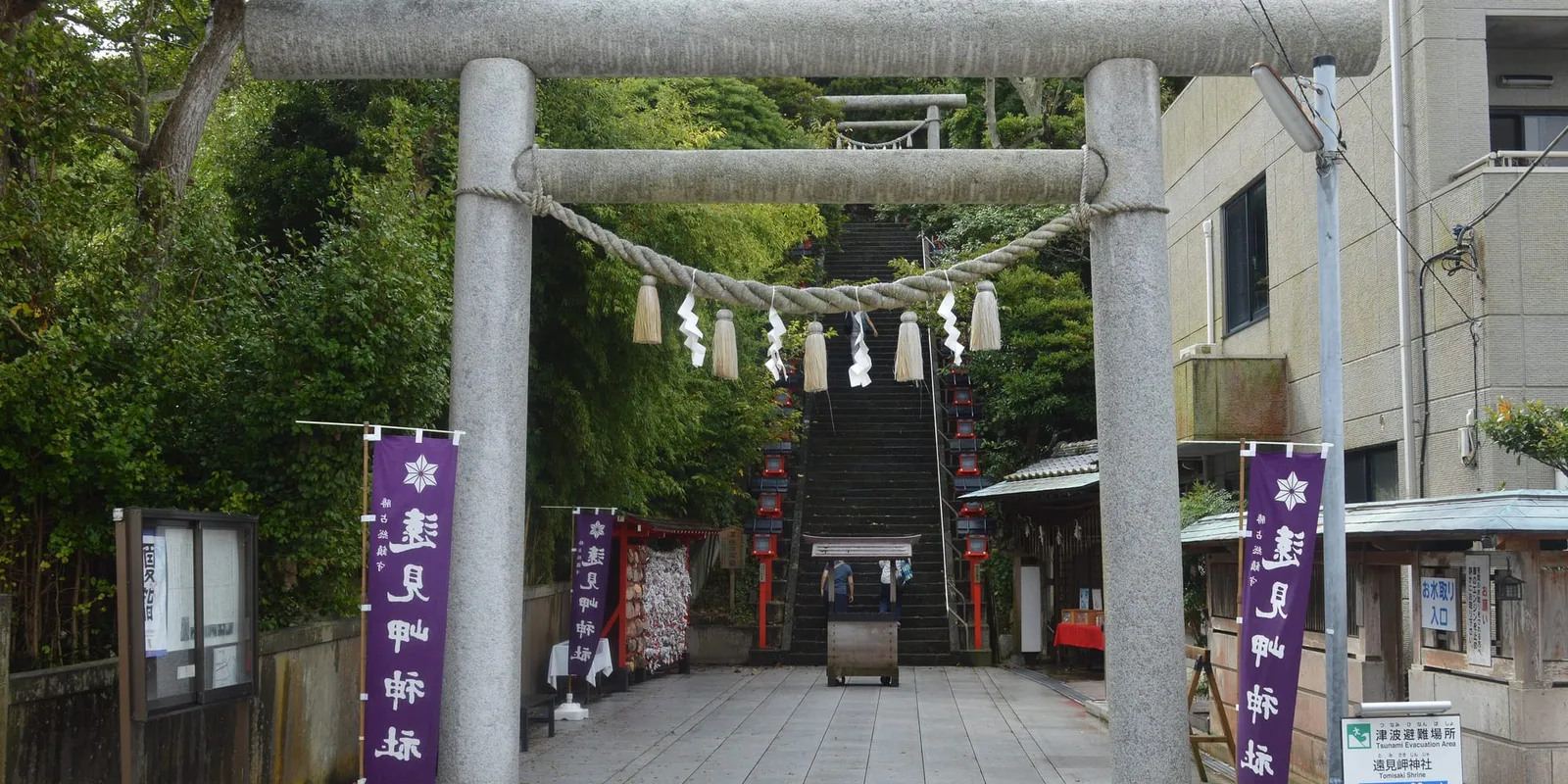
Tomisaki Jinja stands in Hamakatsuura, Katsuura, Chiba, and the official site calls it the guardian shrine of Katsuura. Its name is read “Tomisaki,” not “Toomisaki” (the official site’s title reads 遠見岬(とみさき)神社). The enshrined deity is Ame-no-Tomi-no-Mikoto.
According to the official history, Ame-no-Tomi-no-Mikoto belonged to the Inbe clan and crossed the sea from Awa (Shikoku) to the Boso Peninsula, where he is said to have spread hemp cultivation, sericulture and weaving to the Kanto region. He then lived at Tomisaki (the tip of what is now Hachimanmisaki), teaching fishing, farming and building techniques to the people, the shrine says. After his death, Katsuura-Inbe Susutatsu-no-Mikoto of the Awa Inbe clan built a shrine on Fukijima and enshrined him, which is the origin of the shrine; it is also written that this “Katsura” (勝占) is the origin of the place name Katsuura (勝浦). This is the shrine’s own tradition and not an established historical fact.
The oldest record the shrine holds is a main-hall repair in 835 (Jowa 2); many old documents were lost to repeated tsunami and fires. In 1601 (Keicho 6) a tsunami is said to have swept the shrine away, with the sacred object washing ashore at Takaiso, and in 1659 (Manji 2) the local lord Uemura Yasutomo is said to have moved it to its present site. It had been called “Tomi Daimyojin,” and in 1871 (Meiji 4), under the new shrine-ranking system, it was renamed Tomisaki Jinja and ranked as a gosha, according to the official site (some encyclopedias give 1873 for the renaming, so the years differ).
Highlights
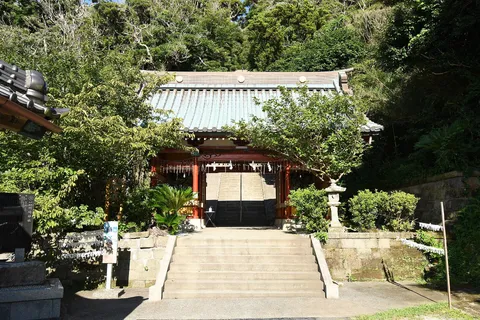
The main highlight is the 60 stone steps leading up to the shrine. At the “Katsuura Big Hina Festival,” held from late February to around March 3 each year, hina dolls line these steps. According to Chiba Kanko Navi there are about 1,800, and they are lit up from the evening. The shrine’s official site says the festival began in 2001, when about 7,000 hina dolls were received from Katsuura Town in Tokushima Prefecture, a place connected to the enshrined deity.
Another distinctive feature is the faith in Funadama-sama, the guardian spirit of ships. The official site says it was originally made of hemp and changed into a doll form around 1852 (Kaei 5), and it describes the use of a doll as a Funadama as rare in Japan and a special rite.
The shrine’s omikuji come in two kinds: the “Katsuo (bonito) Mikuji” for men and the “Kinme (golden eye snapper) Mikuji” for women, available at the shrine office. The festival floats are described on the official site as lacquered, gold-leafed and richly carved, and a Katsuura morning market is held near the entrance.
Visiting Tips
The official site lists the amulet counter (omikuji, charms, goshuin) and the prayer reception as open 9:00 AM–5:00 PM with no regular closing day. Chiba Kanko Navi, however, lists 8:00 AM–4:00 PM with irregular closing days, so the sources differ, and we recommend calling the shrine (0470-73-0034) if you plan to visit late in the day. For prayer services, the shrine asks people from afar to consult by phone.
Goshuin are available at the amulet counter, but the official site gives no fee. On new-moon days the shrine holds a “Shingetsu Kigan-sai” prayer service; its special page (a schedule for 2017) says attendance requires a reservation and the prayer fee starts from ¥5,000. Please ask the shrine office for the latest dates and fees.
It is about a 10-minute walk from Katsuura Station on the JR Sotobo Line. The official site gives 10 parking spaces, while Chiba Kanko Navi gives 18 free spaces, so the numbers differ and both are small. Large buses cannot enter the town, and during the hina festival most nearby lots are paid, so public transport is the better choice.
Annual Festivals
- 1st of every month / new-moon days: Tsukinamisai on the 1st and Shingetsu Kigan-sai on new-moon days (official site).
- February: Hatsuuma festival at Hibuse Inari Shrine, Setsubun festival, a doll-thanksgiving service in early February, Kigensai on the 11th, Kinensai on the 17th, and Ushio Matsuri on the third Saturday (official annual-events table).
- Katsuura Big Hina Festival (late February to around March 3): Hina dolls line the stairs. In 2026 it ran February 21 (Sat) to March 3 (Tue), 9:00 AM–7:00 PM, with panel displays on rainy days (Chiba Kanko Navi).
- Reisai and Shinko-sai (third Saturday of September): According to the official site, the portable shrine tours the parishioner neighborhoods, is carried to Takaiso, where the sacred object is said to have washed ashore, and is then carried back to the shrine at a run to the shout of “Denmyori.” The festival floats are pulled around on the Sunday and Monday, and the Funado Shinji rite takes place on the Monday. The site says the festival day was changed in 1911 (Meiji 44) from the day of the September full moon to September 13 (the current events table gives the third Saturday).
- June 30 / December 31: Nagoshi no Oharae (summer purification) and Toshikoshi no Oharae (year-end purification) (official site).
- November: Shichi-Go-San visits on the 15th (prayer period from October to the end of November) and Niiname-sai on the 23rd (official site).
The official site notes that dates may change depending on circumstances.
Nearby Food & Sightseeing
- Katsuura Morning Market: According to the official site, a morning market is still held at the shrine’s entrance. Chiba Kanko Navi introduces it as one of Japan’s three great morning markets.
- Katsuura Arts and Culture Exchange Center (Kyuste): One of the main venues of the Big Hina Festival. According to Chiba Kanko Navi, about 7,000 hina dolls were displayed inside in 2026, with admission of ¥500 (free for junior high school students and younger).
- Hachimanmisaki (O-Man statue): The shrine’s history describes it as the Tomisaki where the deity is said to have lived, and says a statue there tells the legend of “O-Man Nunozarashi,” in which the daughter of the castle lord escaped down the cliff when Katsuura Castle fell.
Frequently Asked Questions
- Q. What are the visiting hours?
- A. The official site lists both the amulet counter and the prayer reception as open 9:00 AM–5:00 PM with no regular closing day (it may be unattended at times). Chiba Kanko Navi, however, lists 8:00 AM–4:00 PM with irregular closing days, so the sources differ. If you plan to arrive late in the day, it is safest to call the shrine (0470-73-0034).
- Q. Can I get a goshuin at Tomisaki Jinja?
- A. Yes. The official site lists the amulet counter (omikuji, charms, goshuin) as open 9:00 AM–5:00 PM, though it may be unattended at times. No goshuin fee is given on the official site, so please ask at the counter.
- Q. How do I get there, and is there parking?
- A. It is about a 10-minute walk from Katsuura Station on the JR Sotobo Line (Chiba Kanko Navi). The official site says there are 10 parking spaces, while Chiba Kanko Navi lists 18 free spaces; either way the lot is small. Large buses cannot enter the town, and the area gets crowded during the Katsuura Big Hina Festival, so trains and buses are the better choice.
- Q. How many hina dolls fill the stairs during the Katsuura Big Hina Festival?
- A. According to Chiba Kanko Navi, about 1,800 hina dolls line the 60 stone steps. In 2026 the festival ran from Saturday, February 21 to Tuesday, March 3, 9:00 AM–7:00 PM, with lighting from about 5:00 PM, and panel displays on rainy days. The history page of the shrine's own site gives 1,200 dolls on the steps, so the numbers differ. Dates change from year to year, so check official information such as Katsuura City's just before you go.
- Q. When is the annual festival?
- A. The official annual-events table lists the Reisai and Shinko-sai (portable-shrine procession) on the third Saturday of September, festival-float processions on the Sunday and Monday, and the Funado Shinji rite on the Monday. The site notes that dates may change depending on circumstances.
Plan Your Visit
Before you go, you can book a stay and get your shrine-visit items ready.
Amazon links open Amazon.co.jp (Japan) in English; whether an item ships overseas depends on the product.
※ Contains ads (PR). Links open external sites such as Amazon, Rakuten, Trip.com and Booking.com.