History
Kamosu Shrine (Kamosu-jinja) stands in the Oba district of Matsue, Shimane Prefecture, and is affectionately called “Kamosu-san” or “Oba no Omiya-san” by locals. The principal deity is Izanami no Okami, with Izanagi no Okami enshrined alongside. Shrine tradition says that Ame no Hohi no Mikoto, ancestor of the Izumo Kokuso (hereditary chiefs of the Izumo region), descended to this land and founded the shrine. However, it does not appear in the Izumo no Kuni Fudoki or in the Engishiki register of shrines, and the actual founding is thought to date to around the mid-Heian period. Its earliest written mention is a 1208 document from the Kamakura shogunate.
Oba was a political and transport center of ancient Izumo, close to the provincial capital and provincial temple, and is said to be where the Izumo Kokuso lived. The Kokuso served at this shrine for 25 generations, but after 798 they moved to Kizuki, where Izumo Taisha now stands. Even so, the Kamibi Sozoku Ceremony (Ohichi-shiki) held when the Kokuso office passed to a new head, and the ancient Niinamesai, continued to be held here until the early Meiji era. In the medieval period the shrine was called one of the “Ryo Kamosu” (the two Kamosu) together with Manai Shrine, and it counts among the Six Shrines of Ou, which have close ties to the Kokuso family.
Highlights
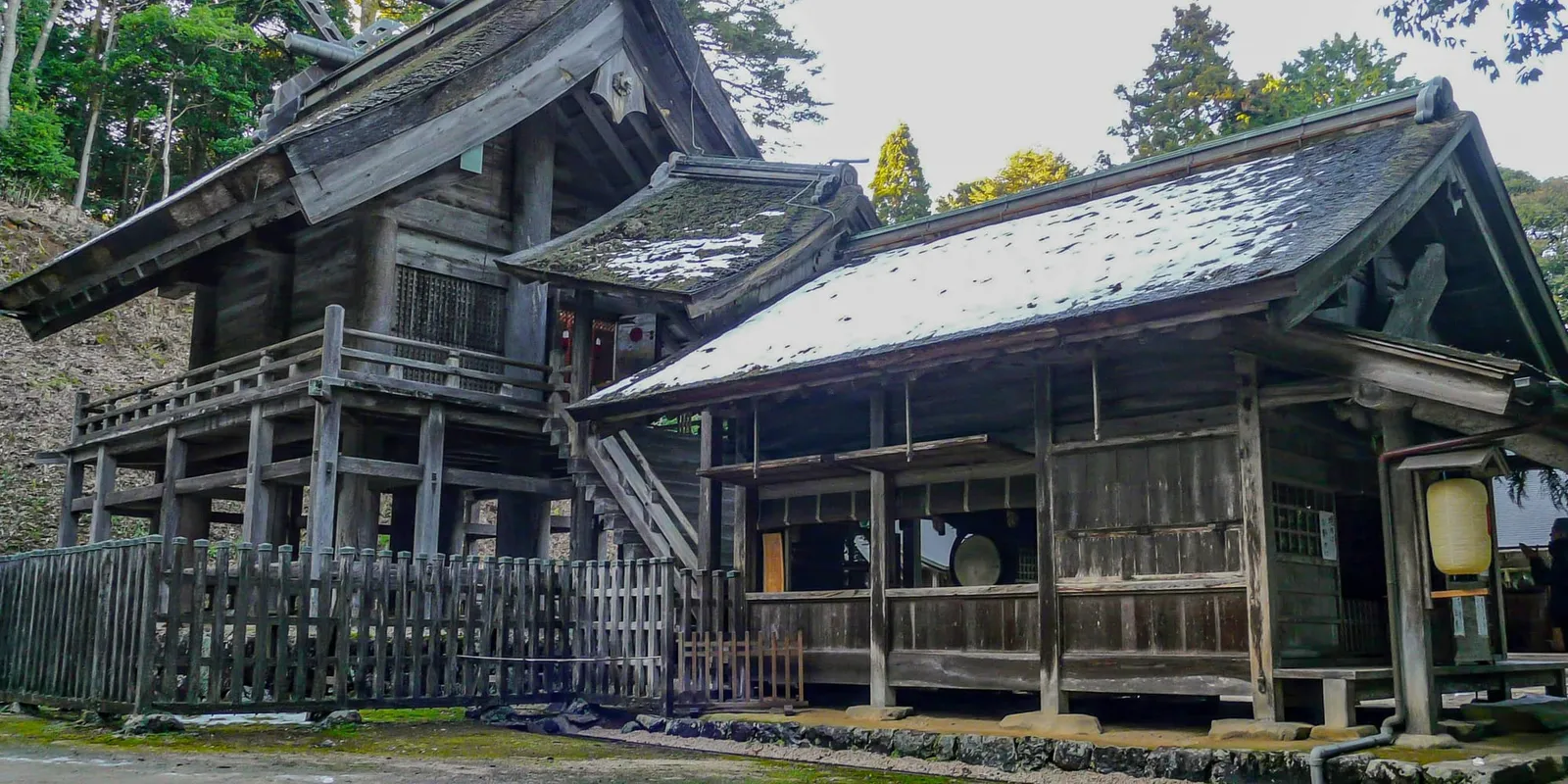
The main attraction is the National Treasure main hall (together with its inner shrine and old central pillar timber). It was designated a National Treasure on March 29, 1952. Rebuilt in 1583 in the traditional manner, it is regarded as the oldest surviving example of Taisha-zukuri, a style found only in the eastern half of Shimane (the old Izumo province). It measures about 5.5 meters square, with a gabled, entrance-in-the-gable layout facing east and a roof of horse-chestnut shingles, and is valued for preserving a form of Taisha-zukuri older than the main hall at Izumo Taisha. Its interior is of the “mezukuri” (female) type, the reverse of Izumo Taisha’s “ozukuri” (male) layout. The interior is decorated with wall paintings attributed to Kano Sanraku and Tosa Mitsuoki, but the inside is normally not open to visitors, and the doors are said to be opened on festival days.
The approach stairs, built of piled-up natural stones, have large steps and a moss-covered look that adds to the solemn atmosphere. Among the subsidiary shrines in the grounds, the Kifune and Inari shrines’ main hall (a two-bay nagare-zukuri building) is also a nationally designated Important Cultural Property, alongside Kumano, Ise, and Kizuki shrines and others. There is also the Okama-no-miya, based on the tradition that Ame no Hohi no Mikoto arrived riding a sacred cauldron. The shrine crest is a “yu” character inside a double tortoiseshell pattern. According to Shimane tourism information, the shrine is said to bring blessings for matchmaking, having children, and safe childbirth.
Visiting Tips
The grounds are open at all hours and there is no admission fee. Goshuin (¥300, handwritten) are handled at the shrine office, but it keeps no fixed hours and may be unattended, so if you want to be sure of getting one, call ahead (0852-21-6379). The approach stairs have large steps, so comfortable shoes are a good idea.
From JR Matsue Station, take the Matsue City Bus bound for “Kanbe no Sato” to the last stop, then walk about 3 minutes (service is infrequent, so check the timetable beforehand). You can also take the Ichibata Bus bound for “Yakumo” to the “Fudoki-no-Oka Iriguchi” stop and walk about 10 minutes, or take a taxi (about 15 minutes). If driving, there is free parking on the grounds.
Annual Festivals
- Spring Festival (Haru-matsuri) (April 18): Said to be the day of the spring festival. The Kamibi Sozoku ceremony, performed when the Izumo Kokuso passes the office to a successor, is known as a special rite, but we could not confirm that it is an annual April 18 event.
- Reisai, the annual grand festival (October 18): The shrine’s main annual festival.
- Kamiarisai (November 11–18): Said to apply the old-calendar dates of the 10th month (the 11th to 18th) to the new calendar; the gods are said to be welcomed on the night of the 11th and sent off on the 18th. The Shimane Tourism Federation’s guide also lists the 2026 Kamiarisai at this shrine as November 11–18.
- Niinamesai and Okama Shinji (December 13): The Niinamesai and the Okama Shinji rite associated with the Okama-no-miya.
Note: Dates and viewing access may change. Please check the latest information before your visit.
Nearby Food & Sightseeing
- Yakumo-tatsu Fudoki-no-Oka: A prefectural facility preserving the archaeological sites of Ou District, the center of ancient Izumo, located in Oba-cho. Its exhibition hall displays ancient-history materials from across Shimane (9:00–17:00, last entry 16:30, generally closed Tuesdays).
- Izumo Kokufu Ruins: A nationally designated historic site that was the political center of Izumo province in the Nara and Heian periods, located around Rokusho Shrine. The site of the ancient Izumo Kokuso residence is believed to be around the approach to Kamosu Shrine.
- Yaegaki Shrine: An old shrine known for matchmaking and another of the Six Shrines of Ou. It is linked to Kamosu Shrine by the “Haniwa Road” walking path (about 2 km), a popular route for visiting both.
Frequently Asked Questions
- Q. What are the visiting hours and is there an admission fee?
- A. The grounds can be visited at any hour and there is no admission fee. The shrine office keeps no fixed hours, so if you want a goshuin or amulets, it is safest to call ahead (0852-21-6379).
- Q. Can I get a goshuin at Kamosu Shrine?
- A. Yes, a handwritten goshuin is available for ¥300. The shrine office has no fixed hours and may be unattended, so it is best to confirm by phone (0852-21-6379) before visiting.
- Q. Is there parking?
- A. Yes, there is free parking for visitors on the grounds. It is limited, with sources citing roughly 10 to 20 spaces.
- Q. What is special about the main hall?
- A. The main hall, a National Treasure, was rebuilt in 1583 and is the oldest surviving example of the Taisha-zukuri style. It closely resembles the main hall of Izumo Taisha but is smaller, and its interior layout is the reverse of Izumo Taisha's, known as the "mezukuri" (female) type.
- Q. When is the shrine's annual festival?
- A. The annual grand festival (Reisai) is held on October 18. Other rites are said to include the Spring Festival (Haru-matsuri) on April 18, the Kamiarisai on November 11–18 (the old-calendar dates of the 10th month, the 11th to 18th, applied to the new calendar; the gods are said to be welcomed on the night of the 11th), and the Niinamesai and Okama Shinji on December 13.
Plan Your Visit
Before you go, you can book a stay and get your shrine-visit items ready.
Amazon links open Amazon.co.jp (Japan) in English; whether an item ships overseas depends on the product.
※ Contains ads (PR). Links open external sites such as Amazon, Rakuten, Trip.com and Booking.com.