History
Tamasaki Shrine stands in Ichinomiya Town, Chiba, and is the Ichinomiya (first-ranked shrine) of the old Kazusa Province. It is listed as a Myojin Taisha in the Heian-period Engishiki register of shrines and has long drawn the devotion of the imperial court, local clans, and the shogunate. The town’s name, “Ichinomiya,” comes from this shrine. A major fire during the Eiroku era (1558–1570) destroyed many of its buildings, treasures, and documents, so its founding date and origins are unclear, but the annual festival held each September is said to have a history of at least 1,200 years.
The enshrined deity is Tamayorihime no Mikoto, a goddess of the sea. According to the shrine’s official site, she raised Ugayafukiaezu no Mikoto, the child born to her elder sister Toyotamahime, as his nurse, and she is said to protect new beginnings such as renewal and good fortune. Matters concerning women’s mind and body, matchmaking, conception, childbirth, and child-rearing are also said to be under her guidance, and Hojo Masako, wife of Minamoto no Yoritomo, is famously said to have prayed here for a safe delivery. The shrine receives an especially large number of thank-you messages about matchmaking, conception, and safe childbirth, which is why it is called a “shrine for women.”
Highlights
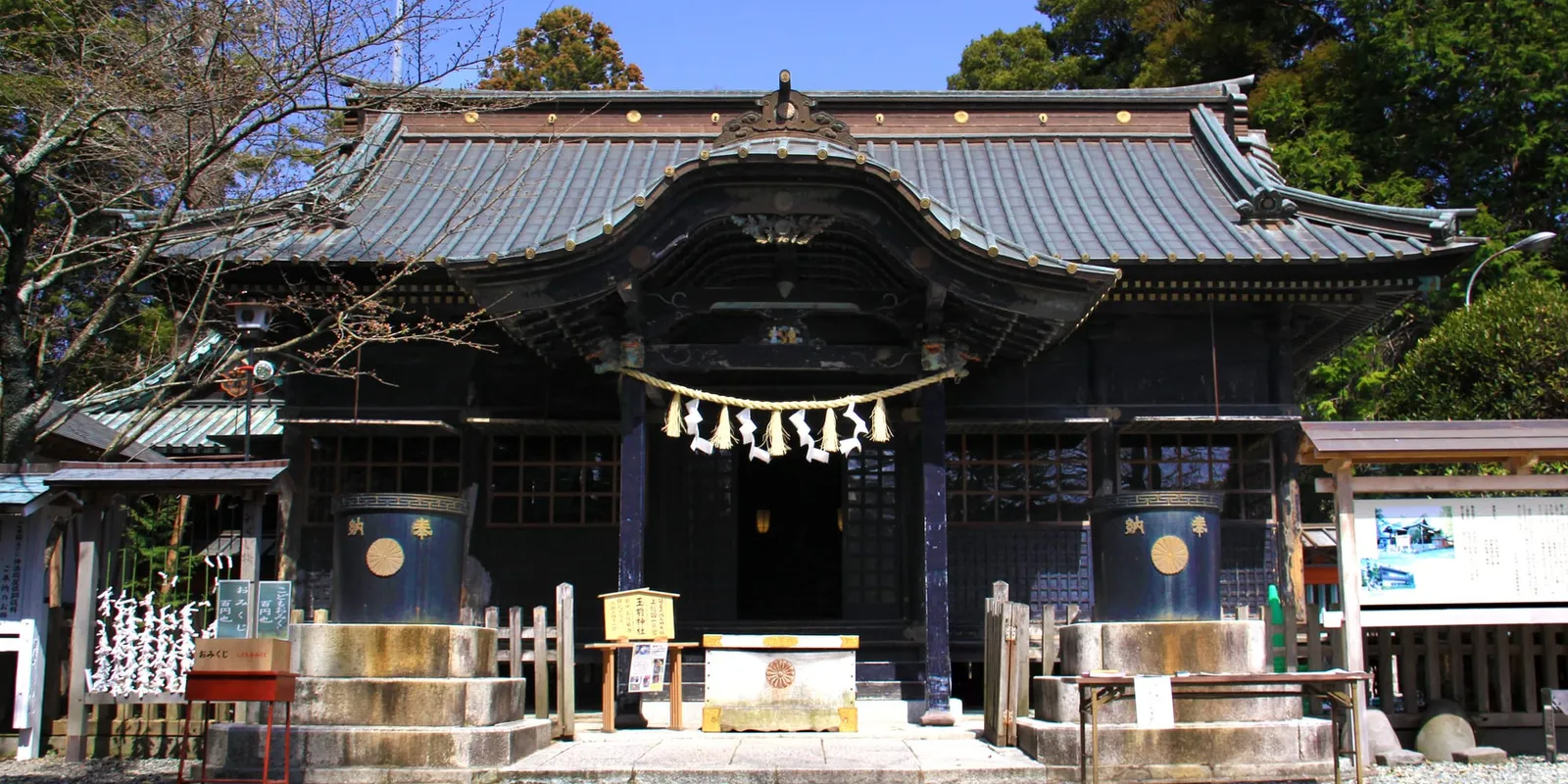
The present buildings were constructed in 1687 (Jokyo 4). The main hall, offering hall, and worship hall are linked in the gongen-zukuri style. The black-lacquered shrine is unusual, with a grand karahafu gable and a flowing irimoya roof; there is a Takasago carving on the front that is also said to be the work of Hidari Jingoro (according to the official site). The shrine buildings and their ridge tablets are designated cultural properties of Chiba Prefecture.
More than twenty inumaki (Chiba’s prefectural tree) grow in the grounds; the oldest, east of the main hall, is said to be about 20 m tall and 300 years old, and the grove is a natural monument designated by Ichinomiya Town. According to the official site, the sacred spring water can be collected freely 24 hours a day if you bring your own container (please check current practice on site). There is also a stone monument inscribed with a Basho verse, and subsidiary shrines including the Junisha, Shokonden, and Mitsumine Shrine.
The sunrises of the spring and autumn equinoxes are said to line up along the “Road of the Rising Sun” (a ley line) linking Tamasaki Shrine with Izumo Taisha, and the shrine is regarded as the starting point of this power-spot line, according to its official notices. Limited-edition goshuin are offered at those times.
Visiting Tips
The grounds are free to enter. The official site lists the gates as open from 8:00 AM to 5:00 PM and the amulet office as 8:00 AM–5:00 PM, with prayer services received 9:00 AM–3:30 PM. According to the official site, the prayer offering starts at ¥5,000 on the day or ¥10,000 for advance reservations (please check the official site for the latest details).
Goshuin are available at the amulet office alongside the monthly goshuin. The shrine’s 2026 notices give hours of 8:00 AM–4:30 PM and a fee of ¥500, issued as pre-written paper sheets. Writing in your own goshuin book is not offered, but people who newly buy the shrine’s original goshuin book have it written in for them. Limited-edition goshuin appear for the annual festival, the equinox ley-line days, the Hinamatsuri and Tango seasonal festivals, and more; as dates and quantities are limited, check the official announcements beforehand.
The shrine is about an 8-minute walk from Kazusa-Ichinomiya Station on the JR Sotobo Line. By car, it is along National Route 128, right by the Ichinomiya IC of the Kujukuri Namino-ri Road. The official site states there is parking for 50 cars, with large buses by prior inquiry.
Annual Festivals
- Kazusa Junisha Festival (annual festival, September 13 each year; a Sunday in 2026): Also known as the “Kazusa Naked Festival,” this is Tamasaki Shrine’s grand annual festival and a designated Intangible Folk Cultural Property of Chiba Prefecture. According to the official site, it is said to have been founded in 807 (Daido 2) and is counted among the oldest of the beach-descent rituals common on the Boso Peninsula. In the afternoon procession, over a thousand men carry nine mikoshi, including the shrine’s own and those of related deities, running along the Kujukuri shoreline to gather at the festival site on Tsurigasaki Beach. After a ritual celebrating the reunion, the mikoshi parade through town and return to the shrine in the evening, circling the main hall three times for the climax. In 2026, a limited-edition annual-festival goshuin (¥500, 500 copies) was issued on that day only.
- Ichinomiya River Lantern Floating (August): Held at the mouth of the Ichinomiya River (August 16 in 2026), with Tamasaki Shrine serving as the organizing office. A limited-edition goshuin was issued on the day (per the 2026 official notice).
- Equinox ley-line limited goshuin (March and September): In autumn 2026 it was distributed for four days, September 20–23, at 500 copies per day.
- Seasonal festivals and monthly goshuin: Limited-edition goshuin are offered for Hinamatsuri (Jomi Sekku festival) and the Tango Sekku festival, and a different monthly goshuin is issued each month.
- New Year’s visit (January): New Year limited-edition goshuin and amulets are offered.
Nearby Food & Sightseeing
- Tsurigasaki Beach: A beach at the southern end of Kujukuri Beach that served as the surfing venue for the Tokyo 2020 Olympics. It is also the festival site where the mikoshi gather every year during the Kazusa Junisha Festival, and has strong ties to the shrine.
- Kanmyoji Temple: A temple said to be the shrine’s former administrative temple (betto-ji). Its Konpira Hall is said to have been moved from the shrine grounds in 1879, a reminder of the shrine’s Shinto-Buddhist history.
- Wagashi-dokoro Kanekichi: A Japanese confectionery shop said to be on the approach to the shrine, a good place for a sweet break after visiting (please check its closing days and hours beforehand).
Frequently Asked Questions
- Q. What are the visiting hours and is there an admission fee?
- A. There is no admission fee for the grounds. The official site lists the gates as opening at 8:00 AM and closing at 5:00 PM; the amulet office is open 8:00 AM–5:00 PM and prayer services are received 9:00 AM–3:30 PM (hours may vary by season).
- Q. When can I get a goshuin at Tamasaki Shrine?
- A. At the amulet office from 8:00 AM to 4:30 PM, according to the shrine's 2026 notices. The fee is ¥500, and goshuin are generally handed over as pre-written paper sheets. Writing in your own goshuin book is not offered, but people who newly buy the shrine's original goshuin book have it written in for them. Limited-edition goshuin are offered monthly and around events such as the annual festival and the spring and autumn equinox ley-line days.
- Q. Is there parking?
- A. The official site states that parking for 50 cars is available, with large buses by prior inquiry. It does not state a fee, so please confirm with the shrine or on site.
- Q. What are the blessings of Tamasaki Shrine?
- A. The enshrined deity, Tamayorihime no Mikoto, is a goddess of the sea. The official site describes her blessings as matchmaking, conception, safe childbirth and child-rearing, along with protection of new beginnings and good fortune. The shrine is also known for Hojo Masako, wife of Minamoto no Yoritomo, having prayed here for a safe delivery, and is often called a shrine for women.
- Q. When is the Kazusa Junisha Festival held?
- A. On the festival day of September 13 every year (a Sunday in 2026). In the afternoon procession, nine mikoshi gather at the festival site on Tsurigasaki Beach, then return to the shrine in the evening and circle the main hall three times. It is designated an Intangible Folk Cultural Property of Chiba Prefecture.
Plan Your Visit
Before you go, you can book a stay and get your shrine-visit items ready.
Amazon links open Amazon.co.jp (Japan) in English; whether an item ships overseas depends on the product.
※ Contains ads (PR). Links open external sites such as Amazon, Rakuten, Trip.com and Booking.com.