History
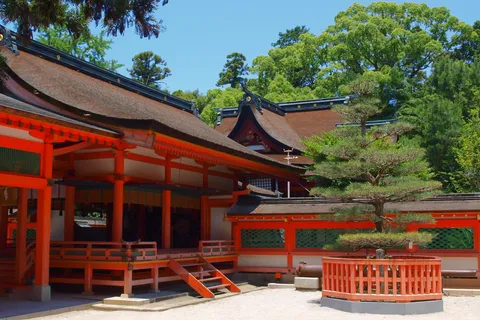
Miyajidake Shrine stands at the foot of Mt. Miyajidake in Fukutsu, Fukuoka Prefecture, and is so well loved locally that in Fukuoka “business prosperity” is almost synonymous with “Miyajidake-san.” Its principal deity is Okinagatarashihime no Mikoto (Empress Jingu), with Katsumura no Okami and Katsuyori no Okami enshrined alongside; the three are worshipped together as the “Miyajidake Three Great Deities.” According to the shrine’s official website, when Empress Jingu stayed here before crossing to the Korean Peninsula, she looked out over the open sea from the summit of Mt. Miyajidake, enshrined the heavenly and earthly deities, and set sail after praying, “I will go in obedience to heaven’s will; grant me good fortune.” She was later enshrined as the principal deity in honor of her achievements, and the shrine came to be revered as “the god of good fortune who overcomes all things.” The shrine’s tradition counts more than 1,700 years since its founding.
In the grounds, the Okunomiya Fudo Shrine sits within a burial mound unearthed in the Edo period. The mound is estimated to date from the late 6th century and has a stone chamber 23 m long and more than 5 m high and wide, which is among Japan’s largest. About 300 items were found, including gilt-bronze crowns and horse fittings, and 20 of them are designated National Treasures. The official website says the shrine’s faith in good fortune and business success spread in connection with these golden finds.
Highlights
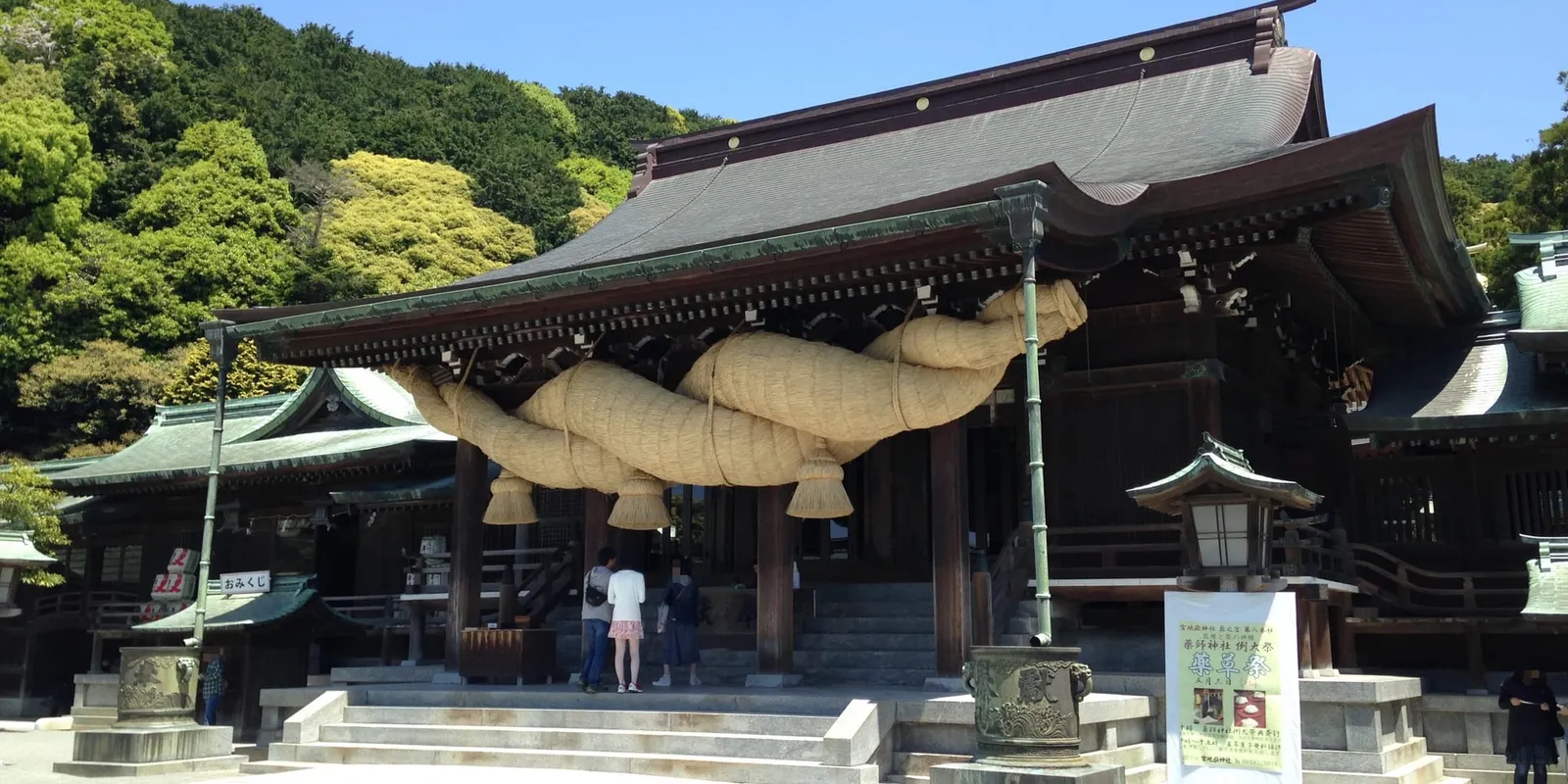
The Three Japan No. 1s: The shrine has three things it calls the largest in Japan. The first is the great shimenawa rope, the shrine’s symbol, 2.6 m in diameter and weighing 3 tons. The second is the great drum, 2.2 m in diameter. The third is a copper great bell weighing 450 kg. The shimenawa is replaced every year, and the great drum is sounded at midnight on January 1. The great bell once hung in the worship hall alongside the shimenawa until 1960, but it is now enshrined with the great drum in a dedicated bell hall.
The Path of Light: Around the 20th of February and October each year, the setting sun shines straight down the approach from the sea, forming the “Path of Light” that links the shrine with the Western Pure Land. The official website explains that this has been carefully handed down as the day the Western Pure Land, where one’s ancestors dwell, is joined in a straight line with Miyajidake. The shrine is also known as the filming location of a JAL commercial featuring the group Arashi, broadcast in 2016, which helped make it famous nationwide.
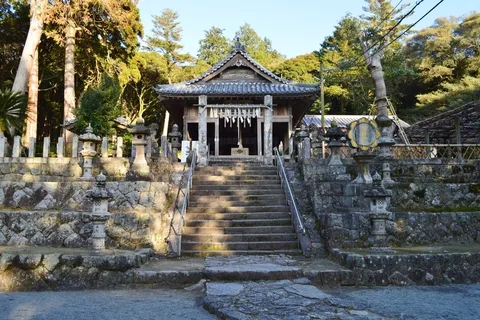
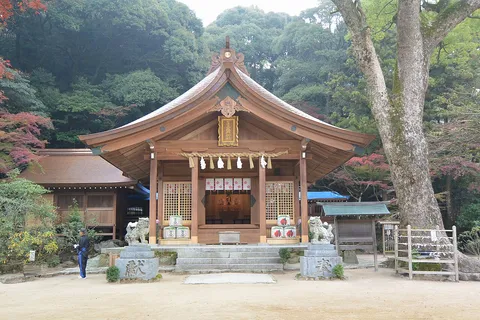
The Eight Okunomiya Shrines and Okunomiya Fudo Shrine: Behind the main hall are the “Okunomiya Hassha” (eight inner shrines), where, it is said, praying at each one will grant your great wish. They are the Shichifuku (Seven Lucky Gods) Shrine, Inari Shrine, Fudo Shrine, Yorozu Jizo, Koi no Miya (shrine of love), Sanpo Kojin, Suijin (water) Shrine, and Yakushi Shrine. The third shrine, Fudo Shrine, enshrines Fudo Myoo inside the stone-chamber burial mound, Japan’s largest, which is also called the “Shosoin underground.”
The golden roof: To mark 80 years since the main hall was enshrined in its present form, the roof was renewed in gold, according to the official website, in the image of the mound’s occupant lifting a golden crown.
Visiting Tips
The grounds are open freely, the main hall’s doors are open from sunrise to sunset, prayer service reception is 9:00 AM–5:00 PM, and the amulet office is open 9:00 AM–6:00 PM. In addition to the regular goshuin, special commemorative goshuin are issued to coincide with events such as the Path of Light and the autumn grand festival. The regular offering is about ¥500, but because the official website does not list a price for the regular goshuin, it is best to check on site or on the official site, including for limited and special editions. Goshuin for the Eight Okunomiya Shrines pilgrimage can reportedly also be received at the offices next to the Fudo and Suijin shrines.
Visitors can enter the stone chamber at Okunomiya Fudo Shrine only on the “opening days” (go-kaiko-bi) tied to its three annual festivals, and the last opening day of 2026 was July 28. We could not confirm future dates or whether an admission fee applies, so we recommend asking the shrine in advance (phone 0940-52-0016).
To see the Path of Light, arrive early, since it gets crowded. For October 2026 (October 10–20), numbered tickets for general viewing are handed out from 2:00 PM beside the front staircase, and guidance to seats begins around 4:30 PM. The reservation-only “Sunset Festival special prayer service” has reception from 9:30 AM to 3:30 PM and a ceremony at 4:00 PM, after which participants are guided to special viewing seats for the Path of Light. Reservations can be made through the online amulet shop or by phone (0940-52-0016) or at the general information desk. Drones are prohibited on the shrine grounds.
To get there, it is about 5 minutes by bus (Nishitetsu Bus, get off at “Miyajidake-jinja-mae”) or taxi from JR Fukuma Station, or about 25 minutes (2 km) on foot. By car, the nearest interchanges on the Kyushu Expressway are Koga IC (from the Fukuoka side) and Wakamiya IC (from the Kitakyushu side).
Annual Festivals
- Path of Light – Sunset Festival (February and October; October 10–20 in 2026): During the weeks when the setting sun lights the approach in a straight line, the Sunset Festival special prayer service (reservation required) and general viewing are held. In February 2026 it ran from the 19th to the 28th.
- Gentansai and New Year’s visit (from midnight on January 1): The year’s first ceremony, opened at midnight by the sound of the great drum. A “Tsuitachi-mairi” visit is also held on the 1st of every month, drawing worshippers through the night.
- Spring Grand Festival (April 4–6): A spring festival praying for national prosperity, the Imperial family’s well-being, everyone’s health, and a rich harvest.
- Okunomiya Fudo Shrine Spring Festival (February 28): Also called the “Zenzai Festival”; eating the zenzai (sweet red bean soup) is said to ensure good health all year.
- Iris Festival (mid-May to early June): About 100,000 Edo irises of 100 varieties, said to be the most in Kyushu, bloom in the grounds.
- Hikari no Ne – Furin Festival (July to the end of August): About 3,000 wind chimes line the approach to Okunomiya Fudo Shrine, along with a recreated Milky Way.
- Autumn Grand Festival (September 21–23): The shrine’s biggest festival of the year, which has continued for about 700 years. On September 23, a procession led by the “festival king” (Saio, 祭王) in an ox-drawn carriage travels the 2 km approach from Miyaji Beach. A wish-granting fireworks ceremony is held on the evening of September 22.
- Oshime Festival (third Saturday or Sunday of December): The ceremony for replacing the great shimenawa rope.
Nearby Food & Sightseeing
- Miyaji Beach: The sandy beach at the end of the approach, with Aishima Island visible across the sea. According to the shrine’s website, cafes and restaurants serving locally landed fish line the coast.
- Fukuma Coast pine grove: A pine grove nicknamed the “Kamakura of Kyushu,” running along the coast. Past the grove you reach the torii at the shore.
- Okunomiya Fudo Shrine and the Miyajidake nature trail: Beyond Fudo Shrine, a 2,400 m nature trail leads to the summit of Mt. Miyajidake, where an old shrine associated with Empress Jingu stands.
Frequently Asked Questions
- Q. When can I see the Path of Light at Miyajidake Shrine in October 2026?
- A. According to the official website, the October 2026 "Path of Light – Sunset Festival" runs from October 10 (Sat) to October 20 (Tue). The sight of the setting sun shining straight down the approach from the sea appears every February and October. Numbered tickets for general viewing are handed out from 2:00 PM beside the front staircase, and guidance to seats begins around 4:30 PM. The Sunset Festival special prayer service requires advance reservation, and the ceremony begins at 4:00 PM.
- Q. What are the visiting hours at Miyajidake Shrine?
- A. The grounds can be visited freely, and the main hall's doors are open from sunrise to sunset. Prayer service reception is 9:00 AM–5:00 PM and the amulet office is open 9:00 AM–6:00 PM (per the official website).
- Q. When can I get a goshuin at Miyajidake Shrine, and how much is it?
- A. The official website lists the amulet office as open 9:00 AM–6:00 PM, but the goshuin office hours may vary by season, so please check the official site. The regular goshuin is about ¥500, while limited-edition and special commemorative goshuin, such as those for the Path of Light, may cost more.
- Q. Is there parking at Miyajidake Shrine?
- A. Yes, there are parking lots for worshippers (the First and Second lots, among others), which most visitor guides describe as free. They get very crowded during the Path of Light period and New Year, and traffic controls apply, so taking the bus from Fukuma Station is another option.
- Q. How big is the great shimenawa rope at Miyajidake Shrine?
- A. The official website describes it as Japan's largest shimenawa, 2.6 m in diameter and weighing 3 tons. It is replaced every December and woven from straw grown in the shrine's rice field of about 2 tan, with a total of 1,500 people helping. Together with the great drum (2.2 m in diameter) and the great bell (450 kg), it is one of the shrine's "Three Japan No. 1s."
Plan Your Visit
Before you go, you can book a stay and get your shrine-visit items ready.
Amazon links open Amazon.co.jp (Japan) in English; whether an item ships overseas depends on the product.
※ Contains ads (PR). Links open external sites such as Amazon, Rakuten, Trip.com and Booking.com.