History
Kashii-gu’s origins trace back to the story of Emperor Chuai, Japan’s 14th emperor, and his consort Empress Jingu. According to the Kojiki and Nihon Shoki, Emperor Chuai traveled to Kyushu to subdue the Kumaso people and established a temporary palace (angu) called Kashii-no-miya in Chikushi. Tradition holds that in 200 CE, the emperor died at this very site. Empress Jingu, grieving but resolute, is said to have received a divine oracle, pacified the region, and led a campaign across the sea to the Korean peninsula (the legendary Sankan Seibatsu) before returning to build a shrine on the site of her late husband’s palace to enshrine his spirit — the founding of Kashii-gu. Empress Jingu’s own spirit was later enshrined alongside his, and the combined mausoleum-shrine of the two was historically known as “Kashii-byo.”
The shrine hall itself is said to have been formally built following a divine oracle from Empress Jingu in 723, with the imperial court ordering its construction; it was completed in 724. Records show that an imperial messenger was dispatched to Kashii-gu as early as 737, to report on deteriorating relations with the Korean kingdom of Silla — the earliest confirmed instance of imperial messengers visiting the shrine. Because its two principal deities are, in effect, a married couple, Kashii-gu is affectionately known today as “the Shrine of Married Couples” (Meoto no Miya), and draws many visitors praying for marital harmony and good relationships.
Highlights: The Unique Kashii-zukuri Architecture and the Ayasugi Cedar
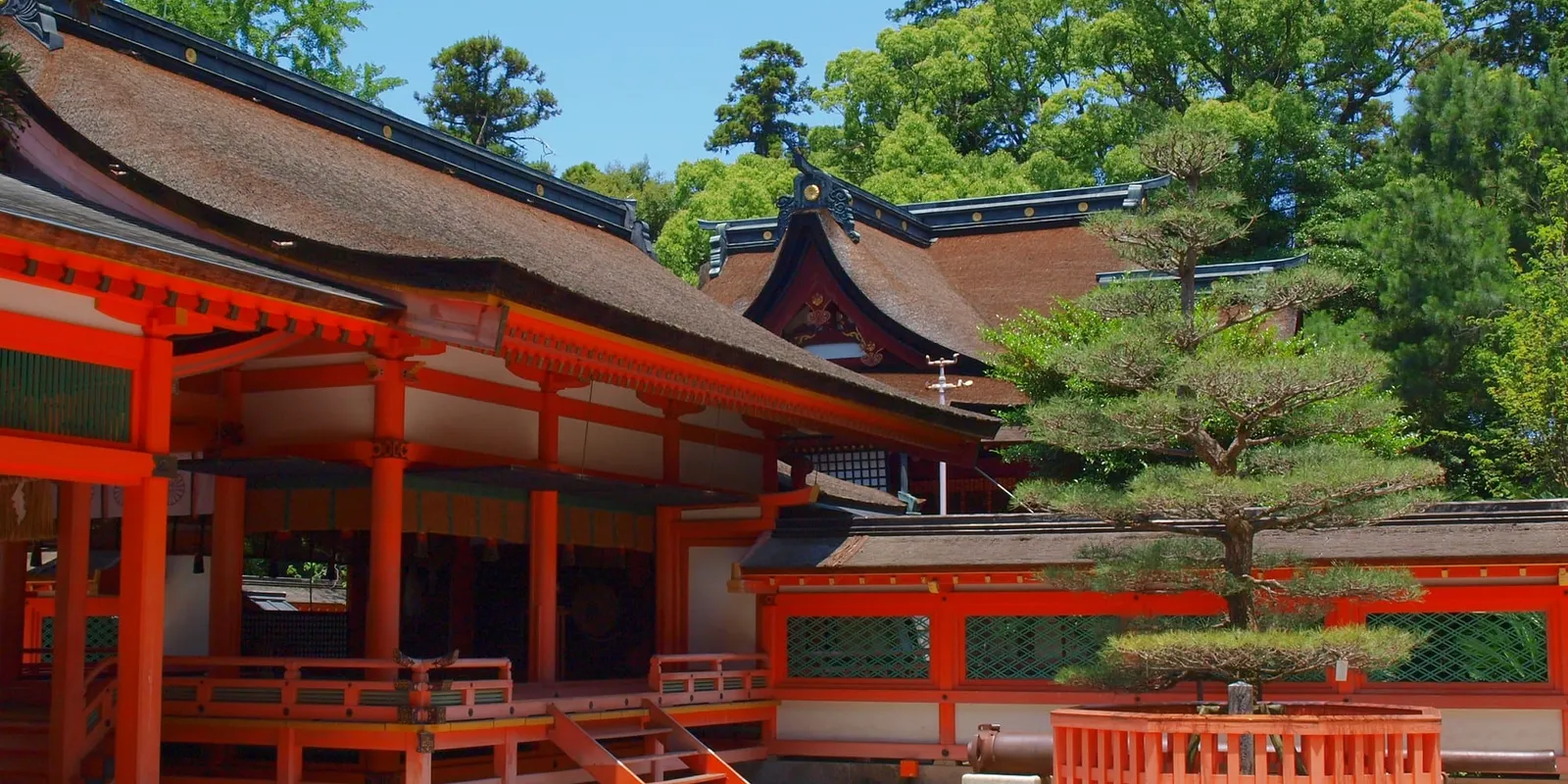
Kashii-gu’s defining feature is “Kashii-zukuri,” an architectural style found nowhere else in Japan. The current honden (main hall) was rebuilt in 1801 under the 10th lord of the Fukuoka domain, Kuroda Nagayori. It combines an irimoya (hip-and-gable) roof with a chidori-hafu (dormer-style gable) and a karahafu-topped entrance porch, flanked on either side by projecting wing-like bays known as “shishi-no-ma” (lion rooms) — an extraordinarily distinctive layout unlike any other shrine hall in the country. This singular design was designated a national Important Cultural Property on April 13, 1922 (note: it is an Important Cultural Property, not a National Treasure).
Standing before the shrine’s Chumon gate is the sacred Ayasugi cedar. According to legend, when Empress Jingu returned victorious from her campaign across the sea, she buried three sacred treasures — a sword, a halberd, and a staff — and planted a cedar branch that had been tucked into the sleeve of her armor, as a prayer for the enduring protection of the imperial court. Over the centuries the trunk has darkened and twisted into a dramatic, sinuous curve resembling a woven (aya) pattern, giving the tree its name. Carefully protected behind a vermillion fence, the ancient, gnarled Ayasugi stands as a living symbol of the shrine’s long history.
The grounds also hold several other historic sites: Furumiya, traditionally identified as the location of Emperor Chuai’s temporary palace, where a sacred tree called “Kankake-shii” is said to mark the spot his coffin was once hung; and Furosui (“The Water of Eternal Youth”), a spring said to have been drawn by the retainer Takeuchi no Sukune, who lived past 300 years thanks to its waters — the spring was named one of Japan’s 100 Best Waters by the Environment Agency in 1985. The shrine’s approach, known as the “Chokushi-do” (Imperial Messenger’s Road), runs for roughly 800 meters beneath a dignified avenue of camphor trees planted in 1926.
Status as a Chokusaisha (Imperial-Envoy Shrine)
Kashii-gu is one of Japan’s chokusaisha — shrines to which the Emperor sends an imperial messenger for the principal festival. Only 16 shrines nationwide hold this designation today, and in all of Kyushu only Kashii-gu and Usa Jingu (in Oita Prefecture) are included. Uniquely, the imperial messengers to Kashii-gu and Usa Jingu are dispatched once every 10 years rather than annually, and the resulting festival — the Chokusai — is likewise held only once a decade. During the ceremony, an official from the Imperial Household Agency serves as the messenger, and a chest (karahitsu) holding offerings from the Emperor is carried in procession through the approach and into the inner precinct beyond the Chumon gate. The most recent Chokusai was held on October 9, 2025.
Visiting Tips
The shrine grounds are open from 7:30 to 17:00, but the shrine office, where goshuin and amulets are available, keeps separate hours of 9:00 to 16:50 — plan your visit with enough time to spare. Access is excellent: it’s just a 4-minute walk from Kashii-jingu-mae Station on the JR Kashii Line, and about 10 minutes on foot from Kashiigu-mae Station on the Nishitetsu Kaizuka Line. A free parking area for worshippers (roughly 300–350 spaces) also makes the shrine easy to visit by car.
Set within an expansive forested precinct, the grounds have a hushed, ancient atmosphere despite being close to central Fukuoka. With the Kashii-zukuri honden, the Ayasugi cedar, Furumiya, and Furosui all worth seeing, it’s worth allowing plenty of time to explore.
Annual Festivals
- Kashii-gu Grand Festival (Chokusai): Held once every 10 years on October 9, this is the shrine’s most solemn and prestigious rite, welcoming an imperial messenger and offerings from the Emperor. Most recently held October 9, 2025.
- Autumn Parishioners’ Festival and Yabusame Rite: Held annually on the Sunday closest to October 17. Three mounted archers ride past a series of targets in a dramatic display, praying for national peace and a bountiful harvest.
- New Year’s Festival and Hatsumode (January): A rite praying for peace in the new year. As “the Shrine of Married Couples,” Kashii-gu draws large crowds during the first three days of the New Year.
Nearby Food & Sightseeing
- Hakozaki-gu: One of Japan’s three great Hachiman shrines and, like Kashii-gu, a former Kanpei-taisha (national shrine of the highest rank). Both shrines sit in Fukuoka’s Higashi Ward and are often visited together as a pair of “fortune-boosting” imperial shrines.
- Kashiihama: A seaside district about a 10-minute drive from Kashii-gu, with a waterfront park and boardwalk popular for a stroll after visiting the shrine.
- The area around Kashii Station and the shrine’s approach: Along the camphor-lined approach and near the nearest stations, a scattering of neighborhood restaurants — sushi counters, cafes, and casual eateries — make for a convenient stop before or after paying your respects.
Frequently Asked Questions
- Q. Can I get a goshuin at Kashii-gu?
- A. Yes, at the shrine office, accepted 9:00–16:50, for a fee of ¥300. Only a pre-written (書き置き) paper goshuin is available, not one written directly in your book.
- Q. What are the shrine's visiting hours?
- A. The grounds are open from 7:30 to 17:00. Note that this differs from the shrine office's own hours for goshuin and amulets.
- Q. Is parking available?
- A. Yes, there's a free parking area for worshippers with about 300–350 spaces. It's open 5:00–18:00 from April to September, and 6:00–18:00 from October to March.
- Q. How do I get to Kashii-gu?
- A. It's about a 4-minute walk from Kashii-jingu-mae Station on the JR Kashii Line, or about a 10-minute walk from Kashiigu-mae Station on the Nishitetsu Kaizuka Line.
- Q. What is the Kashii-gu Grand Festival (Chokusai)?
- A. Kashii-gu is one of only 16 shrines nationwide designated a chokusaisha — a shrine to which the Emperor sends an imperial messenger for its principal festival. In Kyushu, only Kashii-gu and Usa Jingu (Oita Prefecture) hold this status. Once every 10 years, an imperial messenger from the Imperial Household Agency visits for the Chokusai festival; the most recent was held on October 9, 2025.
Related Shrines
Fukuoka, Dazaifu
Kamado Jinja
Kamado-jinja
- Good Relationships
- Protection from Bad Directions
- Protection from Misfortune
Nara Prefecture, Nara
Kasuga Taisha
Kasuga-taisha
- Protection from Misfortune
- Good Fortune
- Good Relationships
Kyoto Prefecture, Sakyo Ward, Kyoto
Shimogamo Jinja
Shimogamo-jinja
- Good Relationships
- Safe Childbirth
- Protection from Misfortune