History
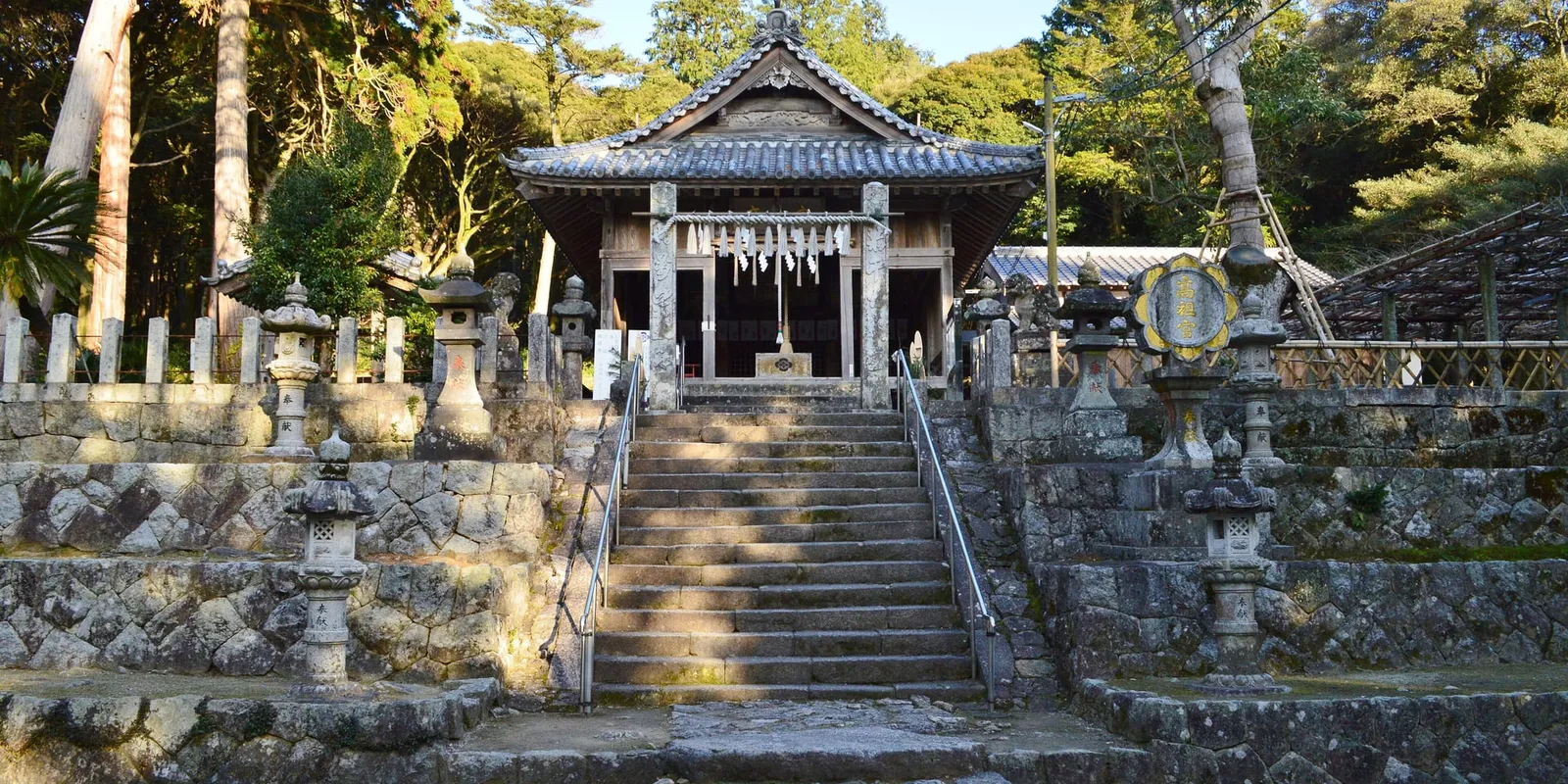
Takasu Shrine stands on the western slope of Mt. Takasu (416 m), on the border between Itoshima and Fukuoka City in Fukuoka Prefecture. Its name is read “Takasu-jinja.” According to the Fukuoka Prefecture tourism site “Crossroad Fukuoka,” the main deity is Hikohohodemi no Mikoto, with Tamayorihime no Mikoto and Empress Jingu enshrined alongside. Some sources also list Amaterasu Omikami and Toyouke no Okami as co-enshrined deities, so accounts differ. The same site says the shrine has long been revered as the local guardian deity and as the general shrine (soja) of Ito District.
The date of founding is uncertain. The earliest written mention is thought to be an entry for 877 in the Nihon Sandai Jitsuroku. According to the explanation on Bunka Isan Online, in the medieval period it was venerated by the Harada clan, who were based at Takasu Castle, and from the early modern period by the Kuroda clan of the Fukuoka domain. The same explanation also notes that copies of ridge-beam tags recorded in the Edo-period Chikuzen Machimura Kakiage-cho say that the shrine buildings were constructed in 1507, 1541 and 1572.
The shrine also appears in a TV drama: the Itoshima Tourism Association’s page supporting the NHK morning drama “Omusubi” introduces it as the shrine where the heroine, Yui, confesses to Shoya.
Highlights
The main highlight is the main hall. Built in 1541, this three-bay nagare-zukuri hall with a cypress-bark roof was designated a national Important Cultural Property on September 25, 2023 (Database of National and Designated Cultural Properties). It was renovated in 1572 and 1662, but much of its main structure and decoration is said to retain its form up to 1572, and it is rated as “one of the oldest surviving shrine main halls in the prefecture.” The explanation on Bunka Isan Online says that research carried out during the conservation repairs from 2013 to 2017 clarified when it was built and renovated. It also describes it as the oldest example in the prefecture in which both the building and its ridge-beam tags survive.
Bunka Isan Online also lists a separate Fukuoka Prefecture-designated tangible cultural property (designated March 26, 2012) that includes the worship hall (Edo period, early 18th century) and a stone Myojin torii bearing an inscription dated 1693 (Genroku 6). The grounds also have a kagura hall, where Takasu Kagura is offered in spring and autumn. Takasu Kagura is a prefecture-designated intangible folk cultural property, and the Itoshima Tourism Association says it began in 1467 (Onin 1), when Harada Tanechika, lord of Takasu Castle, brought Kyoto Noh-style kagura to the area.
Visiting Tips
Visiting hours are not stated in the official information I could confirm, and no official shrine website was found. This is a quiet shrine on a mountainside, so daytime, in good light, is the best time to visit. The grounds are also the trailhead for Mt. Takasu, and a Fukuoka Prefecture tourism site says safety prayers for climbers are held at the shrine during the Takasu-yama Yamabiraki (mountain-opening event), typically in early May.
For the goshuin, I could not find an official source giving the regular offering amount or hours. From October 31 to November 15, 2026, the shrine is a participant in the “Itoshima Hanatemizu” event, and a limited-edition goshuin is listed as handed out in advance-written form from 9:00 AM to 4:00 PM, in limited quantity. Regular availability can change, so check with the shrine beforehand.
From Shusenji Station on the JR Chikuhi Line, take the community bus (Kawahara line) to the “Takasu” stop and walk about 12 minutes (Itoshima Tourism Association). By car it is about 10 minutes from Shusenji Station or about 20 minutes from Imajuku IC on the Nishi-Kyushu Expressway, and parking is available. On kagura days parking is limited and visitors are asked to follow staff guidance. Note that the street number given for the shrine differs by source.
Annual Festivals
- Takasu Kagura (spring): Offered at the kagura hall on the fourth Sunday of April, from around 1:00 PM for about four hours (Itoshima Tourism Association). Two types, mai-kagura and men-kagura, 12 pieces in total; programs can change by year.
- Takasu Night Kagura (autumn): Offered on the fourth Saturday of October at night by bonfire light (Itoshima Tourism Association). In 2026 that was October 24, and because of an approaching typhoon it was planned on a reduced scale for local residents only.
- Takasu-yama Yamabiraki (around early May): The mountain-opening event for Mt. Takasu, with safety prayers for climbers at Takasu Shrine (Fukuoka Prefecture tourism site). Exact dates vary by year.
- Itoshima Hanatemizu (October 31–November 15, 2026): An event decorating Itoshima shrines with locally grown flowers, with Takasu Shrine as one venue. A limited-edition goshuin is offered during the period (Fukuoka Prefecture tourism site).
Event dates and details change from year to year, so check with the Itoshima Tourism Association (tel. 092-322-2098) for the latest.
Nearby Food & Sightseeing
- Mt. Takasu: The 416 m mountain for which Takasu Shrine serves as a trailhead, described by a Fukuoka Prefecture tourism site as popular with hikers in Itoshima.
- Ito Castle Ruins: The remains of a mountain castle on the western slope of Mt. Takasu, a nationally designated historic site. According to the same site, it was built by Kibi no Makibi starting in 756 (Tenpyo-shoho 8) over about 12 years, with eight watchtower sites remaining and about 2 km of earthworks preserved at the foot of the mountain. Admission is free.
- Itokoku History Museum: A museum in Itoshima displaying finds such as those from the Hirabaru site, which are designated a National Treasure. According to the same site, it is open 9:00 AM–5:00 PM and closed on Mondays (the next day if Monday is a holiday) and from December 29 to January 3.
Frequently Asked Questions
- Q. Is the main hall of Takasu Shrine a national Important Cultural Property?
- A. Yes. According to the Agency for Cultural Affairs database, the main hall (built in 1541, three-bay nagare-zukuri style with a cypress-bark roof) was designated an Important Cultural Property on September 25, 2023. Six ridge-beam tags (munafuda) are designated with it. The database explains that it was renovated in 1572 and 1662 but still keeps much of its pre-1572 form, and calls it one of the oldest surviving shrine main halls in the prefecture.
- Q. Can I get a goshuin at Takasu Shrine?
- A. A goshuin is said to be available, but the regular offering amount and hours are not stated in the sources I could confirm. According to a Fukuoka Prefecture tourism site, during the 2026 Itoshima Hanatemizu period (October 31–November 15) a limited-edition flower-basin goshuin is handed out in advance-written (kakioki) form from 9:00 AM to 4:00 PM, in limited quantity and until sold out. Availability and hours can change, so check with the shrine beforehand.
- Q. How do I get there, is there parking, and what are the visiting hours?
- A. From Shusenji Station on the JR Chikuhi Line, take the community bus (Kawahara line) to the "Takasu" stop and walk about 12 minutes (Itoshima Tourism Association). By car it is about 10 minutes from Shusenji Station or about 20 minutes from Imajuku IC on the Nishi-Kyushu Expressway, and parking is available. No capacity or fee is given, and parking is limited on kagura days. Visiting hours are not stated in the official information I could confirm, and no official shrine website was found.
- Q. When can I see Takasu Kagura?
- A. According to the Itoshima Tourism Association, the spring Takasu Kagura is offered on the fourth Sunday of April in the daytime (from around 1:00 PM for about four hours), and the autumn night kagura on the fourth Saturday of October at night by bonfire light. It is a Fukuoka Prefecture Intangible Folk Cultural Property, with two types of kagura (mai-kagura and men-kagura) totaling 12 pieces (programs can change by year). In autumn 2026, because of an approaching typhoon, it was planned on a reduced scale for local residents only.
- Q. Does the shrine have a connection to the NHK morning drama "Omusubi"?
- A. According to the Itoshima Tourism Association's "Omusubi" support page, Takasu Shrine is introduced as the shrine where the heroine, Yui, confesses to Shoya in the drama. The page also introduces other Itoshima spots linked to the drama, such as Ikisan Station. It does not give filming dates or scene details.
Plan Your Visit
Before you go, you can book a stay and get your shrine-visit items ready.
Amazon links open Amazon.co.jp (Japan) in English; whether an item ships overseas depends on the product.
※ Contains ads (PR). Links open external sites such as Amazon, Rakuten, Trip.com and Booking.com.