History
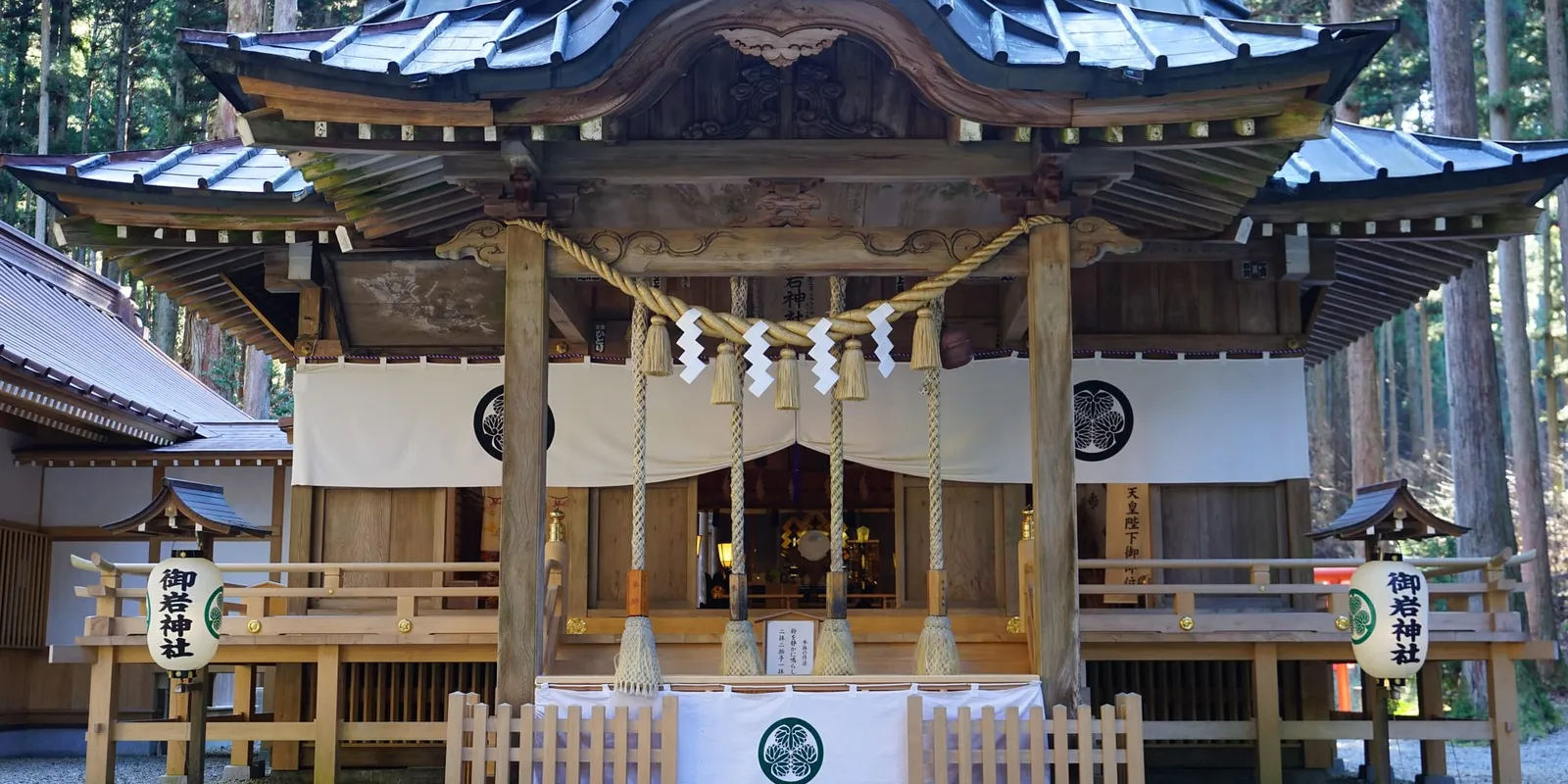
Oiwa Shrine stands at the foot of Mt. Oiwa (about 530 m, according to the shrine’s own guide) in the northern part of Hitachi, Ibaraki. Its founding date is unknown, but excavated ritual remains from the late Jomon period, and a line in the Hitachi no Kuni Fudoki (721) — one of Japan’s oldest regional records — saying that heavenly deities dwell on the “pure mountain peak of Kabire” (an old name for Mt. Oiwa), suggest that this has been a sacred place since ancient times. The shrine’s official history adds that the Sandai Jitsuroku records a rise in the shrine’s court rank in 874 and that the Engishiki Jinmyocho (927) lists it among the Twenty-Eight Shrines of Hitachi.
The main deities are Kunitokotachi no Mikoto, Okuninushi no Mikoto, Izanagi no Mikoto, and Izanami no Mikoto, along with 22 others, and 188 deities in total are said to be enshrined across the whole mountain. In the Middle Ages the mountain became a sacred site where Shinto and Buddhism blended with mountain worship, and in the Edo period the first lord of the Mito domain, Tokugawa Yorifusa, invited the Dewa Sanzan deities here in 1630 and made it the domain’s guardian peak. Successive lords, including Tokugawa Mitsukuni (Mito Komon), made pilgrimage here a regular custom. The grounds once held 21 shrines and temples and were known as “Teramachi” (Temple Town), but the Meiji-era separation of Shinto and Buddhism led to the removal of the Dainichi-do, Kannon-do, Nenbutsu-do, and the great Nio gate, leaving the site as a Shinto shrine. Even so, Buddhist statues survive and the festivals still preserve traces of Shinto-Buddhist syncretism; the official website calls it the “only shrine that enshrines both kami and buddhas.”
Highlights
The best-known feature of the grounds is the sacred tree “Sanbon-sugi” (Three-Trunk Cedar). About 3 m above the ground, the trunk divides into three that rise evenly to the sky. It is a designated Natural Monument of Ibaraki Prefecture and the only tree in Ibaraki chosen for the Forestry Agency’s “100 Giant Trees of the Forest.” The shrine’s website gives a trunk circumference of about 9 m, a height of about 50 m, and an estimated age of 600 years (some sources say about 500 years, so figures vary by source).
The approach is marked by the two-story gate (Roumon, or Dai-Niomon). The Nio gate removed during the Meiji-era separation of Shinto and Buddhism was rebuilt as a two-story gate in the Heisei era, about 120 years later, and it holds statues of the open-mouthed (Agyo) and closed-mouthed (Ungyo) Nio guardians. At the subsidiary Sai Shrine are a statue of Dainichi Nyorai said to date from the end of the Kamakura period (a designated Tangible Cultural Property of Ibaraki Prefecture) and a statue of Amida Nyorai (designated by Hitachi City), which preserve the history of Shinto-Buddhist syncretism. The Dainichi Nyorai statue is normally not open for direct worship and is unveiled at the spring and autumn Eko-sai festivals.
Seasonal flowers also grow in the grounds. According to the official grounds guide, skunk cabbage typically blooms from mid-March to early April and rhododendrons from mid-April to early May.
Visiting Tips
Worship hours are 6:00 AM–5:00 PM, but the shrine office (goshuin and prayer reception) is open only 9:00 AM–5:00 PM, so keep this in mind if you want a goshuin. There are two kinds: Oiwa Shrine and Kabire Jingu (the inner shrine), and the Kabire goshuin is received after climbing up to the inner shrine on the mountain. On weekends and holidays a double-page goshuin combining the two is offered. The shrine notes that it is hard to write in goshuin books other than accordion-style ones, and that it is not available as a pre-written sheet. Limited-edition goshuin are also offered around events such as the Natsuyama Zenjo, the Eko-sai, and New Year. Prayer services are by reservation, by phone (0294-21-8445) or online.
The mountain climb (torai) is open from 6:00 AM to 3:00 PM, and the trailhead is beside the worship hall. Kabire Jingu is about 30 minutes up, and the summit about another 30 minutes beyond, with views of the Pacific Ocean and, far off, the Nasu mountains. In rainy weather entering the mountain is prohibited, and in heavy rain or strong wind access to the mountain is closed. Wear comfortable clothing and footwear. Since March 2026, the grounds, the mountain, and all parking lots have been completely smoke-free, including e-cigarettes.
If you drive, use Parking Lot 1 in front of the shrine office (8:00 AM–6:00 PM). By train, take the JR Joban Line to Hitachi Station and board Ibaraki Kotsu Bus Route 60 (bound for Higashi-Kawachi) from Central Exit, Bus Stop 1; it takes about 35 minutes to Oiwa Jinja-mae.
Annual Festivals
- Saitan-sai (January 1): The New Year festival. A limited-edition New Year goshuin is also offered.
- Setsubun Tsuina-sai (February, on Setsubun; February 3 in 2026): A festival of prayers for protection from misfortune and good fortune, including a bean-throwing ritual.
- Kabire Jingu Festival (February 11): The annual festival of the inner shrine, Kabire Jingu.
- Kinen-sai (February 18): Farmers offer seed rice and pray, then use it for sowing.
- Reisai (April 8)
- Spring Eko-sai (third Saturday and Sunday of April; April 18–19 in 2026): The annual festival of Sai Shrine and a traditional Shinto-Buddhist event, a major memorial service for ancestors and the departed open to people of any religion or denomination, with the Dainichi Nyorai statue unveiled. A limited “Amida Nyorai” goshuin is also offered.
- Sato Shrine Festival (early May; May 1 in 2026): The annual festival of Sato Shrine Nakamiya on the back approach on Mt. Oiwa; a limited goshuin is offered around this time.
- Natsuyama Zenjo Festival (September 1): A festival that keeps alive the memory of the days when the sacred mountain could be entered only in summer for ascetic training; a limited “Natsuyama Zenjo” goshuin is offered.
- Autumn Eko-sai (third Saturday and Sunday of October; October 17–18 in 2026): Like the spring festival, a memorial service open to all religions and denominations, with the Dainichi Nyorai statue unveiled.
- Shichi-Go-San (October–November)
- Niiname-sai / Kenkoku-sai (November 18): A festival offering newly harvested rice in thanks.
Nearby Food & Sightseeing
- Kabire Jingu: The inner shrine halfway up Mt. Oiwa, enshrining Amaterasu Omikami, Ninigi no Mikoto, and Tachihayahio no Mikoto. It is said to be where Tokugawa Mitsukuni offered the prayer for the compilation of the Dai Nihon Shi, and it is about a 30-minute climb from the shrine.
- Mt. Takasuzu: A 623 m mountain on the border of Hitachi and Hitachiota, known as a hiking route that can be combined with Mt. Oiwa. The shrine’s website advises using the Honzan Tunnel parking lot if you are climbing Mt. Takasuzu or Mt. Kamine.
- Kamine Park: A park in the city of Hitachi with views of the Pacific Ocean and the Kamine Zoo inside. Reachable by bus from Hitachi Station, it makes an easy stop on a sightseeing trip to Hitachi.
Frequently Asked Questions
- Q. What are the visiting hours?
- A. According to the shrine's official website, worship hours are 6:00 AM–5:00 PM, the mountain climb (torai) is 6:00 AM–3:00 PM, and the shrine office is open 9:00 AM–5:00 PM. Visits are sometimes suspended because of weather, so it is wise to check the notices on the official website.
- Q. When can I get a goshuin?
- A. During shrine office hours (9:00 AM–5:00 PM). There is a goshuin for Oiwa Shrine and one for Kabire Shrine (Kabire Jingu), the inner shrine on the mountain; the Kabire goshuin requires climbing up to it. A double-page goshuin combining the two is offered on weekends and holidays only and is suspended in rainy weather, when entering the mountain is prohibited. Reported prices are ¥500 each and ¥1,000 for the double-page one, but the official website does not list fees, so please confirm at the shrine office.
- Q. Is there parking?
- A. Parking Lot 1 in front of the shrine office is open 8:00 AM–6:00 PM. When it is crowded, use Lots 2–4 along Prefectural Route 36 near the shrine entrance. Tour groups arriving by bus must reserve in advance (shrine office: 0294-21-8445). It gets very crowded on event days such as New Year and the Eko-sai festivals.
- Q. What does "188 deities" mean?
- A. It is the total number of deities enshrined across the whole of Mt. Oiwa, including Oiwa Shrine itself and subsidiary shrines such as Kabire Jingu, Sai Shrine, and Sato Shrine Nakamiya. Oiwa Shrine enshrines Kunitokotachi, Okuninushi, Izanagi, and Izanami plus 22 others; Kabire Jingu enshrines Amaterasu Omikami, Ninigi, and Tachihayahio; and Sai Shrine enshrines Amenominakanushi, Takamimusubi, Kamimusubi, Yachimatahiko, and Yachimatahime.
- Q. Can I climb Mt. Oiwa?
- A. Yes, mountain climbing (torai) is accepted from 6:00 AM to 3:00 PM. The trailhead is beside the worship hall; it takes about 30 minutes to reach Kabire Jingu halfway up, and about 30 more minutes to the summit. Entering the mountain is prohibited in rainy weather, and smoking, including e-cigarettes, is banned throughout the grounds, the mountain, and all parking lots.
Plan Your Visit
Before you go, you can book a stay and get your shrine-visit items ready.
Amazon links open Amazon.co.jp (Japan) in English; whether an item ships overseas depends on the product.
※ Contains ads (PR). Links open external sites such as Amazon, Rakuten, Trip.com and Booking.com.