History
Goshokomagataki Shrine stands in Yamao, Makabe-machi, in Sakuragawa, Ibaraki Prefecture. Its name is read “Goshokomagataki Jinja” (per Sakuragawa City’s tourism page), and it is described as affectionately known locally as “Komagataki-sama.” The Cultural Heritage Online database, however, registers the shrine’s festival as “Festival of Gosho Komataki Shrine,” with a different spelling and reading, so sources vary in how the name is written and read.
According to Sakuragawa City’s tourism guide, the shrine is said to have been founded in 1014 (Chowa 3) in the Heian period, and in the Joan era (1171–74) a branch spirit of Takemikazuchi, the deity of Kashima Shrine, was enshrined here and it became the tutelary shrine of the Makabe clan. There are several accounts of the founding date and circumstances: some say the Makabe clan made it the general shrine of Makabe in 1172 (Joan 2), and others pass down a legend of a dapple-gray horse appearing in the grounds. These come from articles said to draw on the shrine’s own history, and the dates differ by source.
According to introductory articles (Ibaraki Kenbunroku, Hotokami and others), the enshrined deities are Takemikazuchi as the chief deity, along with Oyamakui, Sarutahiko, Konohanasakuya-hime, and Sugawara no Michizane. In 1873 (Meiji 6) the shrine is said to have merged with four neighboring shrines and taken its present name. It is also said to have been a prayer site for the lord of Kasama in the Edo period, but the period and the lord’s name vary by source.
Highlights
The mountain approach is quiet, shaded by trees and covered in moss, with stone bridges (including the Chojubashi) and torii along the way. Visitor articles also mention a flat stone (written 駒啼石 or 駒蹄石 in different articles) said to have been stepped on by a dapple-gray horse. The grounds are said to include subsidiary shrines such as Inari, Awashima, Hachiman and Toshogu. The shrine is also known for autumn leaves, usually at their best from mid to late November.
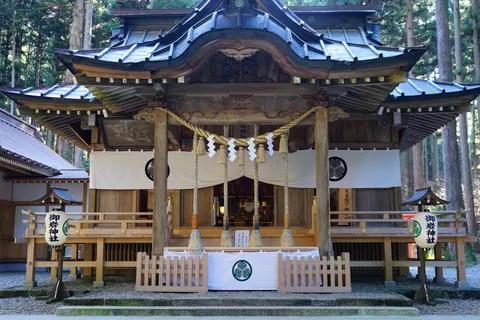
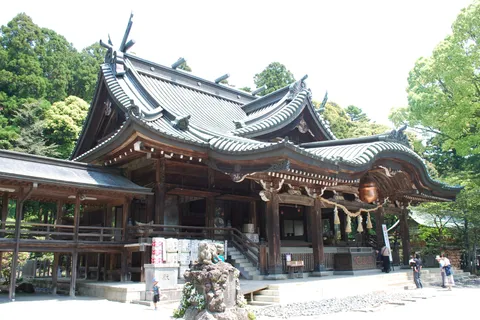
The main hall is said to have been rebuilt in 1704 (Hoei 1), a three-bay nagare-zukuri building with a hip-and-gable roof and copper-plate roofing, made largely of zelkova wood and carved with flowers, birds and dragons. Ibaraki Kenbunroku lists it as a Sakuragawa City designated cultural property from 1978 (this could not be confirmed in city materials).
What is firmly established as a cultural property is the “Festival of Gosho Komagataki Shrine” (the Makabe Gion Festival). According to Cultural Heritage Online, it was selected on December 17, 1986 as a national Intangible Folk Cultural Property for which documentation and similar measures are to be taken. It is described as run by the festival organization of Makabe’s townspeople, which has an Edo-period tradition, with the elders (tairo), deputies (churo) and caretakers (sewanin) of five towns at its center. The neighboring temple Henjo-in is described as the family temple of the Makabe clan.
Visiting Tips
Some sources give the address as 503 Yamao, Makabe-machi, Sakuragawa (the city’s tourism page and Kanko Ibaraki), while others give 499 Yamao, so the street number differs. When using a navigation app or map, searching by the shrine’s name is safest.
No visiting hours are given in the official sources that could be confirmed, and one article says the grounds can be visited all day. The shrine is said to often be without a resident priest, so if you want a prayer service or a goshuin it is safest to call the shrine office ahead (0296-55-1487). One article from 2024 gives the goshuin fee as ¥500. One article mentions monthly-changing designs while another source says there are no limited-edition goshuin, so sources differ.
By public transport, it is about 20 minutes by taxi from Iwase Station on the JR Mito Line, so most visitors come by car. There are 35 parking spaces, but the road to the lots is narrow and winding, so drive carefully.
Annual Festivals
- Makabe Gion Festival (July 23–26): According to Sakuragawa City’s tourism page, this is the shrine’s annual festival with a history of about 400 years, in which elaborately decorated floats parade through the streets of Makabe. Cultural Heritage Online explains that it was formerly held on the 13th–15th of the sixth lunar month, with the portable shrine carried from the shrine at the foot of the mountain to a temporary shrine in town and returned on the last day.
- Kattate Festival (August 31): Sakuragawa City describes it as an event in which parishioners carry sacred fire up to Fuji Asama Shrine on Mt. Gongen, praying for a bountiful harvest. A torch procession and a fireworks offering are said to take place (based on a page last updated in 2009).
Dates and details may change from year to year, so please check the latest information before you go.
Nearby Food & Sightseeing
- Henjo-in: A temple next to the shrine, described as the family temple of the Makabe clan (per Ibaraki Kenbunroku).
- Makabe Townscape: According to Sakuragawa City, a former castle town of about 17.6 hectares selected in 2010 (Heisei 22) as a national Important Preservation District for Groups of Traditional Buildings. Merchant houses and other buildings from the late Edo to early Showa periods remain, and it is the stage for the Gion Festival.
- Makabe Castle Ruins: According to Sakuragawa City’s board of education, the former seat of the Makabe clan, designated a national historic site in 1994 (Heisei 6). It is the heart of the castle town from which the townscape grew.
Frequently Asked Questions
- Q. What are the visiting hours of Goshokomagataki Shrine?
- A. No visiting hours are given in the official sources that could be confirmed. One guide article says the grounds can be visited around the clock, while the shrine office is said to be staffed roughly 9:00 AM–5:00 PM. Since there is often no resident priest, it is safest to call ahead (0296-55-1487) if you want a prayer service or similar.
- Q. Can I get a goshuin here?
- A. Yes. They are given out at the shrine office to the left of the worship hall. One visitor article from 2024 gives the fee as ¥500. Hours are said to be about 9:00 AM–5:00 PM, but when the priest is away only pre-written goshuin are available, in limited numbers. One article mentions monthly-changing designs while another source says there are no limited-edition goshuin, so sources differ.
- Q. How do I get there, and is there parking?
- A. According to Sakuragawa City's tourism guide, it is about 20 minutes by taxi from Iwase Station on the JR Mito Line, or about 20 minutes by car from Sakuragawa-Chikusei IC on the Kita-Kanto Expressway. There are 35 parking spaces (20 upper, 15 lower); no official fee information could be confirmed, though one visitor article says parking is free. The road to the lots is narrow and winding, so drive carefully.
- Q. When is the Makabe Gion Festival?
- A. Sakuragawa City's tourism page gives it as four days, July 23–26 each year, as the annual festival of Goshokomagataki Shrine (described as having a history of about 400 years). The shrine's festival was selected as a national Intangible Folk Cultural Property on December 17, 1986, under the name "Festival of Gosho Komataki Shrine" (per the Cultural Heritage Online database). Dates can change, so check the latest information from the city before you go.
- Q. What is the Kattate Festival?
- A. According to Sakuragawa City's tourism page, it is held on August 31, when the shrine's parishioners carry sacred fire up to Fuji Asama Shrine on Mt. Gongen. The announced schedule was: gather at the shrine at 5:30 PM, ceremony at 6:00 PM, torches lit and the climb begins at 6:30 PM, and a fireworks offering shortly after 7:00 PM (based on a page last updated in 2009, so it may have changed).
Plan Your Visit
Before you go, you can book a stay and get your shrine-visit items ready.
Amazon links open Amazon.co.jp (Japan) in English; whether an item ships overseas depends on the product.
※ Contains ads (PR). Links open external sites such as Amazon, Rakuten, Trip.com and Booking.com.