History
Okuni Shrine (Okuni Jinja) is the “Ichinomiya” (first shrine) of Totomi Province, standing in Ichinomiya, Mori Town, in the Enshu region of western Shizuoka, beside the clear Miya River that flows from the foot of Mt. Honguzan. The enshrined deity is Onamuchi no Mikoto, also known as Okuninushi no Mikoto or Daikoku-sama, the kind-hearted god beloved for helping the White Hare of Inaba in the myths. The shrine’s name is written with the older character form 小國.
According to shrine tradition, it began when the deity appeared on Mt. Honguzan (where the rear shrine, Okuiwato Shrine, now stands) in 555, the 16th year of Emperor Kinmei. In 701 (the first year of Taiho), an imperial envoy is said to have come, opened the village shrine at its present site, and offered a twelve-step dance. The official website advertises “1,470 years since enshrinement.” Note that another shrine, Kotonomama Hachimangu in Kakegawa, also claims to be the Ichinomiya of Totomi.
The shrine is also tied to Tokugawa Ieyasu in the Warring States period. On the 22nd day of the ninth month of 1572, Ieyasu is said to have dedicated a written prayer and two swords inscribed by the master swordsmith Sanjo Kokaji Munechika, praying for victory and good fortune, according to an old record of 1680. In 1574, on his way to attack Inui Castle, he visited again and rested on a stone within the grounds, now called “Ieyasu’s Rising Stone.” In the Meiji era the shrine was ranked as a Kokuhei Shosha (minor national shrine), and today it is a Beppyo shrine of the Association of Shinto Shrines.
Highlights
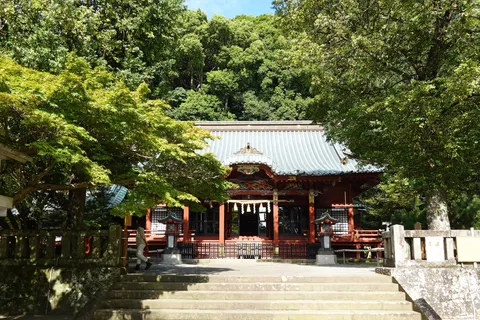
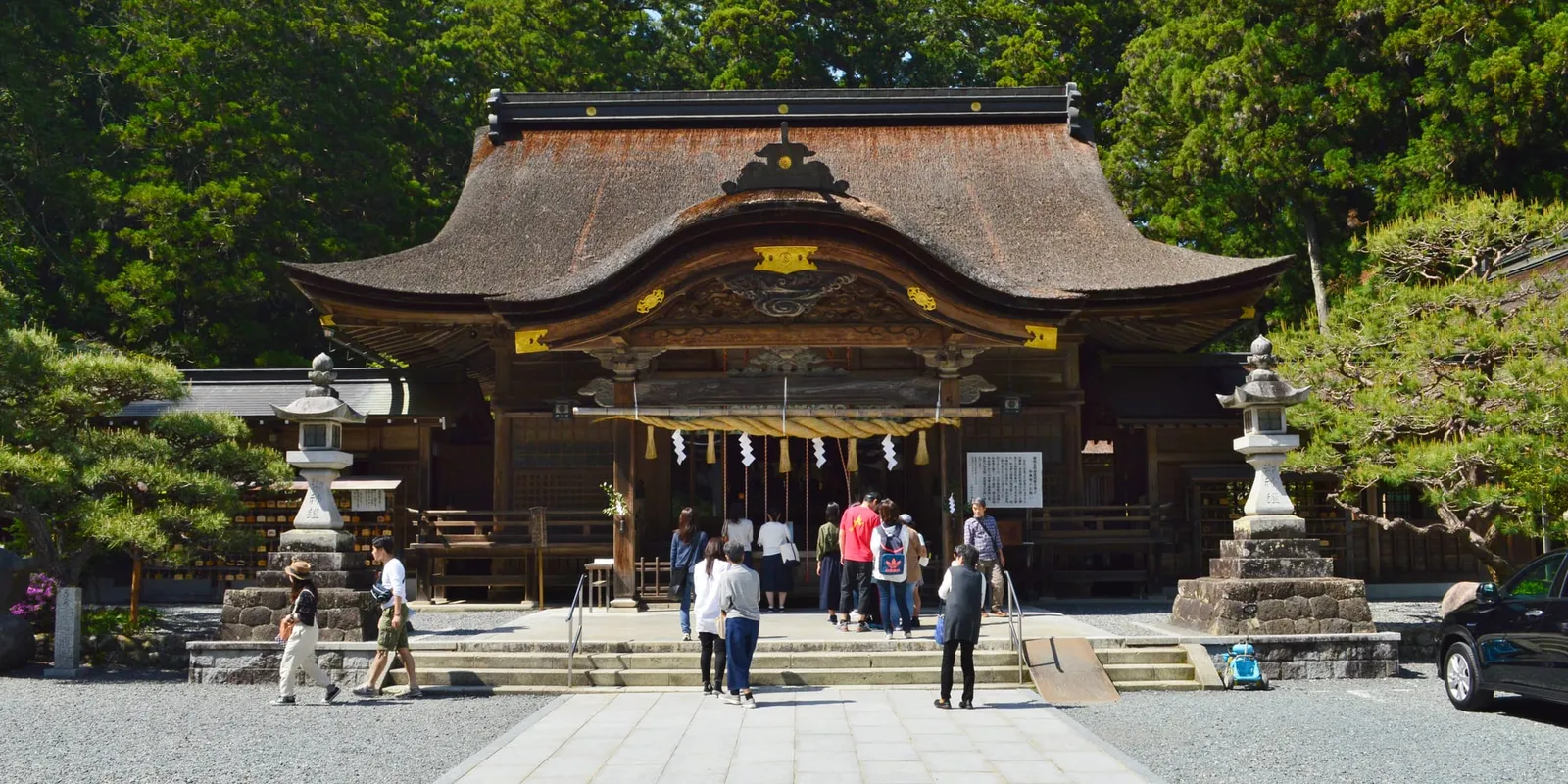
The main sanctuary was destroyed in a great fire in 1882 and rebuilt in 1886 in the Taisha-zukuri style, roofed entirely in cypress bark. The worship hall (haiden) was likewise rebuilt in 1886, with a hip-and-gable (irimoya) cypress-bark roof. On the dance stage (butoden), the “Taasobi Shinji” on January 3 (a nationally selected Intangible Folk Cultural Property) and the Twelve-Step Bugaku at the April festival are performed.
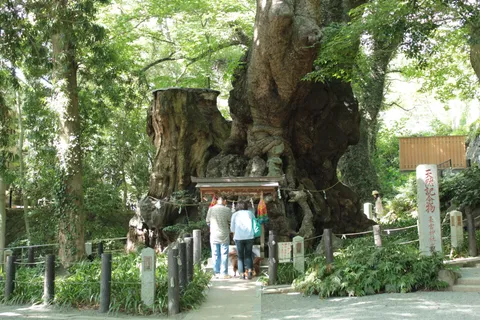
The shrine is best known for enmusubi, the bond-making blessing, and its symbol is the sacred tree “Hyo no Ki” (an isu tree) behind the assembly hall. It is said to be about 800 years old and was registered as a Natural Monument of Mori Town in 2004. Legend holds that when Onamuchi no Mikoto blew on a hyo seed pod, a goddess moved by the beautiful sound appeared and they became bound together, so the tree is revered for tying bonds in love, relationships, and work.
Okuni Shrine is also known as a place where wishes come true as one hopes. Its Kotomachi Pond (Kotomachi-ike) takes its name from the custom of releasing carp into the pond after a wish has been granted; it is also called “Iboto-ri Pond” (wart-removing pond). The sprawling grounds of about 300,000 tsubo (the size of 21 Tokyo Domes) are wrapped in towering cedar and cypress, with about 1,000 maple trees along the Ichinomiya (Miya) River. The plum grove blooms in January–February, cherry blossoms in late March to early April, the iris garden (about 130 varieties and 400,000 plants) from late May into June, and the autumn leaves from mid-November to early December, so there is something in bloom nearly all year.
Within the precinct are subsidiary shrines such as Namino-miya, Hachioji-sha, and Munakata-sha. About 6 km north of the main shrine, on the 511-meter summit of Mt. Honguzan, stands the rear shrine, Okuiwato Shrine.
Visiting Tips
The grounds are free to enter. Prayer services are received at the “Kito Uketsukesho” reception to the left of the worship hall, daily from 9:00 AM to 4:00 PM, with no advance reservations (from ¥5,000 per request, about 20–30 minutes). Goshuin are issued at the shrine office, but the hours and fee (¥300 according to a visitor-information site) are not stated on the official website, so it is safest to check with the office (+81-538-89-7302) before you go. Enmusubi amulets such as the “Enmusubi (Momiji) Omamori” are also available.
If you are praying for good relationships, a good route is to pray at the main sanctuary, then visit the “Hyo no Ki” behind the assembly hall and Kotomachi Pond. By car it is about 7 minutes from Enshu-Morimachi Smart IC on the Shin-Tomei Expressway, with free parking for about 700 cars. Expect traffic regulation and crowds during the autumn foliage season and New Year. By train, take the Akiba Bus “Okunijinja Kaiun Line” from Enshu-Mori Station (Tenryu Hamanako Railroad) or Fukuroi Station (JR), which runs directly to the shrine.
Annual Festivals
- Annual Festival and Twelve-Step Bugaku (April 18; the bugaku is held on the Saturday or Sunday closest to April 18): April 18 is said to be the day the deity was enshrined on Mt. Honguzan and the day an imperial envoy came and the twelve-step bugaku was offered. The bugaku is part of the nationally designated Important Intangible Folk Cultural Property “Totomi Mori-machi no Bugaku” (designated in 1982) and is performed over most of the day. Children perform six of the twelve pieces and adults aged 16 and over perform the rest, along with an extra piece, the “Hana no Mai.” At the festival, the deity travels in a portable shrine to the Shinkosho (the resting place for the portable shrine).
- Taasobi Shinji (January 3): A ritual said to date from the Kamakura period, designated a nationally selected Intangible Folk Cultural Property. It is held on the dance stage.
- New Year’s visit, Yakuyoke Taisai, and Setsubun (January–February): The New Year Festival and first visit of the year are on January 1, the Yakuyoke Taisai (rite for warding off misfortune) runs from late January to around February 3, and the Setsubun festival is on February 3.
- Iris Garden (late May–June): The “Ichinomiya Hanashobu-en” garden opens (in 2026, it opened on May 21). The Iris Festival is held on the first Sunday of June.
- Autumn foliage (mid-November–early December): The maples along the Miya River turn color, the grounds’ peak viewing season. The “Momiji Mamori” amulet is also offered.
- Oharae purification rite (June 30 and December 31): A ritual to cleanse the sins and impurities of the past six months.
Nearby Food & Sightseeing
- Okuni Kotomachi Yokocho: A rest and street-food spot beside the torii, run by a long-established tea wholesaler. Matcha sweets, lucky dumplings (kaiun dango), and warabi mochi are on offer.
- Tenmiya Shrine: A shrine in Mori Town whose twelve-step bugaku is part of the same nationally designated “Totomi Mori-machi no Bugaku” as Okuni Shrine’s. A good stop for exploring Mori Town’s bugaku tradition.
- Honguzan Okuiwato Shrine: The rear shrine of Okuni Shrine, on the summit of Mt. Honguzan, where the deity is said to have first appeared. The route to the summit is an unmaintained mountain trail, so take great care.
Frequently Asked Questions
- Q. What are the visiting hours and is there an admission fee?
- A. The official website does not state visiting hours for the grounds, but visitors can walk in and pray freely. Prayer services are accepted daily from 9:00 AM to 4:00 PM with no advance reservations (from ¥5,000 per request). The amulet office's hours are not stated on the official site, so please check with the shrine office (+81-538-89-7302).
- Q. How do I get a goshuin?
- A. Goshuin are issued at the shrine office. A visitor-information site lists ¥300 and roughly 9:00 AM–4:00 PM, but neither is stated on the official website, so please confirm with the office beforehand. The "Enshu-Mikawa Issha-Sanzan Momiji-meguri" goshuin book (¥1,200, goshuin fee separate) has also been available since November 2024.
- Q. Is there parking?
- A. Yes, there is free parking for about 700 cars, and tour buses use the dedicated Parking Lot No. 2 on the grounds. During busy periods such as the autumn foliage season and New Year, parts of the access roads may be regulated. The nearest interchange is Enshu-Morimachi Smart IC on the Shin-Tomei Expressway, about 7 minutes by car.
- Q. How do I get there by train and bus?
- A. From Enshu-Mori Station (Tenryu Hamanako Railroad) or Fukuroi Station (JR), take the Akiba Bus "Okunijinja Kaiun Line," which runs directly to the shrine. From Totomi-Ichinomiya Station (Tenryu Hamanako Railroad) it is about a 50-minute walk, and a free shuttle bus runs on the 1st and 15th of each month (15th only in January); advance inquiry is required.
- Q. When can I see the Twelve-Step Bugaku dance?
- A. It is performed over most of one day on the Saturday or Sunday closest to April 18, the day of the annual festival. It is part of the nationally designated Important Intangible Folk Cultural Property "Totomi Mori-machi no Bugaku"; children perform six of the twelve pieces and adults aged 16 and over perform the rest.
Plan Your Visit
Before you go, you can book a stay and get your shrine-visit items ready.
Amazon links open Amazon.co.jp (Japan) in English; whether an item ships overseas depends on the product.
※ Contains ads (PR). Links open external sites such as Amazon, Rakuten, Trip.com and Booking.com.