History
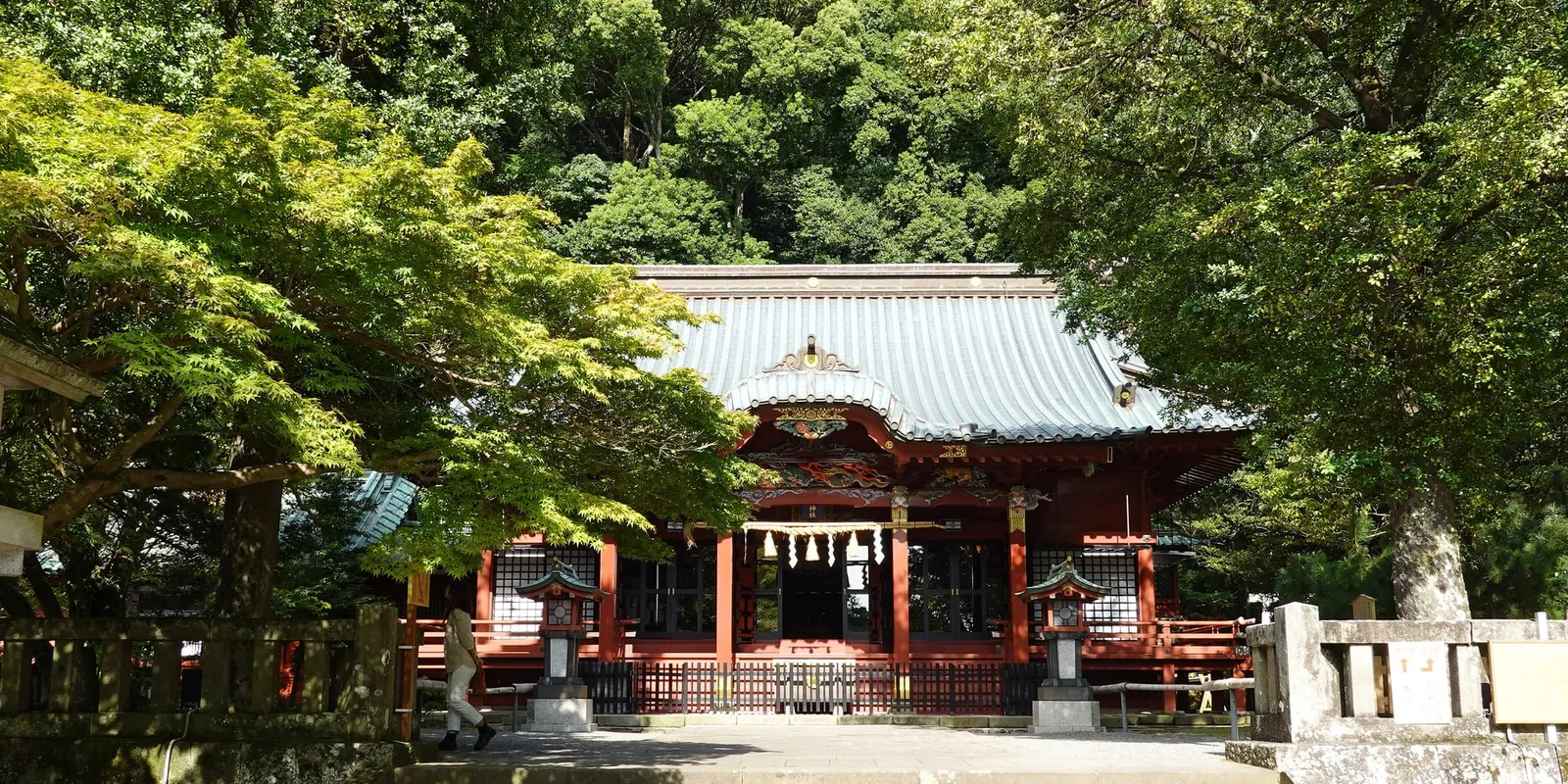
Izusan Jinja stands on high ground overlooking the sea in Atami, Shizuoka Prefecture. Its official site calls it the “Guardian of the Eight Kanto Provinces” (Kanhasshu Sochinju), and the enshrined deity is Izusan no Okami. According to the official site, the grounds spread uphill and seaward from the main hall and cover about 40,000 tsubo, and the main hall sits at around 170 meters above sea level with a view of Sagami Bay.
The official site explains that the shrine was once known as “Izu no Omiya,” “Izu Daigongen” and “Hashiriyu Daigongen,” and has been revered as a god of strong fortune, protection from all directions, harmony and good fortune, and good relationships. Its worship is said to go back to remote antiquity, and a wooden male deity statue from the mid-Heian period (described on the official site as the largest deity statue in Japan and an Important Cultural Property) is said to represent the divine image of Izusan no Okami. “Hashiriyu Daigongen” is a name that deifies the hot spring “Hashiriyu” (literally “running hot water”), and the site also explains that the country name “Izu” derives from the deity, the god from whom hot water emerges (“yu-izu”).
According to the official site, Minamoto no Yoritomo, exiled to Izu Province after the Heiji Rebellion, placed deep faith in the shrine together with Hojo Masako and prayed for the revival of the Minamoto clan. After opening the Kamakura shogunate, Yoritomo is said to have deeply revered the shrine as a “guardian god of strong fortune and protection from all directions” and to have donated many estates to it as the “Guardian of the Eight Kanto Provinces.” Shogunal visits continued as the “Nisho-mode,” the Hojo clan revered it in the Sengoku period, and the Tokugawa shoguns did so in the Edo period. After the Meiji government’s order separating Shinto and Buddhism, it was renamed Izusan Jinja, and in the 3rd year of Showa it was ranked as a Kokuhei Shosha, according to the official site. The “Kanhasshu” (Eight Kanto Provinces) are the old Kanto provinces of Musashi, Sagami, Kozuke, Shimotsuke, Kazusa, Shimosa, Awa and Hitachi (official site).
Highlights
The approach is a long flight of stone steps; the official access page counts 189 steps from the Izusan Jinja-mae bus stop to the main hall. Inside, the lattice ceiling paintings of the worship hall are described on the official site as “overwhelming”: 390 paintings by the children’s-book artist 黒崎義介, covering Japanese mythology, folk tales, festivals, animals and plants. The bell rope of the main hall is described as an eight-tiered knotted cord representing the four directions and four corners, with 28 bells symbolizing the 28 lunar mansions.
In the Ryujin Pond (Dragon Deity Pond) in the grounds, red and white dragon spouts pour water. According to the official site, the shrine’s history (the 走湯山縁起) says that a red and a white dragon lie united beneath Izusan; the red dragon governs fire and the white dragon governs water, and together they are said to produce the hot springs. The two dragons are also likened to male and female, and are associated with marital harmony, success in love and good relationships. At the pond you can perform “hitogata nagashi,” transferring impurities to a paper doll (hitogata) and letting it float away on the sacred hot water (dolls are available at the amulet counter). According to the official site’s notices, the Shinto-sha sub-shrine’s enshrinement ceremony, the pond’s completion ceremony and the first doll-floating took place in September 2026.
The grounds also include the Koshikake-ishi, a stone said to be where Minamoto no Yoritomo and Hojo Masako sat and talked; the Hikari-ishi (Stone of Light), where a deity is said to descend; Musubu Myojin Shrine (Satomiya), enshrining a god of matchmaking between men and women; and the Hakusan-sha Yohaisho, a place to worship from afar the Hakusan-sha (Kukurihime no Kami) on the mountain. The Hongu-sha in the mountains and Hashiriyu Shrine, which guards the “Hashiriyu” spring by the sea, are also introduced as sub-shrines. According to the official site, Hashiriyu is a horizontal-tunnel spring said to have been discovered about 1,300 years ago by En no Ozunu, and is described as rare in Japan.
Visiting Tips
According to the official site, the amulet counter is open 9:00 AM–4:00 PM and prayer services are accepted 9:30 AM–2:30 PM. You can request a service by visiting the shrine office on the day, but because services may not be possible due to rites and events, call ahead (0557-80-3164; reservation inquiries 9:00 AM–4:00 PM). Prayer starts from ¥5,000 for individuals and ¥10,000 for companies. For those who cannot visit in person, the shrine also accepts prayer requests by post.
Amulets, goshuin and similar items are given out at the shrine office and amulet counter, on the right just after you climb the steps and enter the grounds. The goshuin fee and hours are not stated on the official site, so please confirm at the office. For details of amulets, including those for good relationships, see the official site’s amulet page.
Get off at “Izusan Jinja-mae,” about 7 minutes by bus from Bus Stop No. 4 at JR Atami Station, and it is 189 stone steps up to the main hall. The parking area beside the main hall (about 30 spaces) is reached by the side path to the left of the shrine from the city road, and lets you avoid the steps. Large buses cannot park.
Annual Festivals
- Annual festival (April 14–16; festival day April 15): The eve-of-festival rite, main festival, deity procession, lower-shrine rite, return procession and a follow-up festival are held. The “神女舞” dance and the “Sanetomo no Mai” (実朝の舞) are offered at the main festival and the follow-up festival, and in the portable-shrine procession three mikoshi descend the stone steps of the approach to the lower shrine (official site).
- Chinka-sai (January 15): A rite to prevent fires, praying for Atami to remain free of fire.
- Setsubun-sai (Setsubun day): A rite praying for protection from misfortune and good fortune.
- Raiden-sha festival (March 15): The festival of the Raiden-sha sub-shrine.
- Hashiriyu Shrine festival (May 14): A “yu-kumi” (hot-water-drawing) ceremony is held by people connected with the Hashiriyu hot spring association, praying for the blessings of the spring.
- Musubu Myojin Shrine festival (May 15): The festival of Musubu Myojin (Nissho and Gessho), the matchmaking deity.
- Hongu-sha festival (August 23) and Hakusan-sha festival (August 7): Festivals of their respective sub-shrines.
- Kangetsu-sai moon-viewing festival (around August 15 of the old calendar): A festival remembering Minamoto no Sanetomo, the poet-shogun, at which the “Sanetomo no Mai” dance is offered. According to the official site, the full moon of the mid-autumn festival falls on September 25 in 2026. The Izusan poetry gathering hosted by Atami City is also carried on around this time.
- Onsen Kansha-sai (around November 10): People connected with hot-spring facilities and spring owners give thanks for the blessings of the hot springs.
- Niiname-sai (November 23): A major rite offering the new grain to the deities and giving thanks for the harvest.
- Shiwasu Oharae (December 31) and the New Year’s Eve and New Year rites (December 31–January 1): Rites marking the end of the year and the start of the new one.
Dates and content can change from year to year. Please check the festival page and notices on the official site for the latest information.
Nearby Food & Sightseeing
The official access page lists Hannya-in, Koa Kannon, Hashiriyu, Mt. Iwato, Mt. Higane, Jukkoku Pass and Izusan Onsen as nearby attractions.
- Hashiriyu: The official site explains that it is named for hot water that flows from the mountainside down to the coast as if running. The name “Hashiriyu Daigongen” is described as a deification of this sacred hot spring.
- Hannya-in: A spot the official site lists among its nearby attractions.
- Koa Kannon: Also listed by the official site among its nearby attractions.
Frequently Asked Questions
- Q. What are the hours for visiting, prayer services and amulets?
- A. According to the official site, the amulet counter is open 9:00 AM–4:00 PM, and prayer services are accepted 9:30 AM–2:30 PM (go to the shrine office on the day; services may not be possible because of rites or events, so the shrine advises contacting it in advance). Prayer for an individual starts from ¥5,000. The hours when the grounds themselves are open are not stated on the official site. The phone number is 0557-80-3164.
- Q. Can I get a goshuin at Izusan Jinja?
- A. The official site says amulets, goshuin and similar items are given out at the shrine office and amulet counter. The office is on the right just after you climb the steps and enter the grounds. The goshuin fee and separate goshuin hours are not stated on the official site, so please confirm at the shrine office, using the amulet counter hours (9:00 AM–4:00 PM) as a guide.
- Q. How do I get there, and is there parking?
- A. The official site says it takes about 7 minutes by bus from Bus Stop No. 4 at JR Atami Station (routes A41, A42, A43, A45) to the Izusan Jinja-mae stop, followed by 189 stone steps up to the main hall. There are about 30 parking spaces beside the main hall, reached by the side path to the left of the shrine from the city road, so you can avoid the steps. Large buses cannot park.
- Q. What is the connection with Minamoto no Yoritomo and Hojo Masako, and is it good for relationships?
- A. According to the official site, Minamoto no Yoritomo, exiled to Izu Province after the Heiji Rebellion, and Hojo Masako placed deep faith in the shrine and prayed for the revival of the Minamoto clan. The grounds hold a stone said to be where Yoritomo and Masako sat and talked (the Koshikake-ishi). The official site describes the shrine as a god of "strong fortune, protection from all directions, harmony and good fortune, and good relationships," and the sub-shrine deity Musubu Myojin (Nissho and Gessho) is also enshrined as a god of matchmaking between men and women.
- Q. When is the annual festival?
- A. On the official festival calendar, the annual festival day is April 15, with the eve-of-festival rite, main festival, deity procession, lower-shrine rite, return procession and a follow-up festival held from April 14 to 16 (the main festival is at 10:00 AM on the 15th and the procession at 1:00 PM). The "神女舞" dance and the "Sanetomo no Mai" (実朝の舞) are offered at the main festival and the follow-up festival, and in the portable-shrine procession three mikoshi descend the stone steps of the approach to the lower shrine. Schedules and content can change from year to year, so check the official site in advance.
Plan Your Visit
Before you go, you can book a stay and get your shrine-visit items ready.
Amazon links open Amazon.co.jp (Japan) in English; whether an item ships overseas depends on the product.
※ Contains ads (PR). Links open external sites such as Amazon, Rakuten, Trip.com and Booking.com.