History
Osaka Tenmangu enshrines Sugawara no Michizane, the god of learning, and is affectionately known locally as “Tenma no Tenjin-san.” The site’s roots go back to 650, when the Daishogun Shrine was enshrined as a guardian for the capital as Emperor Kotoku built the Naniwa Nagara-Toyosaki Palace. It stood in the northwest of the present grounds, and tradition says Michizane visited it before leaving for Dazaifu. The surrounding area came to be called the “Daishogun Forest” or “Tenjin Forest,” and the names of the nearby Minami-morimachi and Kita-morimachi districts preserve that memory.
About 50 years after Michizane died at Dazaifu, seven pine trees are said to have sprung up overnight in front of the Daishogun Shrine, their tips glowing each night. In response to this auspicious sign, Emperor Murakami ordered that Michizane’s spirit be enshrined here, and Tenmangu was founded in 949. In the Edo period the shrine suffered seven fires, including the great fires of 1724 and 1837 that burned it to the ground; the present main hall dates from its rebuilding in 1843.
Highlights
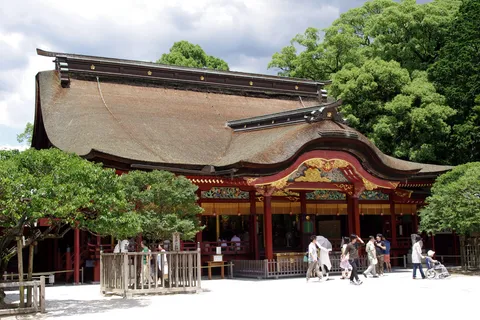
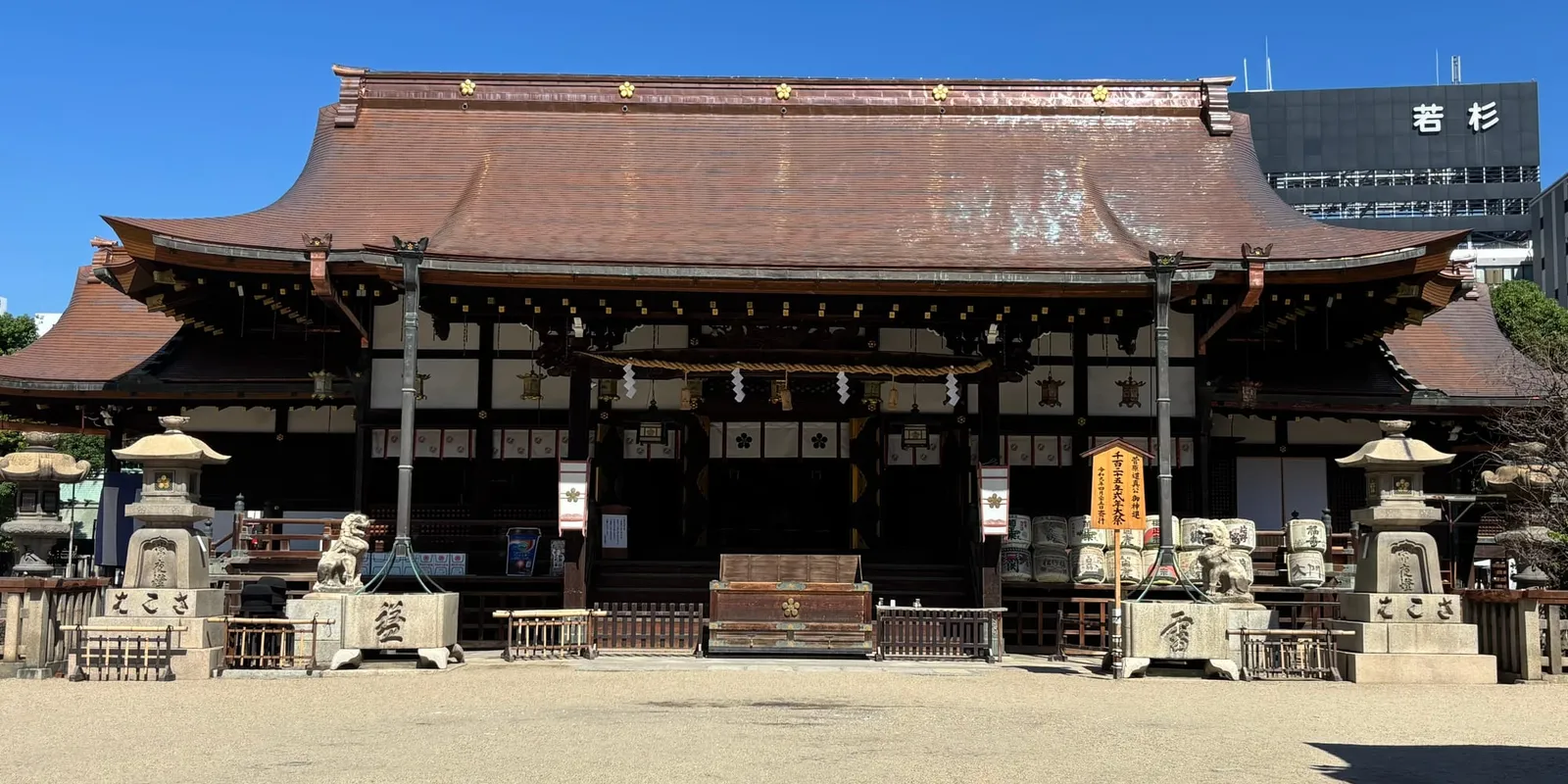
The main hall at the heart of the grounds was rebuilt in 1843. Entering through the Omote-daimon (front gate), you see a large hall with a sweeping roof ahead. The grounds also hold more modern buildings such as the Baikaden and Sanshuden, which were registered as national cultural properties in 1999, along with the Hanjotei rakugo theater and many subsidiary shrines including the Daishogun Shrine — a shrine forest in the middle of the city, surrounded by buildings.
The plum, so closely tied to Michizane, is also treasured here, and plum trees grow in the grounds. A Plum Festival is held from mid-February to early March with displays of bonsai plums and swords (admission is charged; in 2025 it ran February 11 to March 2, with adult tickets at ¥700, and may vary by year).
Visiting Tips
Osaka Tenmangu is in central Osaka and easy to reach by train. You can walk to it along the Tenjinbashi-suji shopping street from either JR Tozai Line Osaka-Temmangu Station or Osaka Metro Minami-morimachi Station (Tanimachi and Sakaisuji lines), so it is pleasant to browse the shops on the way. There is parking, but it can be unavailable when full or during ceremonies, so taking the train is safest at New Year and during Tenjin Matsuri.
The amulet office and goshuin counter are open 9:00 AM–5:00 PM, and a standard goshuin is ¥500. Prayer services are received 9:00 AM–5:00 PM (last reception 4:30 PM) at the amulet office, and usually take around 60 minutes from reception (longer during festival periods). Photography is prohibited inside the main hall and the corridors connected to it.
Annual Festivals
- Tenjin Matsuri (July 24 Yomiya, July 25 Honmiya): A festival with a history of a thousand years, said to have begun in 951 when a sacred spear was floated from the shore in front of the shrine. Counted as one of Japan’s three great festivals and a defining summer event in Osaka, it involves rites for about a month from late June to July 25. On the 24th, the eve festival includes the Hokonagashi ritual, and on the 25th the main festival includes the main service, the transfer of the deity’s spirit, the land procession, the boat procession, and votive fireworks. The Osaka tourism bureau describes about 3,000 costumed participants and more than 100 boats taking part.
- Tenma Tenjin Ebisu Festival (January 9–11): Held over three days (Yoi-Ebisu, Hon-Ebisu / the Toka Ebisu Grand Festival, and Nokori-fuku), with Fukumusume “fortune maidens” giving out lucky bamboo branches and tokens. It revives the Edo-period “Toka Ebisu,” brought back in 2006 with the opening of the Hanjotei theater.
- Hatsu-Tenjin Baikasai and Uso-kae Ritual (January 24–25): The first Tenjin observance of the year, with a plum blossom rite and the Uso-kae ritual.
- Setsubun Festival (February 3): A Setsubun observance held together with a rite at the Reifu Shrine.
- Autumn Grand Festival and Yabusame (October 25): The shrine’s autumn festival, at which yabusame mounted archery is offered.
- Shu-Tenjin (December 25): The year’s final Tenjin observance, when ema plaques are burned in a purification rite.
Nearby Food & Sightseeing
- Tenma Tenjin Hanjotei: A permanent Kamigata rakugo theater on the north side of the Osaka Tenmangu grounds. Opened in 2006, it offers entertainment such as magic as well as rakugo.
- Tenjinbashi-suji Shopping Street: A shopping street running from Tenjinbashi 1-chome to 7-chome, about 2.6 km long and known as the longest in Japan. It is said to have grown up as the approach to Osaka Tenmangu, and is lined with restaurants and shops.
- Okawa River (around Tenjinbashi): The river where many boats pass in the Funatogyo on the night of the Tenjin Matsuri main festival. The land procession reaches the north end of Tenjin Bridge, where the deity is transferred to a boat.
Frequently Asked Questions
- Q. What are the visiting hours and is there an admission fee?
- A. There is no admission fee for the grounds. The amulet office is open 9:00 AM–5:00 PM, and prayer services are also received 9:00 AM–5:00 PM (last reception 4:30 PM). The gates open at 5:30 AM and close at 6:30 PM according to the shrine's summer-hours notice, and hours may vary by season.
- Q. When can I get a goshuin at Osaka Tenmangu?
- A. From 9:00 AM to 5:00 PM. A standard goshuin is ¥500. Limited-edition goshuin may be offered around Tenjin Matsuri and the New Year.
- Q. Is there parking?
- A. Yes, there is visitor parking, said to hold about 20 cars and entered from the Ebisu Gate on the south side. It may be unavailable when full or during ceremonies, so public transport is recommended at New Year and during Tenjin Matsuri.
- Q. When is Tenjin Matsuri held?
- A. It centers on July 24 (the eve festival, Yomiya) and July 25 (the main festival, Honmiya) every year. Rites take place for about a month from late June to July 25, and on the 25th there are the land procession (Rikutogyo), the boat procession (Funatogyo), and votive fireworks. It is counted as one of Japan's three great festivals.
- Q. When was Osaka Tenmangu founded?
- A. It was founded in 949 (the 3rd year of the Tenryaku era) by imperial order of Emperor Murakami. The site is traced back further to the Daishogun Shrine, enshrined in 650 when the Naniwa Nagara-Toyosaki Palace was built.
Plan Your Visit
Before you go, you can book a stay and get your shrine-visit items ready.
Amazon links open Amazon.co.jp (Japan) in English; whether an item ships overseas depends on the product.
※ Contains ads (PR). Links open external sites such as Amazon, Rakuten, Trip.com and Booking.com.