History
Sada Shrine (Sada Jinja) stands in Sada-miyauchi, Kashima-cho, Matsue, Shimane. The reading comes from Japanese Wikipedia. The shrine name is written 佐太, while the place name and the performing art use the character 佐陀, and the official site also uses the title “Sada Taisha” (佐陀大社). According to the official site, it appears in the Izumo no Kuni Fudoki as a shrine “at the foot of Kannabiyama,” and it has been revered as the Second Shrine of Izumo Province and one of the three great shrines of Izumo.
The official site says twelve deities are enshrined across the three main halls, and that the chief deity, Sada no Okami, is one of the four most venerated deities of Izumo and the same deity as Sarutahiko no Okami. It describes the deity as one of good fortune and prosperity who leads people to happiness.
In the medieval period, the shrine is said to have received the sacred tomb of Izanami from Mount Hiba. Because of this, the eight million gods are said to gather here in the tenth lunar month to remember their mother goddess, and the shrine has also been called the “shrine of the gods’ presence” (Kamiari no Yashiro). According to the official site, at its height it held 7,000 kan of land and 224 priests and held more than seventy festivals a year. During the Edo period it supervised shrines in part of Izumo Province. It declined with the reforms of 1870 (Meiji 3) but was ranked as a Kokuhei Shosha (small state-funded shrine) in 1928 (Showa 3), the official site explains.
Highlights
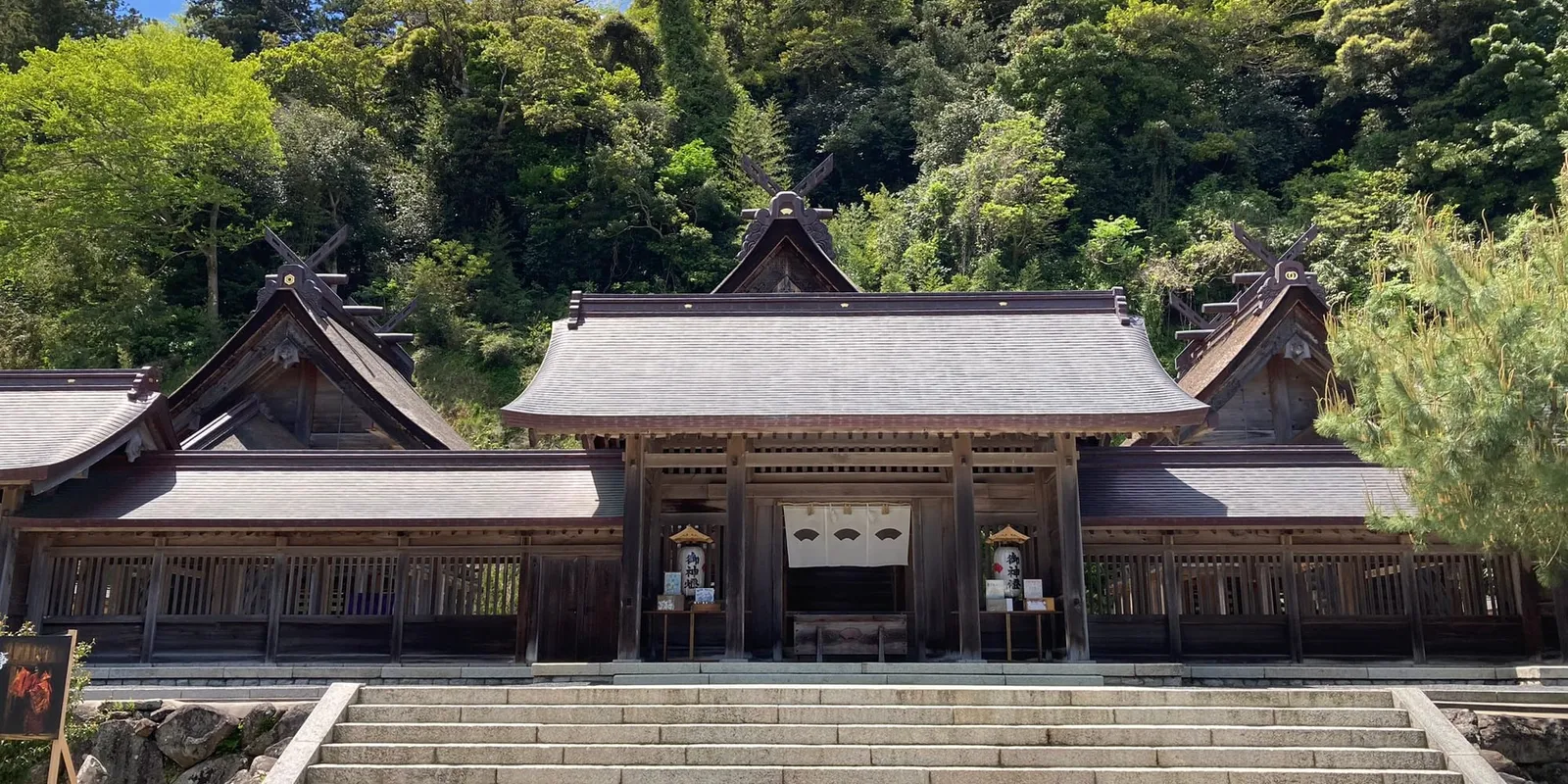
The main attraction is the main hall complex. Three Taisha-zukuri buildings stand side by side in the “sanden heiritsu” style and are a national Important Cultural Property (per Matsue City). The official site also points to the idea of placing the South and North halls symmetrically on either side of the central hall, and says the South Hall on the left is built in reverse of the usual Taisha-zukuri structure and has no counterpart elsewhere. Japanese Wikipedia and other sources give the year of construction as 1807.
The other core attractions are the Kamiari Festival, held every year from November 20 to 25, and the Gozagae Festival and Sada Shinno in September. The official site introduces the Kamiari Festival here as the one documented as the oldest in Izumo, with its procedure nearly identical to a record about 500 years old. Sada Shinno is the collective name for the Shichiza Shinji, Shikisanban and Shinno performed the day after the Gozagae Festival. According to the official site, it was designated a national Important Intangible Folk Cultural Property in May 1976 (Showa 51) and inscribed on UNESCO’s Intangible Cultural Heritage list on November 28, 2011.
Within the grounds is the auxiliary shrine Tanaka Shrine, and the official amulet page introduces a “bad-ties-cutting and good-ties-binding” amulet linked to the goddesses Konohanasakuya-hime and Iwanaga-hime.
Visiting Tips
The official site does not give visiting hours for the grounds. Phone inquiries are taken 8:30 AM–5:00 PM and prayer requests are accepted 9:00 AM–5:00 PM. Prayers start from ¥5,000, formal worship in the main hall enclosure (reservation required) from ¥10,000, and the Akugiri prayer (reservation required), a traditional Izumo-region rite, from ¥80,000.
Whether goshuin are offered, and their fee, are not given on the pages of the official site that I checked, so please call the shrine office to confirm along with the hours for amulets. A combined good-ties and bad-ties amulet is available for ¥1,000.
It is about 25 minutes by Ichibata Bus from JR Matsue Station (bound for Etomo) to “Sada Jinja-mae,” right at the shrine. Parking has room for 60 standard cars and about 10 large buses, but the official site notes that the shrine is busy with visitors during the Kamiari Festival.
Annual Festivals
These are the main festivals in the official calendar (it gives no year, so only dates are shown).
- Saitan-sai (January 1) and Nanakusa-sai (January 7): Twenty-four traditional offerings are presented, and seven-herb rice porridge is cooked.
- Setsubun-sai (February 3) and Kudagayu-sai (February 15): In the Kudagayu-sai, red-bean porridge is cooked with bamboo tubes in it, and how the porridge packs in is used to predict that year’s harvest.
- Naorai-sai (May 3, from 2:00 PM): A cup ceremony, a lion dance and the Sarutasanban dance are performed. Tradition holds that having the lion bite your head brings a life free of illness.
- Kamiari-sai Urazuki-sai (May 20–25): The “reverse-month” version of the November festival.
- Otaue-sai (July 15): A rice-planting rite praying for next year’s harvest.
- Gozagae-sai (September 24) and Reisai (September 25): The Gozagae-sai, a major rite in which the mats at the divine seats are replaced, begins at 8:00 PM. On the night of the Reisai (from 7:00 PM), Shikisanban and Shinno are performed.
- Kamiari-sai (November 20–25): Popularly called “Oimi-san.” The Kamimukae rite is at 8:00 PM on the 20th, the Niiname-sai on the 23rd, and the Karasade rite at 8:00 PM on the 25th. The official site says the tradition that the gods stop at Izumo Taisha first and then come here is a mistaken account. On November 30 the Shiwagami-okuri rite sends off any gods who did not leave on the 25th.
- Joya-sai (December 31)
During the Kamiari Festival, formal worship inside the main hall enclosure and the Akugiri prayer are not available. Check the festival calendar on the official site for the latest schedule.
Nearby Food & Sightseeing
- Kashima Taku-no-yu: A hot-spring bathing facility that Matsue City’s publication lists as a stop to combine with Sada Shrine on a “Kashima tour.” Check the facility’s official site for hours and closing days before you go.
Frequently Asked Questions
- Q. What are the visiting hours?
- A. Visiting hours for the grounds are not given on the official site. It says phone inquiries are taken 8:30 AM–5:00 PM and prayer requests are accepted 9:00 AM–5:00 PM. Booking ahead is preferred for prayers, and formal worship requires a reservation. It is safest to call (0852-82-0668) before you go.
- Q. Can I get a goshuin at Sada Shrine?
- A. Whether goshuin are available, and their fee and hours, are not given on the pages of the official site that I checked. The official amulet page lists a "bad-ties-cutting and good-ties-binding" amulet (¥1,000) and a wish-split tally (¥1,000, or ¥1,800 for both). Please ask the shrine office by phone about goshuin.
- Q. How do I get there, and is there parking?
- A. Per the official site, take an Ichibata Bus bound for Etomo from JR Matsue Station for about 25 minutes and get off at "Sada Jinja-mae," right at the shrine. Parking is listed as 60 standard cars or about 10 large buses. No fee is mentioned.
- Q. What is special about the main halls?
- A. According to Matsue City, the main halls are three grand Taisha-zukuri buildings standing side by side in a rare "sanden heiritsu" arrangement, and they are designated a national Important Cultural Property. The one on the left (the South Hall) is a mirror image of the usual Taisha-zukuri floor plan, which the city describes as unique to Sada Shrine.
- Q. When is the Kamiari Festival?
- A. The official festival calendar gives November 20–25. The Kamimukae rite (welcoming the gods) is at 8:00 PM on the 20th, the Niiname-sai on the 23rd, and the Karasade rite (seeing the gods off) at 8:00 PM on the 25th. During these days formal worship inside the main hall enclosure and the Akugiri prayer are not available.
Plan Your Visit
Before you go, you can book a stay and get your shrine-visit items ready.
Amazon links open Amazon.co.jp (Japan) in English; whether an item ships overseas depends on the product.
※ Contains ads (PR). Links open external sites such as Amazon, Rakuten, Trip.com and Booking.com.