History
Hinomisaki Shrine stands at the western tip of the Shimane Peninsula, in Hinomisaki, Taisha-cho, Izumo. Its name is read “Hinomisaki-jinja.” According to the official site, it consists of two shrines: the upper shrine Kami-no-miya, which enshrines Susanoo no Mikoto, and the lower shrine Hishizumi-no-miya, which enshrines Amaterasu Omikami. The official site writes the second name with the character 沉; it is also commonly written 日沈宮.
Tradition says Kami-no-miya was moved to the present site from Kakushigaoka in the 13th year of Emperor Annei. Hishizumi-no-miya is said to have moved to its present site around 948 (Tenryaku 2); before that it stood on Fumishima island, about 200 m to the west. Izumo City’s introductory page explains that the shrine is an ancient one recorded as “Misaki no Yashiro” in the Izumo Fudoki and as “Misaki-sha” in the Engishiki. The official site adds that Hinomisaki appears in the late-Heian song collection Ryojin Hisho and was known in the capital as a sacred place of mountain asceticism.
The official site says that in the Sengoku period the shrine had influence comparable to Izumo Taisha and was revered by the court, the shogunate and daimyo as the guardian shrine of Izumo Province. The present group of buildings was begun in 1635 (Kan’ei 12) on the order of Tokugawa Iemitsu, finished in 1643, and the transfer of the deities took place the following year. Among the shrine’s treasures is the National Treasure “Shiraito-odoshi Yoroi” armor; according to a shrine notice, the original is currently on deposit at the Tokyo National Museum. In the Agency for Cultural Affairs’ Japan Heritage story “Izumo, the Holy Land Where the Sun Sets,” Hishizumi-no-miya is also introduced as a sacred place associated with the setting sun.
Highlights
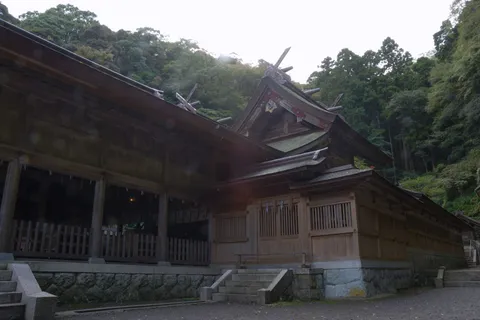
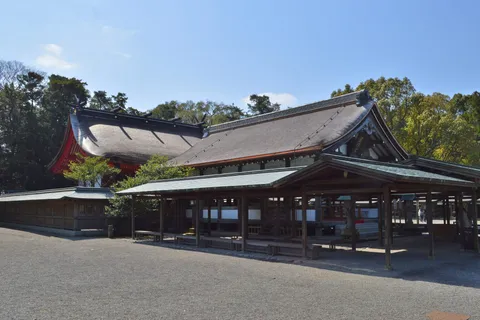
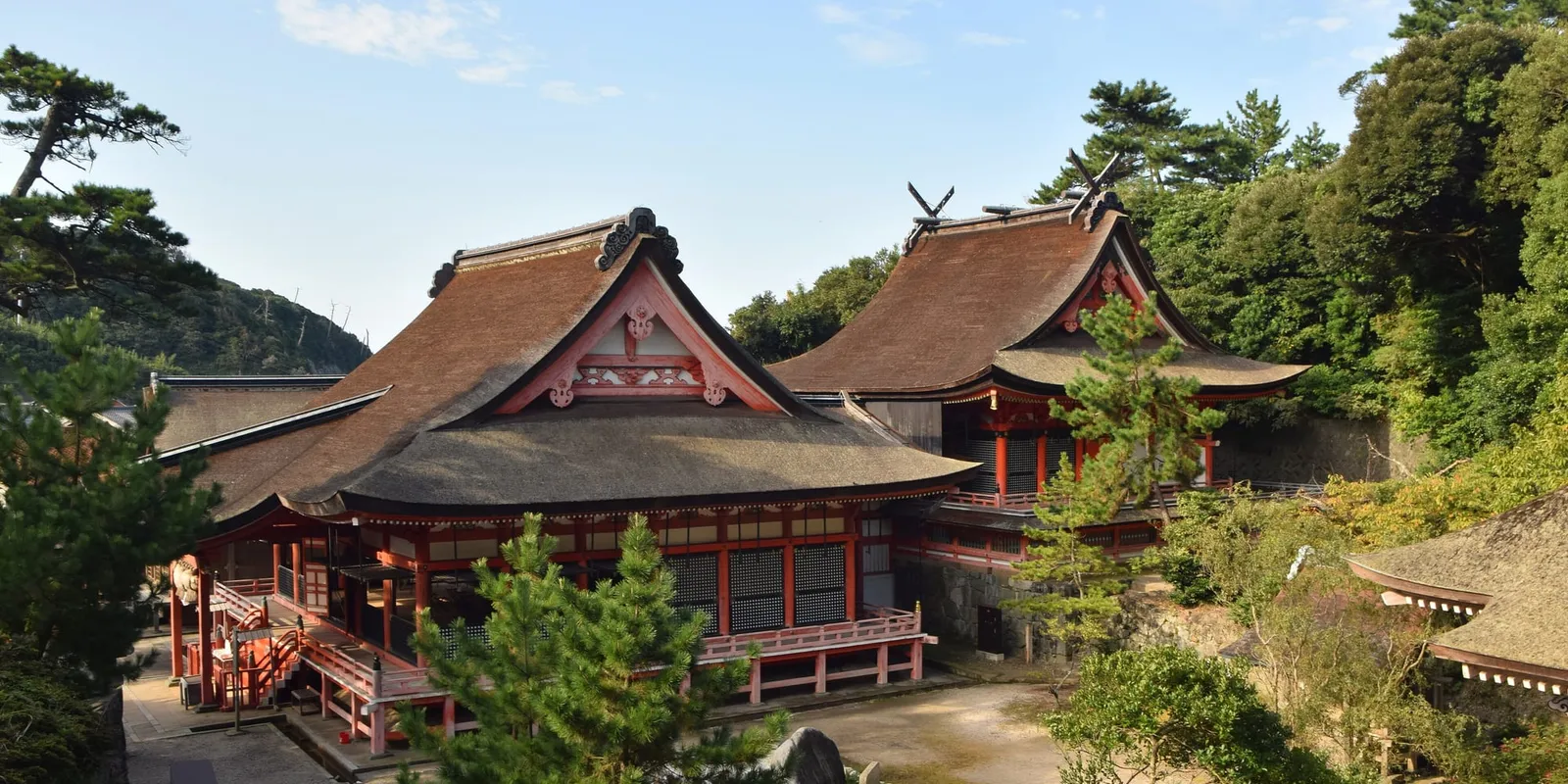
The precincts lie at the foot of a hill, and the vermilion halls, surrounded by a two-story gate and a covered corridor, stand out against the green pines. The main hall, offering hall and worship hall are arranged to make use of the changes in ground level, so the two shrines, Hishizumi-no-miya and Kami-no-miya, stand side by side. According to the official site, 14 buildings and 2 torii in the precincts were designated national Important Cultural Properties in 1953, with 5 stone lanterns and related drawings and documents designated as attached items.
The brightly colored carvings, such as those in the frog-leg struts and gable decorations, are another highlight. The official site says there are more than 100 carvings of animals, plants, dragons and other creatures, and that no two designs are the same. The nose carvings of the front porch use a lion design at Hishizumi-no-miya and an elephant design at Kami-no-miya. The shrine crest is the three oak leaves, and the precincts have a crest stone shrine associated with the fossilized oak leaf from which the crest is said to derive.
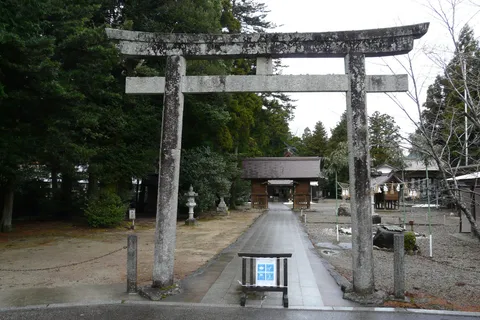
Stone torii stand at the seaside on the west and at the entrance on the east. According to the official site, they were built for worshippers arriving by boat and for those using the old overland route. Offshore to the west lies Fumishima island; according to Shimane Prefecture’s tourism information, it is a breeding ground for black-tailed gulls designated a national Natural Monument, and you cannot land there.
Visiting Tips
According to the official site, the amulet office is open 8:30 AM–4:50 PM and prayer services are accepted 8:30 AM–4:00 PM, with no reservation needed. A service takes about 20 minutes, and the fee starts at ¥3,000. No prayer services are held during the festival period of August 5–7 and on some other days. For worship etiquette, the site describes two bows, two claps and one bow after making your offering. Pets are allowed in the grounds as long as they do not disturb others, but not inside the halls or the shrine office.
The goshuin costs ¥500 or more at the amulet office (official notice dated September 27, 2026). Only pre-written goshuin are offered during New Year’s, Setsubun, long holiday periods, August, November and the year-end, and in the tenth lunar month only the special goshuin is available. Since you must wait at the counter until yours is finished, allow some extra time.
There are no restrooms in the precincts; the official site points to the public toilets at the bus stop or along the path to the lighthouse. The visitor lot has limited space and the road beside the shrine is narrow, so the official site advises using the public lot in front of the torii. The lighthouse is about 15 minutes on foot along the coastal path, or about 4 minutes on foot from the prefectural parking lot.
Annual Festivals
- Mekari Shinji (5th day of the 1st lunar month): A rite based on the legend that a seabird left seaweed at the shrine, which then became wakame. Priests and parishioners cross by boat, harvest new wakame and offer it before the deity, praying for a good catch. The Hinomisaki wakame harvest begins only after this rite (official site). In 2026 it fell on February 21.
- Spring Grand Festival (April 3): Listed in the official festival calendar.
- Reitaisai (August 7): The most important festival of the year. The evening Shinko-sai is also called the “Sunset Festival”: a portable shrine travels from the shrine to the Hiwazaki otabisho while priests perform rites on Fumishima. In 2026 the Shinko-sai was at 6:00 PM. In August, goshuin are pre-written only, and prayer services are not held August 5–7.
- Autumn Grand Festival (October 17): Listed in the official festival calendar.
- Kamimukae-sai, Ryuja Shrine festival and Kamiokuri-sai (11th, 14th and 17th days of the 10th lunar month): Listed in the official calendar as events of Kamiarizuki, the month when the gods are said to gather in Izumo.
- Izumo Kagura regular performances: Advance-booking performances held in the worship hall of Hishizumi-no-miya. In 2026 they were scheduled on Saturdays from June to November, with prices from ¥4,000 for adults (Izumo Tourism Association). Schedules change from year to year.
Check the “Festival Calendar” on the official site for the latest dates. The shrine has also announced that, from October 16 to December 13, 2026, a restored replica of the Shiraito-odoshi armor is on display at the Matsue Historical Museum, and from October 9 to November 29, 2026, the “Hinomisakisha Zoei Kanjinki” scroll (a prefectural cultural property) is on display at the Shimane Museum of Ancient Izumo.
Nearby Food & Sightseeing
- Hinomisaki Lighthouse: A white stone lighthouse completed in 1903. According to Shimane Prefecture, the interior is open to the public, with views of the Sea of Japan from the top. It is about a 15-minute walk from the shrine along the coast.
- Fumishima Island: A black-tailed gull breeding ground, visible from the southwest coast near the shrine, and a national Natural Monument. According to Shimane Prefecture, you can see it from Torimidai, a lookout along the walking path toward the lighthouse.
- Inasa Beach: According to the Izumo Tourism Association, the Hinomisaki Kaido road, which runs from Inasa Beach to Hinomisaki Lighthouse, offers views of the shrine.
- Izumo Taisha: About 18 minutes away by car, according to the Izumo Tourism Association.
Frequently Asked Questions
- Q. What are the visiting hours and prayer hours?
- A. According to the official site, the amulet office is open 8:30 AM–4:50 PM and prayer services are accepted 8:30 AM–4:00 PM (reception pauses 12:00–1:00 PM except at busy times). No reservation is needed, a service takes about 20 minutes, and the fee starts at ¥3,000. Prayer services are not held during the annual festival period (August 5–7) or on the day of the Mekari Shinji rite. The official site gives no visiting hours for the grounds themselves, and the Izumo Tourism Association says you can pray outside the amulet office hours.
- Q. Can I get a goshuin, and what does it cost?
- A. Yes. According to the official notice dated September 27, 2026, goshuin are available at the amulet office (8:30 AM–4:50 PM) for ¥500 or more. During New Year's, Setsubun, long holiday periods, August, November and the year-end, only pre-written goshuin are offered, and in Kamiarizuki (the tenth lunar month) only the special Kamiarizuki goshuin is available. If you leave three or more goshuin books, they are all pre-written, and you must wait at the counter until they are finished. Handling can change without notice.
- Q. How do I get there, and is there parking?
- A. The Izumo Tourism Association gives about 60 minutes by bus from JR Izumoshi Station or about 20 minutes from the Izumo Taisha bus terminal. By car it is about 28 minutes from Izumo IC on the San'in Expressway or about 18 minutes from Izumo Taisha, and one-lane alternating traffic was noted on Prefectural Route Daisha-Hinomisaki (Izumo Tourism Association; shrine traffic notice). There is a shrine visitor lot (no large vehicles), and because the road beside the shrine is narrow, the official site advises using the public lot in front of the torii. The visitor lot is closed August 5–8.
- Q. What are Hishizumi-no-miya and Kami-no-miya, and are they Important Cultural Properties?
- A. According to the official site, Hinomisaki Shrine consists of two shrines: the lower shrine Hishizumi-no-miya, which enshrines Amaterasu Omikami, and the upper shrine Kami-no-miya, which enshrines Susanoo no Mikoto. The official site says 14 buildings and 2 torii in the precincts were designated national Important Cultural Properties in 1953. They were built in the Kan'ei era of the early Edo period on the order of Tokugawa Iemitsu.
- Q. When is the annual festival?
- A. The official festival calendar lists the Reitaisai (annual grand festival) on August 7 every year and calls it the most important festival of the year. In the evening a Shinko-sai procession takes a portable shrine to the Hiwazaki otabisho, which is why it is also called the "Sunset Festival." The 2026 schedule was rites at 10:00 AM, kagura at 2:00 and 4:00 PM, the portable shrine at 5:30 PM and the Shinko-sai at 6:00 PM, and the public was invited to join the procession.
Plan Your Visit
Before you go, you can book a stay and get your shrine-visit items ready.
Amazon links open Amazon.co.jp (Japan) in English; whether an item ships overseas depends on the product.
※ Contains ads (PR). Links open external sites such as Amazon, Rakuten, Trip.com and Booking.com.