History
Takaoka Shrine stands in Kaminakatsui, Maniwa City, Okayama Prefecture. Its name is written with the variant character 髙 (the “ladder-top” form of 高). According to the official website, the deities were first invited to nearby Mt. 髙丸山 in 904 (Engi 4, during the reign of Emperor Daigo) and moved to the present site on Mt. 宝宮山 in 1168. The shrine later suffered a fire and was rebuilt in 1787. The head priest’s greeting describes it as a village shrine (gosha) with a history stretching back to the Heian period.
Five deities are enshrined: Emperor Korei (Oyamato-nekohiko-futoni no Mikoto), Amaterasu Omikami (Ohirume no Muchi no Mikoto), Ame no Koyane no Mikoto, Emperor Ojin (Homudawake no Mikoto), and Takemikazuchi no Mikoto. They were once collectively known as “Gosha Daimyojin.”
A local legend says that when the shrine buildings once burned down, a woman carried the deity to safety, and the deity promised in gratitude, “From now on I will be a protector of women.” For this reason the shrine is cherished as a place for women, with blessings for safe childbirth and for having children.
According to the shrine’s official announcement, the shrine was introduced for about one minute (from around the 24:30 mark), focusing on the sacred cedar, on the Nippon TV program “元日しゃべくり007×上田と女が吠える夜と初コラボ4時間SP!!” (a New Year’s Day four-hour special), broadcast on January 1, 2026.
Highlights
Heian Cedar (sacred tree): This giant cedar stands at the entrance to the approach. It is estimated to be 850 to 950 years old or more, about 30 meters tall, with a trunk circumference of 8.65 meters, and is a Maniwa City Natural Monument. Look up and you will soon spot a branch shaped like a dragon. According to the official website, it was not made by human hands but was shaped naturally over many years by wind and rain; it drew wide attention after a local Okayama weather program featured it, with people saying a dragon had appeared in the sacred tree. On the opposite side, a white branch shaped like a snake can also be seen. The base of the tree splits into two trunks, and you can peer from above into the large hollow inside.
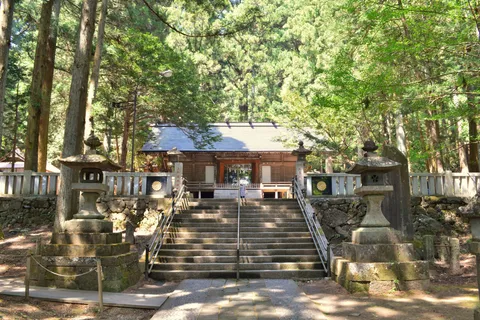
Great Torii and approach: The great torii visible from Route 313 is said to be the second largest in Okayama Prefecture and serves as the shrine’s landmark. The approach has 232 stone steps, and climbing the quiet, tree-lined path opens suddenly onto the hilltop precincts. A road also leads by car to the top.
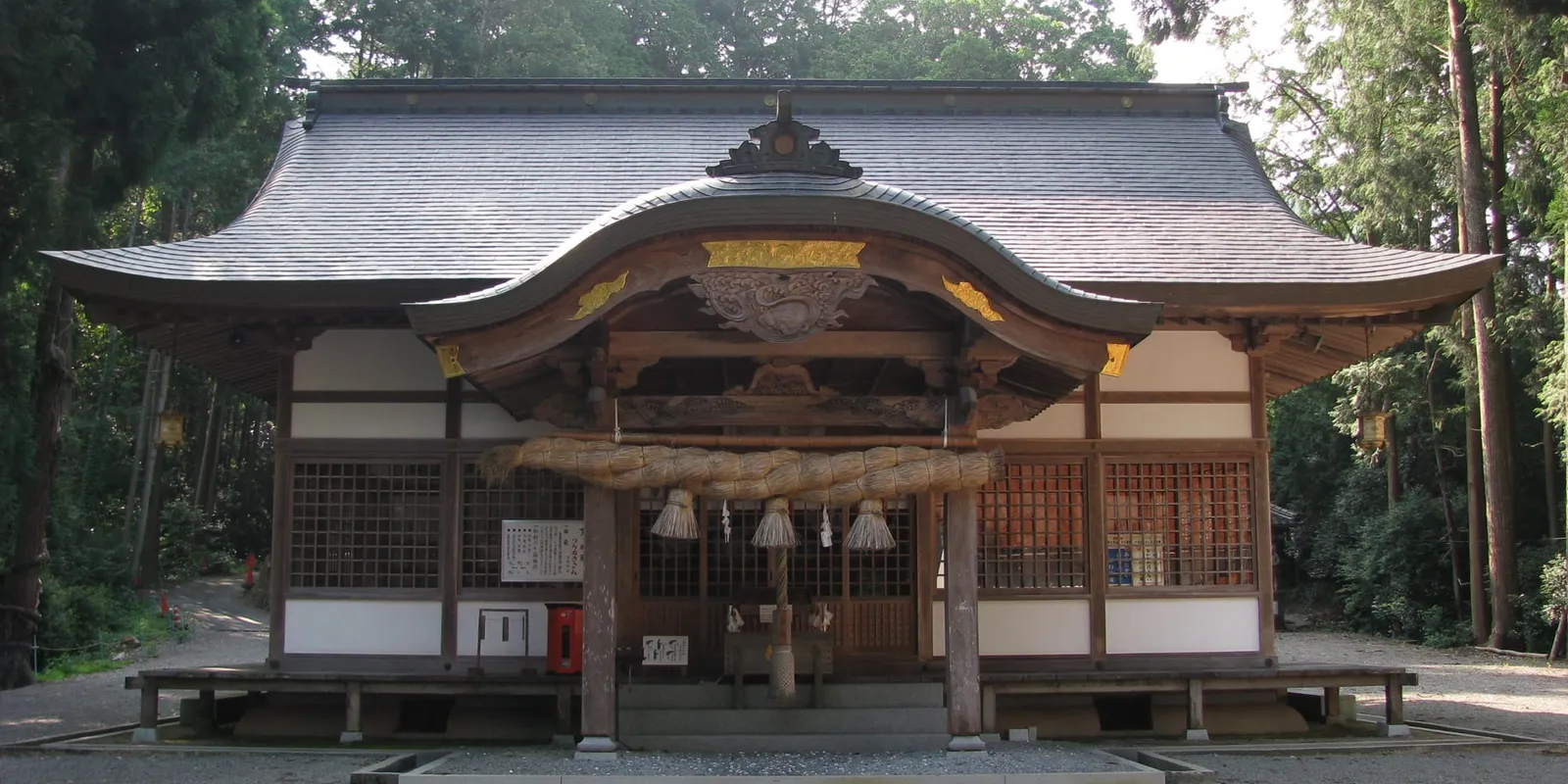
Main hall and worship hall: Five deities are enshrined in the main hall, whose pillars and walls bear careful carving by craftsmen of the past. According to the Okayama prefectural tourism association, the main hall is built in the irimoya style with a copper-plate roof and is a city-designated cultural property. The worship hall displays calligraphy written at the age of four (by East Asian count) by Yamada Hokoku, known for his reforms of the Bitchu Matsuyama domain, along with hanging scrolls introducing three swords dedicated in prayer for peace.
Other shrines and halls on the grounds: There is Shijuyaku Shrine, which wards off misfortune, an Inari shrine split from Kyoto’s Fushimi Inari, Hinomisaki-gu dedicated to the fire deity, and the Ema Hall and Kokuzo-do, which houses the bodhisattva Kokuzo Bosatsu, who grants wisdom (the ceiling is covered with votive plaques and a Yamata no Orochi serpent). The shrine also keeps a wooden sacred horse known as a “winning horse.”
Visiting Tips
The official website lists no shrine office hours. The Okayama prefectural tourism association gives roughly 9:00 AM–5:00 PM, but if you want a prayer service or goshuin, it is best to call ahead at +81-866-52-3659. Prayers are offered for purification from misfortune, household safety, business prosperity, exam success, recovery from illness, first shrine visits for babies, Shichi-Go-San, and car purification (traffic safety), among others, and proxy visits and prayers by mail are also accepted.
Goshuin are available, along with an original goshuin book made from Ibara denim with a three-dimensional embroidery of the sacred tree’s dragon and snake. According to the official website, it cannot be mailed or set aside and is issued only to people who visit the shrine in person. The goshuin fee is not listed on the official website, so please ask at the shrine office.
By car, the shrine is about 10 minutes from Hokubo IC on the Chugoku Expressway via Route 313, or about 12 minutes from Ukan IC on the Okayama Expressway. By public transport, take the JR Hakubi Line from Okayama Station to Bitchu-Takahashi Station, then a Bihoku Bus to the “Takaoka” stop. Buses are infrequent, so check the timetable in advance. The approach has 232 steps; if you are unsure about the climb, use the road that leads by car to the top.
Annual Festivals
- New Year’s Day Festival and first shrine visit (January 1): The 2026 announcement listed prayer services and goshuin from midnight, a children’s Bitchu Kagura performance, and a rice-cake scattering.
- Spring Festival, Toshigoi-sai (April 19): Reports the start of the farming year to the deities and prays for a good harvest and good health. People who are not parishioners may attend.
- Nagoshi-sai (around the end of the sixth month of the old calendar): A purification ritual to cleanse the sins and impurities of the past half year, with passing through a ring of reeds (chinowa) and the burning of paper figures (hitogata). In 2026 the reed ring was set up on August 6, with the eve festival on August 11 and the main ritual on August 12.
- Autumn Grand Festival, Reisai (third Sunday of October): A harvest thanksgiving festival and the shrine’s main annual festival. In 2026 it is held on Sunday, October 18, with the ceremony from 10:00 AM, followed by a procession carrying the portable shrine around the area on a truck (canceled in rain) and a rice-cake scattering from about 3:30 PM. People who are not parishioners may attend.
- Niiname-sai (November 23): A harvest thanksgiving rite for the year’s crops.
Nearby Food & Sightseeing
- Bitchu Matsuyama Castle: A mountain castle in neighboring Takahashi whose surviving main keep is designated an Important Cultural Property of Japan. It is reportedly about 10 minutes by car from Bitchu-Takahashi Station, the rail and bus starting point for visiting Takaoka Shrine.
- Hokoku Station: A station in the Nakai district of Takahashi, named after Yamada Hokoku, whose calligraphy is kept in the shrine’s worship hall. The official website mentions it as being near the shrine.
- Yubara Onsen and Sunayu: A hot-spring area in the same city of Maniwa, known for Sunayu, a free mixed-gender open-air bath on the riverbank just below the dam. It is best reached by car if you want to combine it with a shrine visit.
Frequently Asked Questions
- Q. What are the visiting hours and when is the shrine office open?
- A. The official website lists no office hours, but the Okayama prefectural tourism association gives roughly 9:00 AM–5:00 PM for the shrine office. If you want a prayer service or goshuin, it is safest to call ahead at +81-866-52-3659.
- Q. Can I get a goshuin at Takaoka Shrine?
- A. Yes, goshuin are mentioned in the official announcements, including acceptance from midnight on New Year's Day 2026. The shrine also has an original goshuin book made from Ibara denim and embroidered with the sacred tree's dragon and snake. It cannot be mailed or reserved and is issued only to people who visit in person. The fee is not listed on the official website, so please ask at the shrine office.
- Q. Is there parking?
- A. The official website says the parking area holds 30 cars (some tourism listings say 50). The approach has 232 stone steps, but a road also leads by car to the top.
- Q. What is the Heian Cedar (Heian-sugi)?
- A. It is the shrine's sacred tree, said to have watched over the area since the Heian period. It is estimated to be 850 to 950 years old or more, about 30 meters tall with a trunk circumference of 8.65 meters, and is a Maniwa City Natural Monument. One of its branches has naturally taken the shape of a dragon, and a white branch on the opposite side looks like a snake.
- Q. Has the shrine been featured on TV?
- A. According to the shrine's official announcement, it was introduced for about one minute, focusing on the sacred cedar, on the Nippon TV program "元日しゃべくり007×上田と女が吠える夜と初コラボ4時間SP!!" (a New Year's Day four-hour special), broadcast on January 1, 2026.
Plan Your Visit
Before you go, you can book a stay and get your shrine-visit items ready.
Amazon links open Amazon.co.jp (Japan) in English; whether an item ships overseas depends on the product.
※ Contains ads (PR). Links open external sites such as Amazon, Rakuten, Trip.com and Booking.com.