History
Akagi Shrine stands in Miyosawa-machi on the southern foot of Mt. Akagi in Maebashi, Gunma Prefecture. Among the many Akagi shrines enshrined across the Kanto region and beyond, it is counted as one of the shrines considered the original main shrine, and it is also called “Miyosawa Akagi Shrine” to distinguish it from the others. Its deities are Akagi no Kami (the kami of Mt. Akagi), Toyokiirihiko no Mikoto, and Onamuchi no Mikoto. The year of its founding is unknown, but shrine tradition says it began when Toyokiirihiko no Mikoto came to govern the ancient Kamitsukeno Province and enshrined Onamuchi no Mikoto.
Mt. Akagi has long been revered as a mountain where the kami dwell. Classical histories of the Heian period record court ranks being granted to the “Akagi kami,” and the Engishiki shrine register lists an Akagi shrine as a Myojin Taisha (a major shrine with a particularly venerated deity). However, which shrine those records refer to is still debated: several shrines are candidates, including Odo Akagi Shrine beside Lake Onuma, and Miyosawa Akagi Shrine is considered one of them. It is likewise considered a candidate for the second-ranked shrine of Kozuke Province. Records also show it was involved in a long dispute with the Odo side during the Edo period over the use of the titles “main shrine” and “head shrine.”
The grounds once held two shrines side by side, an East Shrine and a West Shrine, each with its own Buddhist temple. In 1869, during the Meiji-era campaign against Buddhism, the temples were abolished and the two shrines were merged into one. The present main hall and middle gate are said to date from that same year, and under the modern shrine ranking system it was a prefectural shrine.
Highlights
At the start of the approach stands a wooden torii built in the same style as those of Ise Grand Shrine, set among the cedar trees (according to the official website, the present torii was rebuilt in 2021 using a cedar of about 150 years old from the grounds). As you walk over the gravel, you will find a purification fountain where water pours from a dragon’s mouth, surrounded by a sacred pond fed by spring water from Mt. Akagi.
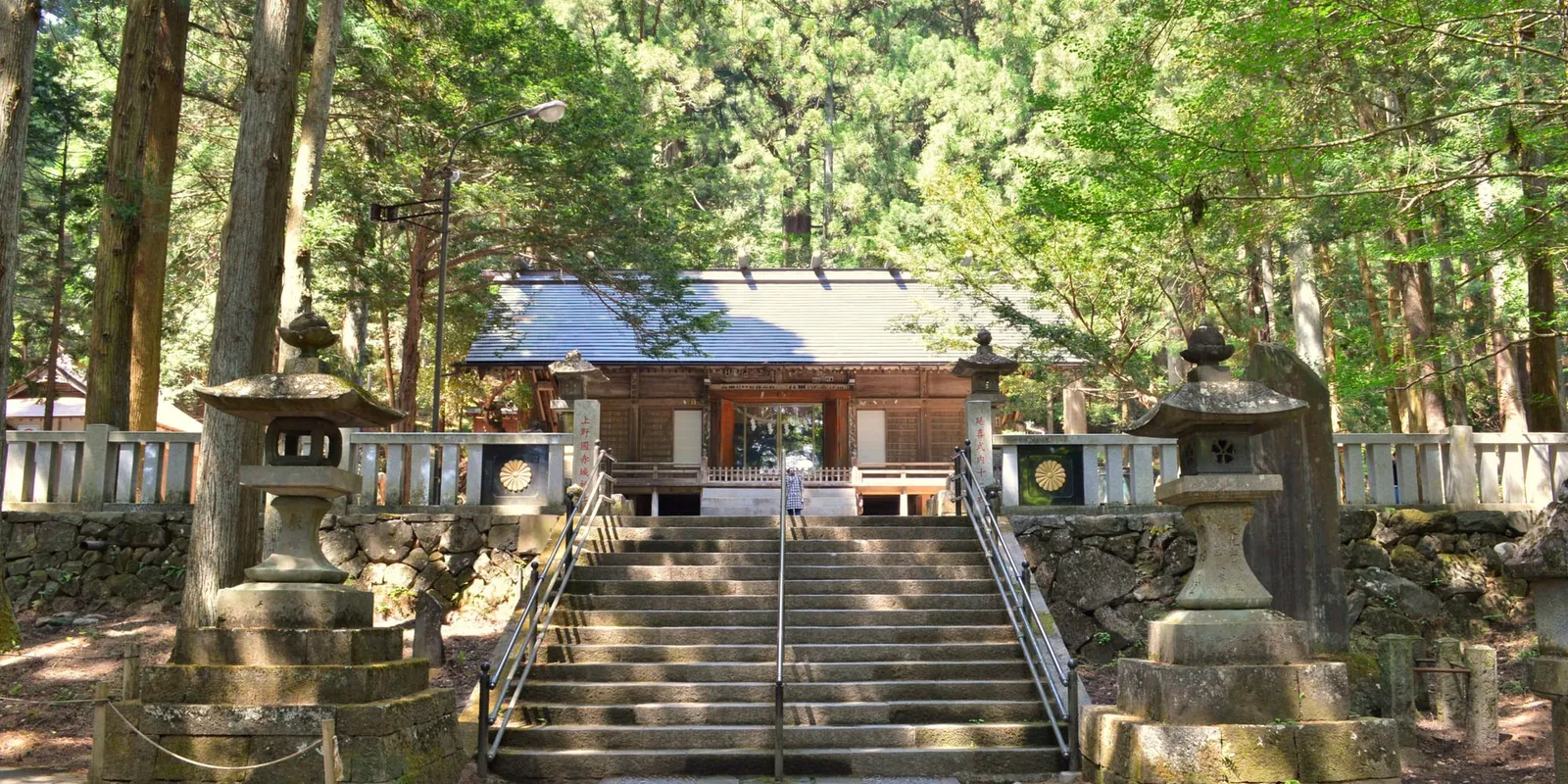
Up a flight of steps behind the worship hall stands the main hall, built in the shinmei-zukuri style, with eight billet-shaped logs (katsuogi) and crossed finials (chigi) on its roof. The main hall and the four-legged middle gate in front of it are both designated Important Cultural Properties of Gunma Prefecture. The ornate shrine (kuden) kept inside the main hall and the outer gate (Somon), about 450–500 m down the approach, are also prefectural Important Cultural Properties. For the Somon, some guides give its construction as 1556, while others cite a 1751 construction record, so accounts differ.
The three giant cedars called “Tawara-sugi,” beside the middle gate in front of the main hall, are said to have been donated by Fujiwara no Hidesato (Tawara Toda), who defeated Taira no Masakado, and are a Gunma Prefectural Natural Monument. If the legend is true, they are over 1,000 years old. Elsewhere on the grounds are the “Jindai Moji” stele, an Important Cultural Property of Maebashi City and a relic of Restoration Shinto, a stone treasure pagoda (Akagi-to) showing the features of the Muromachi period, and the mirror-clad “Kyokai no Torii,” dedicated after being shown in 2023.
Visiting Tips
According to the official website, the shrine office is open 9:30 AM–4:30 PM (varies by season), and some tourism sites list 10:00 AM–4:00 PM. Since this is a shrine in the mountains, it is best to allow plenty of time. Goshuin are available at the shrine office; visitor reports say the fee is ¥500 and they are issued as pre-written paper goshuin (this is not listed on the official website, so please confirm the current practice with the office). One visitor’s blog reports that goshuin are written in directly only in the shrine’s original goshuin book (¥2,000). For prayer services (from ¥5,000) and formal worship (from ¥3,000 for individuals), please contact the shrine by phone first to inquire and book.
Parking is free, with a first lot (60 cars) and a second lot (20 cars). By train, take the reservation-only Furusato Bus (demand bus) from Ogo Station on the Joshin Electric Railway. The ride takes about 20 minutes and the adult fare is ¥300; book by phone (027-283-3122) or through the GunMaaS web service. By car, it is about 30 minutes from the Isesaki interchange on the Kita-Kanto Expressway.
Annual Festivals
- Saitan-sai (January 1) and Shuseie (January 5): New Year ceremonies, at which two sets of Dai-Dai Kagura are offered on the kagura stage at each.
- Kinen-sai (February 19): A festival praying for a good harvest (the date is from reference sources and is not listed on the official website).
- Reitaisai grand annual festival (May 5): The shrine’s grand annual festival, at which 14 sets of Dai-Dai Kagura are offered on the kagura stage. The kagura is said to have been brought from Kyoto in 1684 and is designated an Important Intangible Folk Cultural Property of Maebashi City.
- Summer festival (first day of the 7th lunar month): A one-night festival at which the “Kyokai no Torii” dedicated to the shrine is publicly lit. In 2024 it took place on the night of August 4. Please check the date with the shrine office each year.
- Gojinko (the first Tatsu day of April and of December): A procession in which a portable shrine is carried from Ninomiya Akagi Shrine to Miyosawa Akagi Shrine (reference-source information, not listed on the official website).
- Shinkoku Kansha-sai (December 10): A festival giving thanks for the year’s new rice (likewise not listed on the official website; reference-source information).
Nearby Food & Sightseeing
- Akagi Shrine Approach Pine Avenue: A pine-lined approach about 3.2 km long, said to have been planted in 1612, with around 1,000 pines aged 80 to 400 years. The mountain azaleas at their roots bloom from late April to early May (according to the Maebashi tourism association).
- Akagi Nanmen Senbonzakura: A row of cherry trees about 3.5 km long along the southern slope of Mt. Akagi, usually at its best from early to mid April.
- Odo Akagi Shrine: The other Akagi Shrine, on Kotorigashima island beside Lake Onuma at the summit of Mt. Akagi. It is reached by mountain road from Miyosawa, so allow extra time and check road conditions, which can change with the season.
- Ninomiya Akagi Shrine: Another candidate for the second-ranked shrine of Kozuke Province, in Ninomiya-machi, Maebashi. It is said to be the starting point of the Gojinko procession to Miyosawa.
- Gunma Flower Park: A flower park on the southern foot of Mt. Akagi, about a 10-minute drive from the shrine according to a visitor-oriented article.
Frequently Asked Questions
- Q. What are the visiting hours and is there an admission fee?
- A. According to the official website, the shrine office is open 9:30 AM–4:30 PM (varies by season). Some tourism sites list 10:00 AM–4:00 PM instead, so it is wise to confirm with the shrine office (027-283-1268) before you go. No admission fee is mentioned, and the grounds are described as open to visitors during the day.
- Q. Can I get a goshuin?
- A. Yes, at the shrine office during its opening hours. According to visitor reports, the fee is ¥500 and it is issued as a pre-written paper goshuin (this is not listed on the official website, so please confirm the current practice with the office). Some visitors also report that the shrine's original goshuin book (¥2,000, goshuin fee included) is written in directly.
- Q. Is there parking, and how do I get there by public transport?
- A. There is free parking: 60 spaces in the first lot and 20 in the second. By train, take the reservation-only Furusato Bus (demand bus) from Ogo Station on the Joshin Electric Railway, about 20 minutes, and get off at the Akagi Jinja stop, right by the shrine. The bus must be booked in advance; the reservation line is 027-283-3122.
- Q. What is the difference between Miyosawa Akagi Shrine and the Akagi Shrine at Lake Onuma (Odo Akagi Shrine)?
- A. They are two separate shrines that both go by the name Akagi Shrine, and both are known as candidate sites for a shrine listed in the Engishiki. Miyosawa Akagi Shrine stands on the southern foot of Mt. Akagi (Miyosawa-machi, Maebashi) and is known for its deep cedar grove and a main hall and middle gate designated as Gunma Prefectural Important Cultural Properties. Odo Akagi Shrine sits beside Lake Onuma at the summit of Mt. Akagi. The Miyosawa shrine is also considered a candidate for the second-ranked shrine of Kozuke Province, and records show the two shrines disputed the use of the titles "main shrine" and "head shrine" in the Edo period.
- Q. When is the shrine's grand annual festival?
- A. The grand annual festival (Reitaisai) is held every year on May 5. On that day, 14 sets of Dai-Dai Kagura are offered on the kagura stage.
Plan Your Visit
Before you go, you can book a stay and get your shrine-visit items ready.
Amazon links open Amazon.co.jp (Japan) in English; whether an item ships overseas depends on the product.
※ Contains ads (PR). Links open external sites such as Amazon, Rakuten, Trip.com and Booking.com.