History
Kamikawa Jinja stands in Kaguraoka Park in Asahikawa, Hokkaido. The official site does not give a reading of the name, but Hotokami lists it as “Kamikawa-jinja.” According to the official history, the pioneers who worked to build the town of Asahikawa enshrined Amaterasu-sumeomikami in July 1893 (Meiji 26) on a rise called Yoshitsune-dai, near today’s Asahikawa Station, as the guardian of the Kamikawa region’s development and the tutelary shrine of Asahikawa. As the railway arrived and the town grew, the shrine moved to 8-chome of Rokujo and Nanajo streets in 1898 and to Miyashita-dori 21-chome in 1902. Onamuchi no Okami and Sukunahikona no Okami later joined the enshrined deities. On June 6, 1924 (Taisho 13), it was moved to Kaguraoka, where an imperial villa had once been approved.
The principal deities are Amaterasu-sumeomikami, Onamuchi no Okami and Sukunahikona no Okami. The left seat holds Toyouke-hime, Omononushi, Ame no Kaguyama no Kami, Takeminakata, Homuda-wake and Prince Atsuzane, and the right seat holds Nabeshima Naomasa, Kuroda Kiyotaka, Nagayama Takeshiro and Iwamura Michitoshi. The official site explains that the right seat honors people who rendered special service to the development of Hokkaido, the Kamikawa region and Asahikawa. In 1992 (Heisei 4) a rite to enshrine Iwamura Michitoshi and a ceremony for the shrine’s 100th anniversary were held.
Kaguraoka is where Iwamura Michitoshi and others advanced the idea of placing a “northern capital” in Kamikawa, and where the cabinet decided in December 1889 to build an imperial villa. The “About Kaguraoka” page of the official site goes into detail, including Iwamura’s travel record “Kamikawa Kiko” and a poem composed at Kaguraoka by Nagayama Takeshiro (handed down as a shrine treasure). The villa plan was never carried out, and the official site says it faded away, with the Sino-Japanese and Russo-Japanese wars also intervening.
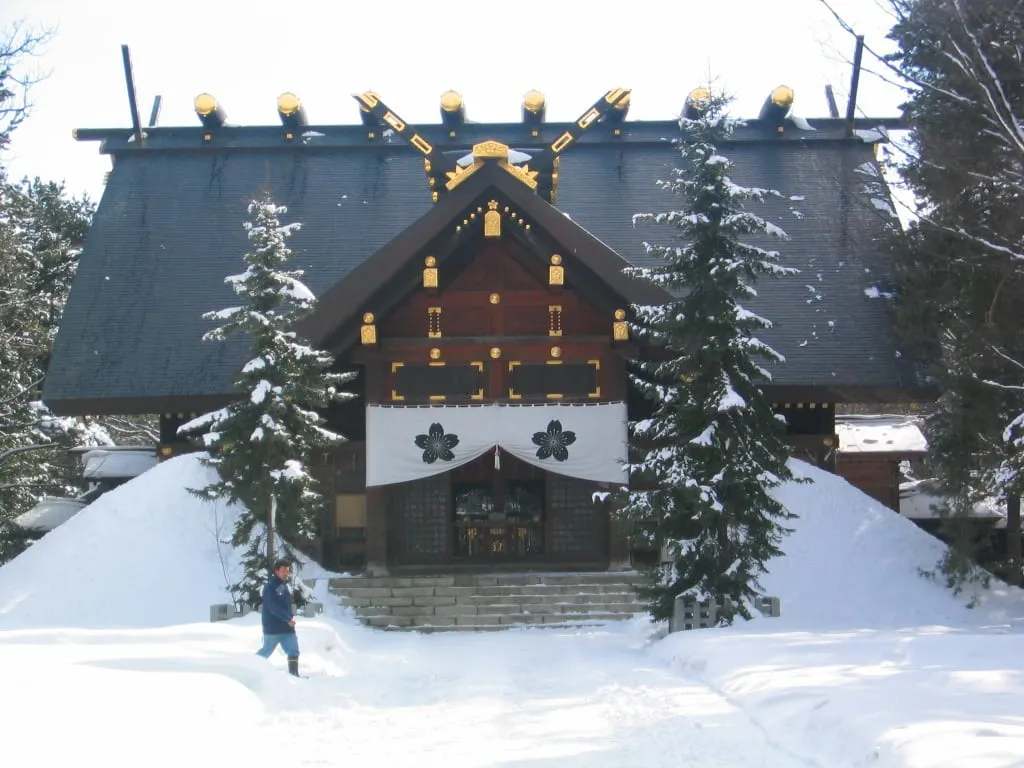
The official site also says that Shibata Yoshinao, the first head priest, received permission to found Kamikawa Jinja in January 1903 (Meiji 36), and chose the mountain cherry blossom as the shrine crest by linking “asahi” (morning sun) in Motoori Norinaga’s poem to the “asahi” of Asahikawa.
Highlights
According to the official site, Kaguraoka Park is a forest of about 44.5 hectares that preserves the original appearance of the land before settlement, and it notes that few cities of a similar size keep this much forest in the town center. The shrine sits on a hill overlooking the city, and the site says foxes, Ezo squirrels, great spotted woodpeckers and tits can be seen in the park.
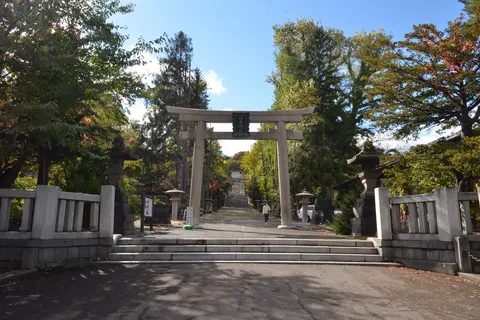
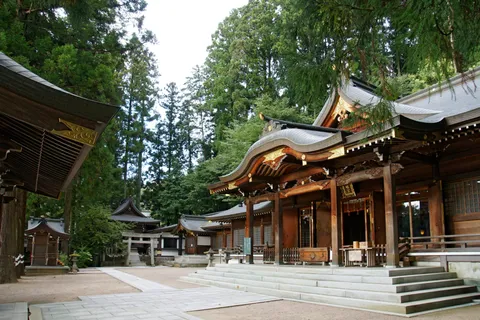
The shrine buildings are in the shinmei-zukuri style, built over four years from 1920 to 1924 (Taisho 9–13), and underwent a major renovation for the 100th anniversary project in 1993 (Heisei 5). Inside the worship hall, the official site says, is a wooden “komaguma” (bear guardian) carved from onko (yew), a rare sight in Japan. The first torii, donated in 1933 (Showa 8), is a 9.09 m granite gate made of stone from Nagano, and the stone steps of the approach were laid in 1936 (Showa 11). The number of steps is inconsistent on the official site: the history page says 106, while the grounds guide says 109 from the first to the second torii.
The auxiliary shrine Asahikawa Tenmangu, which enshrines Sugawara no Michizane as a god of learning, arts and culture, was established in 1966 (Showa 41) with a divided spirit from Dazaifu Tenmangu. The Noh stage (kagura hall) built for the 100th anniversary project in 1992 hosts kagura dances, offerings at the annual festival, takigi Noh and concerts, according to the official site. The Kaguraoka Monument records the history of the planned villa site and was erected by citizens in 1933.
Visiting Tips
The official site says prayer requests are accepted daily from 9:30 AM to 4:00 PM, except July 20–22 and December 29–31. The main shrine at Kaguraoka does not take advance bookings for individuals; you go to the shrine office during those hours. For prayers at the Tongu in Tokiwa Park, the site asks you to phone the Tongu office first. The site lists prayers for protection from misfortune, traffic safety, safe childbirth, first shrine visits for babies, Shichi-Go-San (October 1 to November 15), exam success and academic achievement, recovery from illness and protection from disaster.
The goshuin is not mentioned on the official site. According to Hotokami, three goshuin are offered (Kamikawa Jinja, Asahikawa Tenmangu and Amaburi Shrine) and they can be written directly into a goshuin book. The fee differs between sources: a 2019-era guide article gives ¥300 per goshuin, while Hotokami lists a new paper-cut goshuin at ¥1,000.
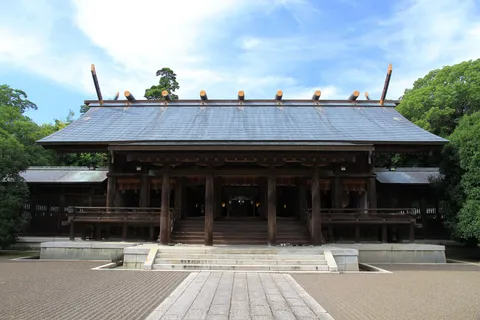
The official site gives the distance as about 4 km from JR Asahikawa Station and about 1.5 km from Kaguraoka Station on the JR Furano Line, and by bus from the station take Route 82 or 83 (Route 83 does not run on weekends and holidays) to “Kamikawa Jinja.” Parking is not mentioned on the official site; guides say it is free, with the number of spaces ranging from about 30 to 50 by source. The second photo on this page shows, according to its Wikimedia Commons description, the “Kamikawa Jinja Tongu” in Tokiwa Park.
Annual Festivals
Main regular events from the official festival calendar (no year is given, so please confirm dates with the shrine):
- Kitansai (January 1, 6:00 AM): A New Year rite praying for national prosperity, social flourishing and happy lives.
- Hikiri Shinji (January 7, 10:00 AM): A rite in which the fire for the Dondo-yaki is made with a wooden fire drill.
- Furu-ofuda Shono-sai / Dondo-yaki (January 8 from 9:00 AM through the 12th): Burning of the past year’s amulets, charms and shimenawa.
- Hatsu-Tenjin (January 25, 10:00 AM): The first monthly Tenjin festival day of the year, praying for academic success and progress in the arts and crafts.
- Kigensai (February 11, 10:00 AM) and Toshigoi-sai (April 17, 10:00 AM): The Toshigoi-sai prays for a bountiful harvest and more.
- Annual festival (July 20 eve festival, July 21 main rite, July 22 follow-up rite): The shrine’s largest festival, with the mikoshi processing through the parishioner district. Per the official site, the eve festival is at 7:00 PM on July 20, the main rite at 7:00 AM on July 21, and the follow-up rite around 1:00 PM on July 22 (after the mikoshi arrives).
- Kannamesai-tojitsu-sai (October 17, 10:00 AM), Meiji-sai (November 3, 10:00 AM) and Niiname-sai (November 23, 11:00 AM).
- Shu-Tenjin (December 25, 10:00 AM): The last monthly Tenjin festival day of the year, giving thanks to the god of learning, arts and culture.
- Great Purification and New Year’s Eve Rite (December 31): The Great Purification is at 2:00 PM and the New Year’s Eve Rite at 9:00 PM.
Nearby Food & Sightseeing
These are places you can visit together with the shrine. The official site gives no restaurant information.
- Kaguraoka Park: The roughly 44.5-hectare park that contains Kamikawa Jinja. The official site says it preserves the original forest as it was before settlement.
- Asahikawa City Science Museum “Cypal”: A facility the Hokkaido Tourism Organization page lists among nearby attractions.
- Heiwa-dori Shopping Park: A shopping park that the same Hokkaido Tourism Organization page lists among nearby attractions.
- Platanus Avenue: A tree-lined avenue that the Hokkaido Tourism Organization page lists among nearby attractions.
- Kamikawa Jinja Tongu (inside Tokiwa Park): The shrine’s Tongu, whose address and phone number appear on the access page of the official site.
Frequently Asked Questions
- Q. What are the prayer and visiting hours?
- A. The official site says prayer requests are accepted daily from 9:30 AM to 4:00 PM, except on the festival days (July 20–22) and during the New Year preparation period (December 29–31). The main shrine at Kaguraoka does not take advance bookings for individual prayers; you go to the shrine office during those hours. The official site does not give visiting hours for the grounds, and guide sites differ: 9:00 AM–5:00 PM from March to October and 9:00 AM–4:30 PM from November to February (Hokkaido Tourism Organization), or main hall open 7:00 AM–5:00 PM in summer and 7:00 AM–4:30 PM in winter (Hotokami).
- Q. Can I get a goshuin?
- A. According to Hotokami, three goshuin are offered (Kamikawa Jinja, Asahikawa Tenmangu, and the shrine's concurrently managed Amaburi Shrine), and they can be written directly into a goshuin book. The fee is not stated on the official site: one 2019-era guide article gives ¥300 per goshuin, and Hotokami lists a new paper-cut goshuin at ¥1,000. Hotokami lists the amulet counter as open 7:00 AM–5:00 PM, but the official site gives no goshuin hours. Amounts and hours can change, so please confirm at the amulet counter.
- Q. How do I get there, and is there parking?
- A. The official site says it is about 4 km from JR Asahikawa Station and about 1.5 km from Kaguraoka Station on the JR Furano Line. By bus, take Route 82 or Route 83 from the Asahikawa Station bus stop (Miyashita 9-chome) and get off at "Kamikawa Jinja" (Route 83 does not run at all on weekends and holidays). The Hokkaido Tourism Organization page gives about 5 minutes by car from Asahikawa Station. Many guides say parking is free, but the official site does not mention it, and the number of spaces ranges from about 30 to 50 depending on the source.
- Q. Why is Kaguraoka called the planned site of an imperial villa?
- A. According to the official site, on December 28, 1889 (Meiji 22) the cabinet decided to build an imperial villa at Kaguraoka, and the area became hereditary imperial land. The plan gradually faded away, and in 1911 (Meiji 44) Crown Prince Yoshihito, later Emperor Taisho, visited Kaguraoka. In 1920 (Taisho 9) the land was leased as the shrine's precincts, and the shrine buildings were completed and moved here in 1924 (Taisho 13). The Kaguraoka Monument in the grounds, erected by citizens in 1933 (Showa 8), records this history, according to the official site.
- Q. When is the annual festival?
- A. According to the official festival calendar, the annual festival runs for three days: the eve festival on the evening of July 20, the main rite at 7:00 AM on July 21, and the follow-up rite around 1:00 PM on July 22 (after the mikoshi arrives). After the July 21 rite, the mikoshi processes through the parishioner district and stays overnight at the Tongu. On the 22nd it makes a second round before returning to the main shrine. The calendar does not state a year, so please check with the shrine before planning to attend.
Plan Your Visit
Before you go, you can book a stay and get your shrine-visit items ready.
Amazon links open Amazon.co.jp (Japan) in English; whether an item ships overseas depends on the product.
※ Contains ads (PR). Links open external sites such as Amazon, Rakuten, Trip.com and Booking.com.