History
Warei Jinja stands in Warei-cho, Uwajima, Ehime Prefecture. The official site calls it the shrine of “Uwajima in Iyo Province,” and the main deity is Yanbe Seibei Kimiyori-no-Mikoto (山家清兵衛公頼命). The companion deities are Seibei’s second, third and fourth sons (山家治郎命, 山家丹治命, 山家美濃命), his retainer 塩谷内匠命, and 塩谷内匠’s eldest and second sons (塩谷帯刀命, 塩谷勘太郎命).
According to the official history, Seibei was a chief retainer of Date Hidemune, founder of the Uwajima domain. When Hidemune was granted the 100,000-koku Uwajima domain by the Tokugawa for his service in the Battle of Sekigahara and the Winter Siege of Osaka, his father Date Masamune, worried about the young man, is said to have chosen the trusted Seibei as his chief retainer to accompany him. Uwajima was then worn down by repeated wars and poor rule by its lord. Seibei cut domain spending, lowered taxes, encouraged industry and strengthened defenses, and the people’s livelihoods are said to have stabilized. Some retainers, however, resented him, and the site says he fell to their blades on the night of June 29, 1620 (Genna 6).
Afterward, the people of the domain, from commoners to the lord and his retainers, built a small shrine to calm his spirit, and on June 23–24, 1653 (Joo 2), with court approval, it was formally enshrined as Yamayori Warei Shrine (山頼和霊神社), the official site explains. The whole complex was destroyed in the Uwajima air raid of July 28, 1945, but with the efforts of its supporters’ association it was rebuilt, and the official site now places it as the head shrine of Warei faith across Japan. All of this is the shrine’s own account.
Highlights
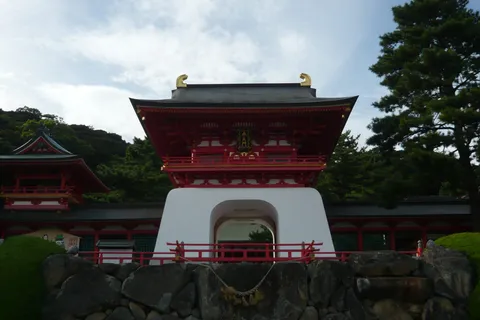
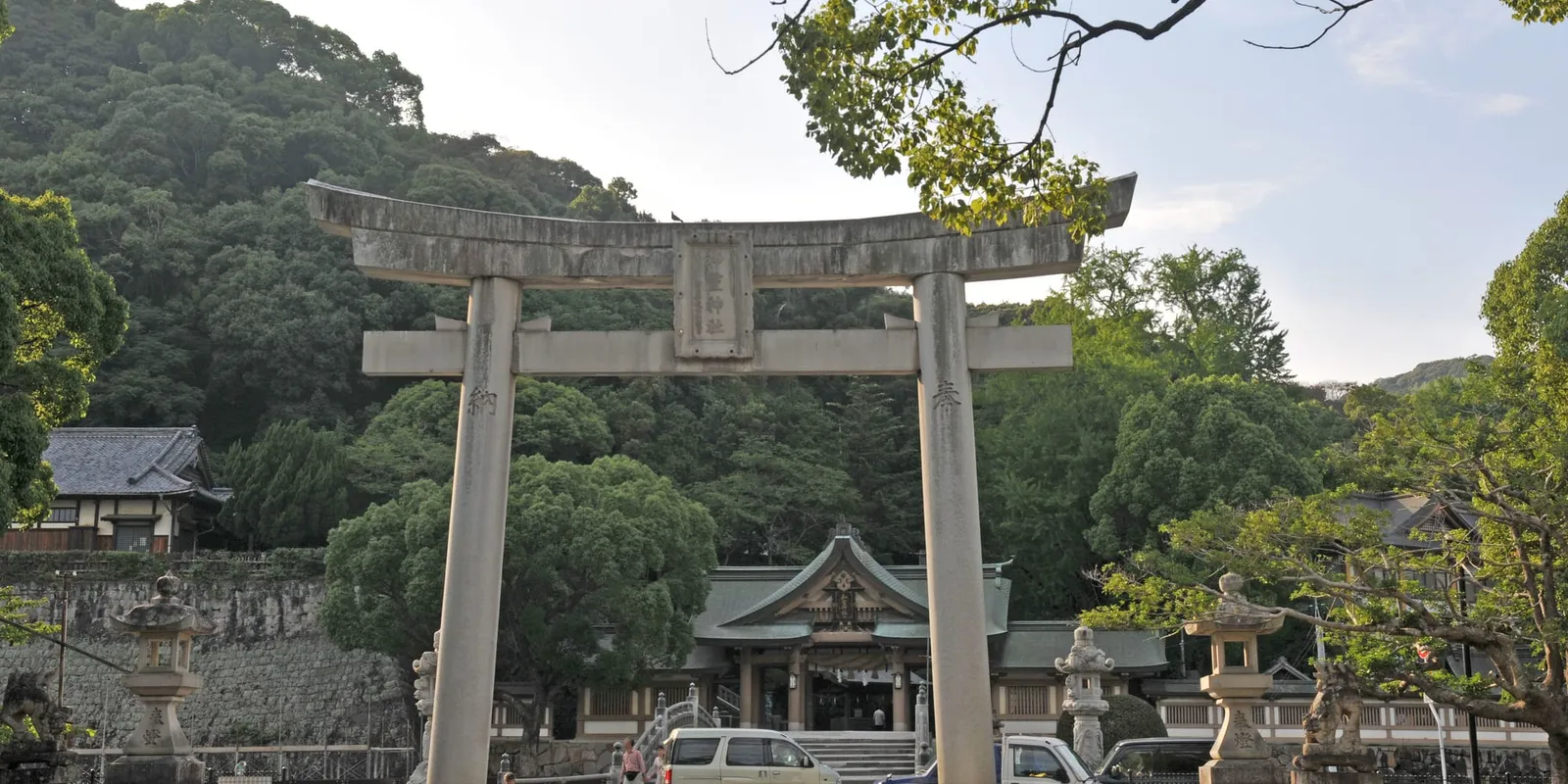
The first torii at the entrance dates from 1917 (Taisho 6). The second torii was built in 1938 of Aji stone from Aji in Kagawa Prefecture and stands a little over 12 meters tall; the official site says it is the largest stone torii in Japan. The arched Shinko Bridge (built 1932) crosses the Suga River and links Warei Park with the shrine, and inside the Shinmon gate (completed 1966), masks of Otafuku and a long-nosed figure hang on either side.
The hand-washing pavilion (dedicated 1954) is also made of Aji stone, and the grounds hold a great ginkgo said to be more than 450 years old. The present main hall was completed in 1951 by the war-reconstruction supporters’ association. There is also a bronze horse statue donated in 1960, a horse shrine said to bring good luck for healthy legs, and subordinate shrines including Wakamiya, Kamado, Mishima, Yamamoto and Mii.
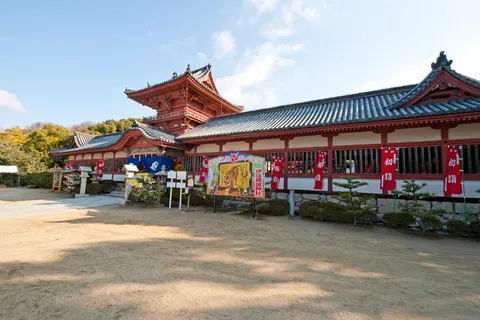
The large ema has been installed since Heisei 2 (Year of the Horse) in commemoration of an enthronement and is replaced each year for the zodiac animal. The Reiwa 3 (Year of the Ox) ema was painted and inscribed by the Matsuyama-born sumi-e artist 茂本ヒデキチ (the link goes to the artist’s own website; no official social media accounts could be confirmed), and the official site says the Reiwa 7 ema is also his design.
Amulets cover a wide range, including household safety, business, sea safety, traffic safety, academic success and safe childbirth, along with an “Ushioni” charm, a leg-health charm, a victory charm and a money-luck charm, according to the official amulet page (as of 2020).
Visiting Tips
Prayer services are accepted daily 8:30 AM–4:00 PM with no reservation needed (official site). Apply at the prayer reception in the shrine office; it takes about 20 minutes, and since waits can occur around ceremonies, calling ahead is reassuring. Besides life-stage rites such as first shrine visits, Shichi-Go-San, safe-childbirth prayers, misfortune-warding, weddings and exam success, the shrine accepts prayers for sea safety, fishing prosperity, traffic safety and construction safety. The official site does not state prayer fees.
The amulet page lists a Warei Jinja goshuin book (朱印帖) at ¥1,500, but the fee for the goshuin itself and its hours are not given. Visiting hours for the grounds are not stated either, so arriving before 4:00 PM is advisable.
According to Weathernews’ New Year’s visit page, it is about a 10-minute walk from Uwajima Station on the JR Yosan Line, or about 5 minutes by car along Route 56 from Uwajima-Asahi IC. It lists parking for 60 cars and 5 buses, but says bus parking is unavailable at New Year. The official site has none of this, so the shrine office (0895-22-0197) can confirm.
Annual Festivals
These are the dates listed in the official annual calendar. Check with the shrine office for any yearly changes.
- New Year’s Day Festival (January 1): Kagura dance begins at midnight, followed by the New Year’s Day festival and New Year prayer service.
- Old Amulet Burning Rite (January 10): At 3:30 PM, returned old amulets are purified and burned.
- Toshigoi-sai (February 17): 10:00 AM. Prayers for industrial development, a good harvest and family businesses.
- Spring Grand Festival and Supporters’ Association Festival (April 24): 10:00 AM.
- Great Purification (June 30): 4:30 PM. The summer purification of the past half-year’s impurities.
- Nagoshi-sai (July 12): 6:00 PM. A ceremony of the subordinate Mishima Shrine, in which worshippers pass through a ring of reeds to purify body and mind.
- Warei Grand Festival (July 23–24): The shrine’s biggest event. On the 23rd: ritual at 10:00 AM and eve festival at 7:00 PM. On the 24th: children’s procession at 1:00 PM, portable shrine departure at 5:30 PM, otabisho rite at 7:00 PM, sea procession at 8:00 PM, and the “hashirikomi” running dash at 9:00 PM. The official site says it includes special rites such as the portable-shrine procession, sea procession and hashirikomi.
- Mishima Shrine Festival (October 23), Kamado Shrine Festival (first Day of the Rabbit in November), Yamamoto Shrine Festival (November 22): Festivals of subordinate shrines within the grounds.
- Niiname-sai (November 23): 11:00 AM.
- Large Ema Dedication Ceremony (late December): The next year’s zodiac ema is dedicated and replaced together with the donors.
- Great Purification and New Year’s Eve Festival (December 31): From 4:30 PM.
- Monthly Festival (the 23rd of each month): From 4:30 PM.
Nearby Food & Sightseeing
- Warei Park: The park that, according to the official grounds guide, is linked to the shrine by the Shinko Bridge over the Suga River.
- Uwajima Castle: The castle where Date Hidemune, whom Seibei served, became lord. According to nippon.com’s castle guide, its keep is a national Important Cultural Property and one of the 12 surviving original keeps. Check a map for the distance from the shrine.
Frequently Asked Questions
- Q. How is Warei Jinja read, and who is enshrined here?
- A. It is read "Warei-jinja" (われいじんじゃ, per the official site). The main deity is Yanbe Seibei Kimiyori-no-Mikoto (山家清兵衛公頼命; the official site gives the reading やんべせいべえきんよりのみこと), and the official site says the shrine enshrines the spirit of a chief retainer of Date Hidemune, founder of the Uwajima domain. Seibei's second, third and fourth sons, and his retainer 塩谷内匠 with two sons, are enshrined as companion deities.
- Q. When is the Warei Grand Festival?
- A. In the official annual calendar, the Warei Grand Festival (Warei Taisai, the shrine's annual festival) is on July 23 and 24 and is described as the shrine's most important event. On the 23rd there is a ritual at 10:00 AM and an eve festival at 7:00 PM. On the 24th: a children's procession at 1:00 PM, the portable shrine's departure at 5:30 PM, a rite at the resting place (otabisho) at 7:00 PM, a sea procession at 8:00 PM, and the "hashirikomi" (running dash) at 9:00 PM. Schedules can change, so check the official site or the shrine office (0895-22-0197).
- Q. Can I get a goshuin at Warei Jinja?
- A. The official site's amulet page (dated November 30, 2020) lists a Warei Jinja goshuin book (朱印帖) at ¥1,500, so goshuin appear to be available. However, the fee for the goshuin itself and the hours for receiving it are not stated on the official site. Prayer reception runs daily 8:30 AM–4:00 PM, so an earlier visit is safest.
- Q. How do I get there, and is there parking?
- A. According to Weathernews' New Year's visit page, it is about a 10-minute walk from Uwajima Station on the JR Yosan Line, or about 5 minutes by car along Route 56 from Uwajima-Asahi IC on the Matsuyama Expressway. It lists 60 car spaces and 5 bus spaces, with bus parking unavailable at New Year because of food stalls. The official site gives no written access or parking information, so ask the shrine office (0895-22-0197) for details.
- Q. What is the large ema that is replaced every year?
- A. The official site says a large ema (votive picture) for each year's zodiac animal is hung in the grounds. At the Large Ema Dedication Ceremony in late December, the next year's ema is dedicated and replaced together with the donors. The ema for Reiwa 7 (2025) was designed by the sumi-e artist 茂本ヒデキチ and, according to the top page, was dedicated on December 21.
Plan Your Visit
Before you go, you can book a stay and get your shrine-visit items ready.
Amazon links open Amazon.co.jp (Japan) in English; whether an item ships overseas depends on the product.
※ Contains ads (PR). Links open external sites such as Amazon, Rakuten, Trip.com and Booking.com.