History
Akama Jingu stands in the Amidaji-cho district of Shimonoseki, Yamaguchi, overlooking the Kanmon Strait, and enshrines Emperor Antoku, the 81st emperor. On March 24, 1185 (Juei 4), the Taira clan was defeated in the Battle of Dannoura, the last great battle of the Genpei War, and the eight-year-old emperor, held in the arms of Nii-no-Ama (Taira no Tokiko), entered the sea together with the Taira. According to the shrine’s official website, the imperial court then ordered a memorial hall to be built in Nagato Province in 1191 (Kenkyu 2), and a Mieido hall was raised over the tomb. The temple that guarded it, Amidaji, was an imperially sponsored temple that later became a Shingon-sect temple and is said to have been revered by powerful figures including Toyotomi Hideyoshi and the Ouchi and Mori clans.
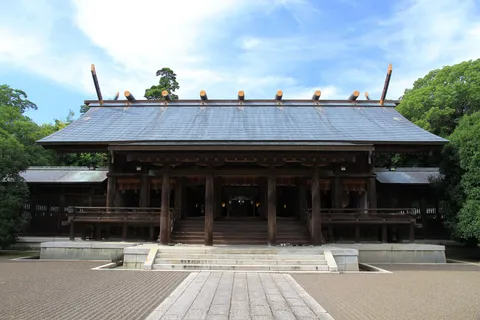
After the Meiji-era order separating Shinto and Buddhism, Amidaji was abolished and the Mieido was first renamed Tenno-sha, then established on October 7, 1875 (Meiji 8) as the Kanpei Chusha shrine Akama-gu. In 1940 (Showa 15) it was raised to Kanpei Taisha and renamed Akama Jingu. The main hall and the other buildings were destroyed by wartime damage in July 1945, and were rebuilt in stages after the war: the main hall and norito-den in 1949, the Suiten-mon gate in 1958, and the worship halls and cloisters in 1965, completing the present Ryugu-zukuri (dragon-palace-style) shrine.
Highlights
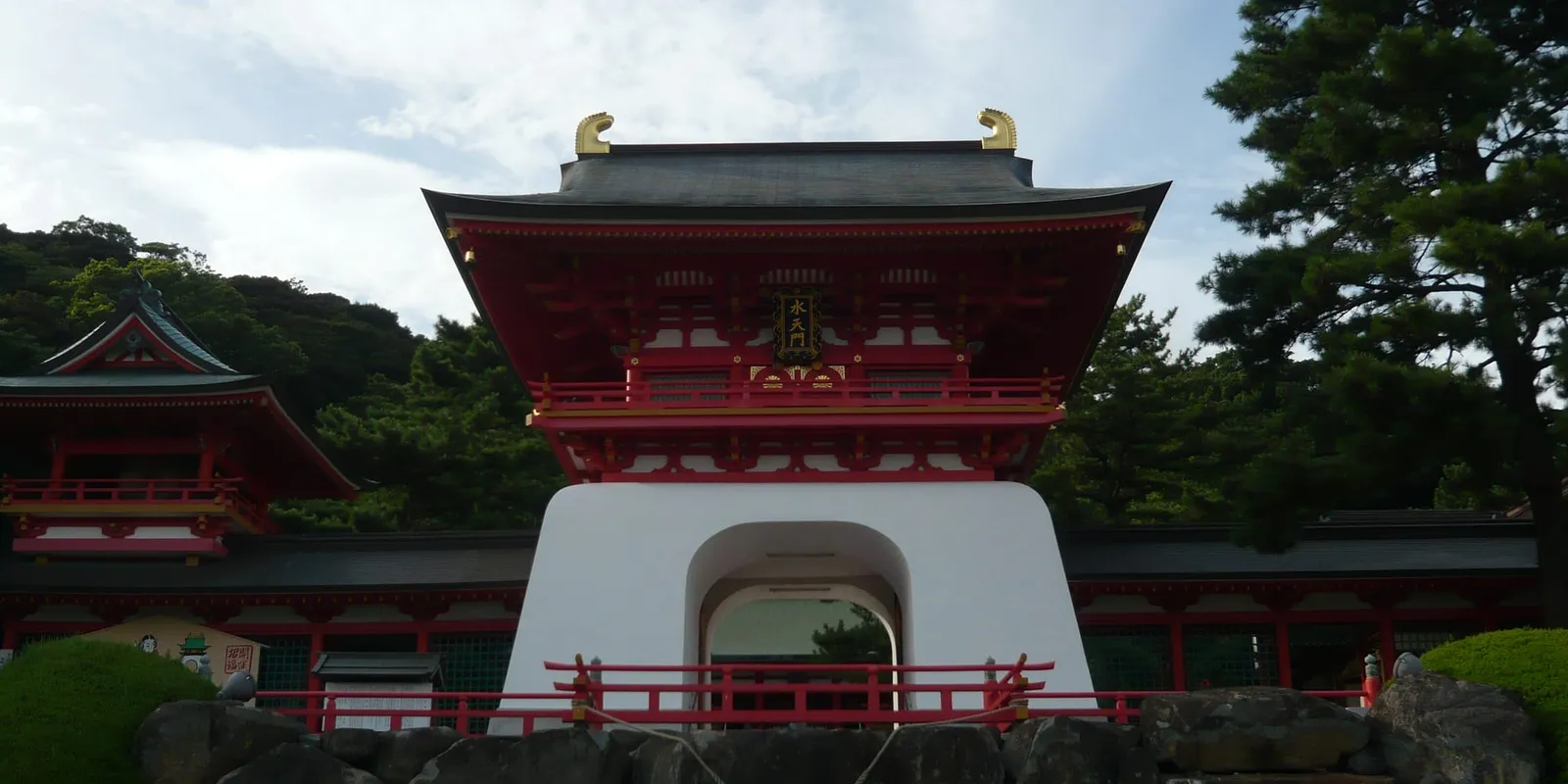
Suiten-mon is the shrine’s main gate, a vermilion-lacquered two-story gate that evokes the Dragon Palace. The official website calls it “the world’s only Ryugu-zukuri” structure, and its design draws on a poem said to have been composed by Nii-no-Ama that speaks of a “capital beneath the waves.” It was completed in April 1958 and was registered as a national Registered Tangible Cultural Property in 2018.
The worship halls were completed in 1965 and consist of an outer hall with vermilion pillars and white walls and an inner hall with a karahafu (curved) gable. Because the deity is also called “Suiten-no-Okami” (Great Deity of Water and Heaven), the courtyard holds a “water garden” flooded with water, where the dragon-palace style shows most clearly.
Nanamori-zuka (the Taira clan tombs) is where warriors such as Taira no Tomomori, who were defeated at Dannoura, and Nii-no-Ama (Taira no Tokiko) are enshrined. Next to it is Antoku Tenno Amidaji no Misasagi, the imperial mausoleum maintained by the Imperial Household Agency, where the Senteisai mausoleum ceremony takes place every May 2.
Hoichi-do (the Hall of Hoichi the Earless) houses a wooden statue of Hoichi, the blind biwa player of a tale that was handed down at Amidaji (today’s Akama Jingu). The story became widely known when Lafcadio Hearn (Koizumi Yakumo) translated it into English in his Kwaidan, and the hall was built in March 1957.
The treasure hall holds the Nagato-bon manuscript of the Tale of the Heike and the Akama Jingu documents (both Important Cultural Properties), as well as an illustrated scroll of Emperor Antoku’s legend, portraits of the Taira clan and Heike biwa lutes. It is open 9:00 AM–4:30 PM, with an admission fee of ¥100.
Visiting Tips
The grounds are free to enter, and the shrine office is open 9:00 AM–5:00 PM. The goshuin costs ¥500 and is issued only as a pre-written sheet of paper, so entries in a goshuincho book are not accepted. Prayer requests (for household safety, business prosperity, maritime safety, traffic safety, safe childbirth, protection from misfortune and more) are accepted from 9:00 AM to around 3:00 PM at the shrine office without a reservation.
It is about a 10-minute ride on a Sanden Bus (bound for Chofu) from JR Shimonoseki Station to the “Akamajingu-mae” stop, right at the shrine. There is a seaside parking lot for about 50 standard cars, but on the day of the Senteisai Jorō Sanpai there is no general parking, so public transport is recommended.
Annual Festivals
- Senteisai (every year, May 2–4): A special Shinto ritual held over three days from the memorial day of Emperor Antoku (the 24th day of the third lunar month, fixed as May 2 in the new calendar at the Meiji calendar reform). On May 2 there is the mausoleum ceremony at Antoku Tenno Amidaji no Misasagi and a memorial service for the Taira clan. On May 3, after the main ritual and dedicated performances, comes the Jorō Sanpai, in which five groups of Jorō (court ladies) cross a special bridge set up in the grounds in the “outer eight-figure” gait and bow before the deity. May 4 is the Goshinko-sai and Otabisho-sai; in recent years the procession has been cancelled and only the rites are held (no procession in 2026 either). The Jorō Sanpai draws large crowds and entry is restricted (doors opened at 9:30 AM in 2026).
- Hoichi Biwa Memorial Service (July 15): The festival day of Hoichi-do, when a biwa memorial service is held.
- New Year’s rites and first visit (January 1): The first drum of the year is struck on the drum tower every New Year’s Day.
- Other annual events include Setsubun (February 3), the Heike Hina-nagashi rite (early March) and the tea offering ceremony (April 24).
Nearby Food & Sightseeing
- Mimosuso River Park: A seaside park laid out on the site of the Battle of Dannoura. It has statues of Minamoto no Yoshitsune leaping between ships and of Taira no Tomomori, who sank carrying an anchor, with close-up views of the Kanmon Bridge and passing ships.
- Kanmon Bridge: The 1,068 m bridge linking Honshu and Kyushu, visible across the Kanmon Strait from the Dannoura battlefield site.
- Karato Market: A market for Shimonoseki seafood. On Fridays, Saturdays, Sundays and public holidays, the “Ikiiki Bakkan-gai” event is held, where wholesale fishmongers sell sushi.
Frequently Asked Questions
- Q. What are the visiting hours and admission fee at Akama Jingu?
- A. The grounds are free to enter, and the shrine office (goshuin, amulets and more) is open 9:00 AM–5:00 PM. The treasure hall on the grounds is open 9:00 AM–4:30 PM, with an admission fee of ¥100.
- Q. Can I get a goshuin at Akama Jingu?
- A. Yes, at the shrine office from 9:00 AM to 5:00 PM for ¥500. It is issued only as a pre-written sheet of paper, and entries in a goshuincho book are not accepted.
- Q. How do I get to Akama Jingu, and is there parking?
- A. Take a Sanden Bus (bound for Chofu) from JR Shimonoseki Station for about 10 minutes to the "Akamajingu-mae" stop, right at the shrine. There is a seaside parking lot for about 50 standard cars, but on the day of the Senteisai Jorō Sanpai (May 3) there is no general parking and visitors are asked to use public transport.
- Q. Which deity is enshrined at Akama Jingu?
- A. Emperor Antoku, the 81st emperor, who entered the sea at the age of eight during the Battle of Dannoura in 1185. The shrine grew out of Amidaji temple, which began as a memorial hall over his tomb. It became Akama-gu in 1875 and was renamed Akama Jingu in 1940.
- Q. When is the Senteisai festival held?
- A. Every year over three days, May 2–4. May 2 is the mausoleum ceremony, May 3 is the highlight Jorō Sanpai, and May 4 is the Goshinko-sai and Otabisho-sai rites. In the Jorō Sanpai, five groups of Jorō (court ladies) cross a special bridge in the "outer eight-figure" gait and bow before the deity.
Plan Your Visit
Before you go, you can book a stay and get your shrine-visit items ready.
Amazon links open Amazon.co.jp (Japan) in English; whether an item ships overseas depends on the product.
※ Contains ads (PR). Links open external sites such as Amazon, Rakuten, Trip.com and Booking.com.