History
Isaniwa Shrine stands on a hill directly behind the Dogo Onsen district of Matsuyama. According to the shrine’s website, it enshrines Empress Jingu, Emperor Ojin, Emperor Chuai, and the Three Princess Deities (written 三柱姫大神), and it has also been called Yuzuki Hachiman and Dogo Hachiman. Its founding date and circumstances are unclear, but it is said to stand on the site of the temporary palace used by Emperor Chuai and Empress Jingu when they visited the Dogo hot spring. It is listed in the Engishiki shrine register, and the shrine’s website adds that it is also said to be one of the Hachiman shrines founded in Dogo during the reign of Emperor Seiwa (858–876) by the monk Gyokyo of Daian-ji in Nara, at the request of the provincial governor of Iyo.
It is thought to have originally stood at the foot of what is now Dogo Park, and tradition says it was moved to its present site in the 14th-century Kenmu era when the Kono clan built Yuzuki Castle. In the Edo period the Matsuyama domain lord Kato Yoshiaki made it a prayer site for martial success and gave it a land grant. The present buildings were rebuilt by Matsudaira Sadanaga, third lord of the domain, in thanks for success in a yabusame (mounted archery) performance at Edo Castle, which he had prayed for beforehand; construction began in 1664 and was completed in 1667. The shrine’s history page also records a legend that a golden dove flew up in front of Sadanaga as he drew his bow, and his arrow struck the center of the target.
Highlights
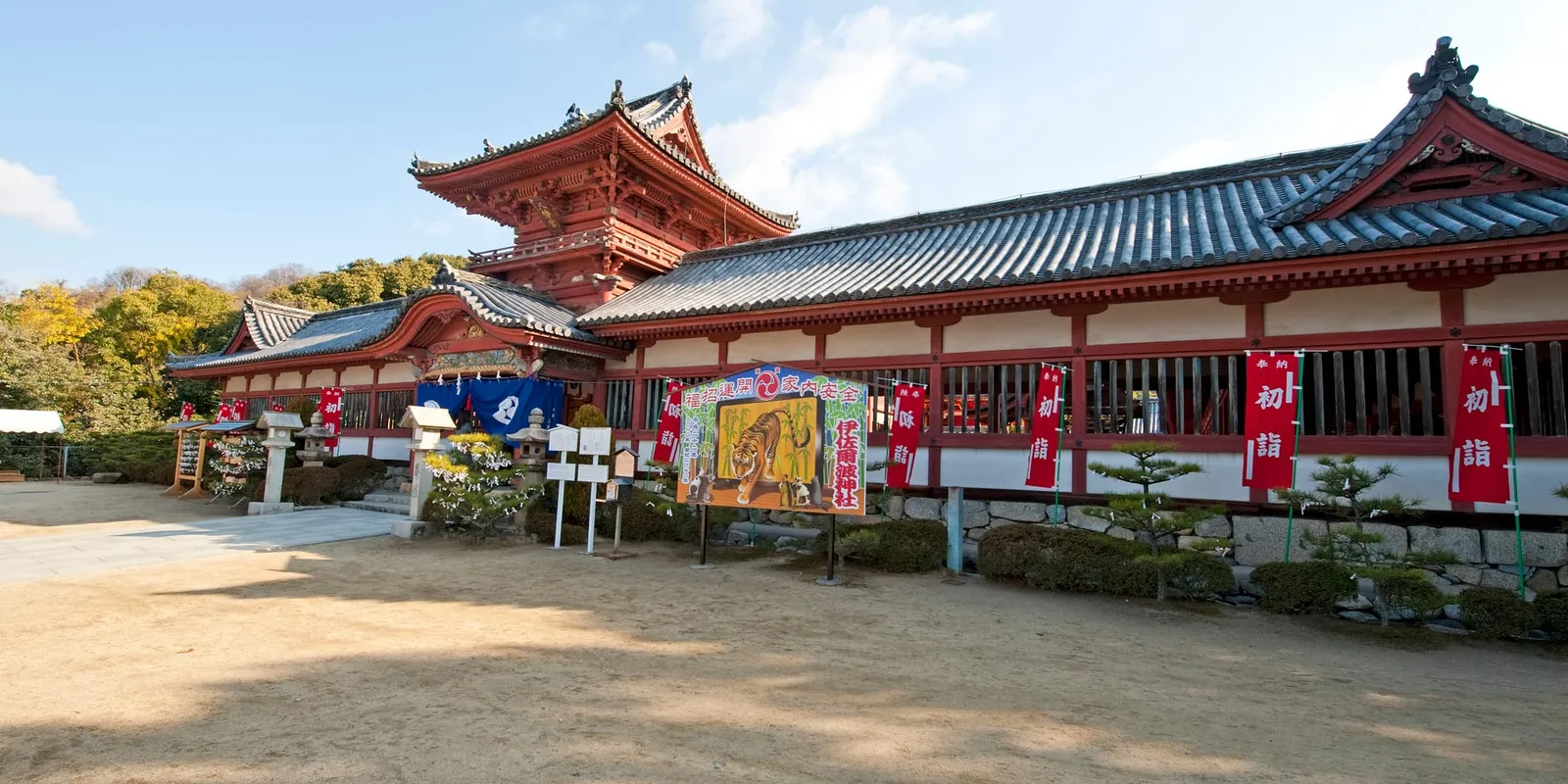
The main attraction is the hachiman-zukuri main hall, a National Important Cultural Property. In this style, a front hall and a rear hall are placed one behind the other and joined under a shared roof gutter; the building is said to be modeled on Iwashimizu Hachimangu in Kyoto. The shrine’s website says it is one of only three surviving examples of hachiman-zukuri in intact form in Japan, and Matsuyama City’s official tourism site counts it among the “three great hachiman-zukuri” together with Iwashimizu Hachimangu (Kyoto) and Usa Jingu (Oita). The hall is vermilion-lacquered, with gold leaf on the front pillars, in the lavish Momoyama-period style, and has a cypress-bark roof. According to the shrine’s website, it underwent a three-year dismantling and restoration from 1970 and a roof re-covering and repainting in 2000–2002.
As for the designation, Matsuyama City’s cultural property page says the main hall (with its open-lattice fence) was designated on June 28, 1956; Matsuyama City’s tourism site and the shrine’s website say the shrine buildings were designated in 1967 (some sources describe the offering hall, corridor, main gate, and cloister as added then). The shrine’s website also introduces the National Important Cultural Property sword “Kuniyuki” among its treasures.
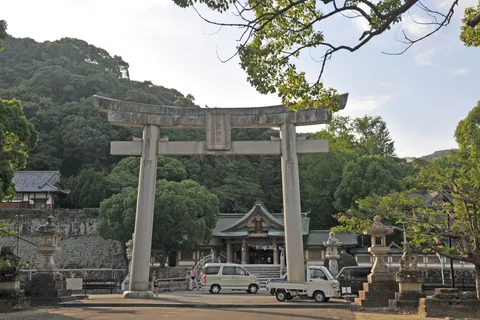
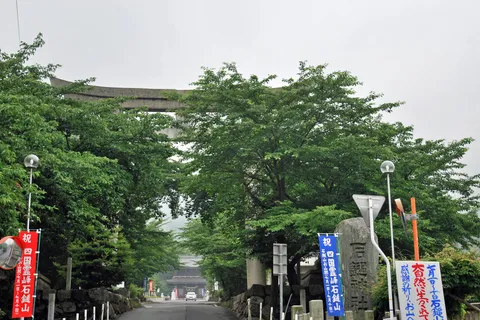
Looking up from the foot of the stairs, the vermilion main gate is visible on the hilltop. The stairs are described as 135 steps (the official site does not give a count). Inside the grounds, a large new-year ema plaque is introduced on the shrine’s website each year-end, and 22 sangaku (votive mathematics tablets, dated 1803 to 1937) are designated an Ehime Prefecture Tangible Folk Cultural Property (designated 2005, per Matsuyama City). According to the shrine’s website, the originals are not on display because of deterioration; photographs are shown instead.
Visiting Tips
The grounds are free to enter. Visiting hours could not be confirmed on the official site, though travel listings give 6:00 AM–6:00 PM. The goshuin counter is listed as open 9:00 AM–5:00 PM (Matsuyama City’s tourism site) and the goshuin are issued at the shrine office. Besides the regular goshuin, a cut-paper goshuin of the main gate and a limited “Hiten carving cut-paper goshuin” are announced (ends when the planned quantity runs out; no mail orders). The fee could not be confirmed on the official site, so please check at the shrine. For inquiries, the phone number listed by Matsuyama City’s tourism site is 089-947-7447.
How to get there and pair it with Dogo Onsen: Take the Matsuyama city tram (Iyotetsu) to its terminus, Dogo Onsen Station, then walk uphill for about 5 minutes (per the shrine’s website). The final approach is a steep flight described as 135 stone steps, so wear sturdy shoes rather than the geta sandals you might wear after a bath. If the steps are a problem, the worshippers’ parking lot behind the buildings (about 57 spaces) is about a 30-second walk to the halls. For the first hour between 6:00 AM and 6:00 PM it is free for worshippers; take a ticket at the entrance and use the payment machine at the exit. Because the shrine is within walking distance of Dogo Onsen Station and the Dogo Onsen district, it is easy to combine with a visit to the hot spring.
Annual Festivals
These are the main events listed in the shrine’s annual events calendar (dates may change, so please check the official site).
- Grand Festival (Reitaisai, October 6): The eve festival is on October 5 and the Shinko-sai procession on October 7. According to the shrine’s autumn festival notice, the eve festival takes place in the evening in front of Dogo Onsen Station; on October 6 the ceremony begins at 10:00 AM at Isaniwa Shrine (and at 11:00 AM at Yu Shrine); and on the 7th the mikoshi leave the shrine early in the morning for the station area, tour the neighborhoods, and return to the shrine in turn. The shrine says it has no information on seating or other performances and refers visitors to the individual mikoshi groups.
- New Year’s Day service (January 1) and exam-success prayer service (January 5): Prayers for the new year and for exams.
- Yakuyoke Festival (February 3): A ritual listed in the shrine’s annual events calendar.
- Nagoshi Festival (July 30): A summer purification ritual listed in the annual events calendar.
- Shichi-Go-San festival (November 15): Listed in the annual events calendar as the shrine’s Shichi-Go-San day.
Nearby Food & Sightseeing
- Dogo Onsen Honkan: The public bathhouse, a National Important Cultural Property, which fully reopened in July 2024 after about five and a half years of conservation work. The shrine sits on the hill behind this hot-spring district, so the two are easy to combine. Please check official sources for current hours and fees.
- Yuzuki Castle Ruins (Dogo Park): The former seat of the Kono clan, now a park and a National Historic Site with free entry. The shrine is said to have been moved to its present site when this castle was built.
- Hogonji: A temple known as the birthplace of the monk Ippen, and formerly one of Isaniwa Shrine’s administering temples. It is described as lying along the slope between Dogo Onsen Honkan and the shrine. Please check its current condition before visiting.
Frequently Asked Questions
- Q. How many steps are there, and can I avoid them?
- A. The front approach is described as 135 stone steps (according to travel guides; the official site does not give a count). The steps are steep, so sturdy shoes are recommended. There is a worshippers' parking lot (about 57 spaces) behind the shrine buildings, about a 30-second walk from the halls, so if you arrive by car you can reach the shrine without climbing the front steps.
- Q. What at Isaniwa Shrine is a National Important Cultural Property?
- A. The shrine's website says the whole set of buildings is a National Important Cultural Property. According to Matsuyama City's cultural property page, the main hall (with its open-lattice fence) was designated in 1956, and Matsuyama City's tourism site and others say the shrine buildings were designated in 1967 (some sources describe the offering hall, corridor, gate, and cloister as added then). The main hall is in the hachiman-zukuri style, with front and rear halls joined under a shared roof gutter.
- Q. Can I get a goshuin?
- A. Yes, at the shrine office. Matsuyama City's tourism site lists the goshuin counter as open 9:00 AM–5:00 PM. Besides the regular goshuin, there is a cut-paper goshuin of the main gate, and the shrine's website announces a limited "Hiten (celestial maiden) carving cut-paper goshuin" (ends once the planned quantity is reached; no mail orders). The fee could not be confirmed on the official site, so please check at the shrine.
- Q. What are the visiting hours, admission fee, and parking?
- A. The grounds are free to enter. Visiting hours could not be confirmed on the official site; travel listings give 6:00 AM–6:00 PM. Parking is behind the shrine buildings (about 57 spaces); per the shrine's website, worshippers get 1 hour free between 6:00 AM and 6:00 PM, with a charge beyond that.
- Q. When is the main festival?
- A. According to the shrine's annual events list, the grand festival (Reitaisai) is held every year on October 6, with the eve festival on October 5 and the Shinko-sai procession on October 7. The shrine's autumn festival notice says the eve festival is held in the evening in front of Dogo Onsen Station, and on the 7th the mikoshi leave the shrine early in the morning for the station area, tour the neighborhoods, and return to the shrine one after another.
Plan Your Visit
Before you go, you can book a stay and get your shrine-visit items ready.
Amazon links open Amazon.co.jp (Japan) in English; whether an item ships overseas depends on the product.
※ Contains ads (PR). Links open external sites such as Amazon, Rakuten, Trip.com and Booking.com.