History
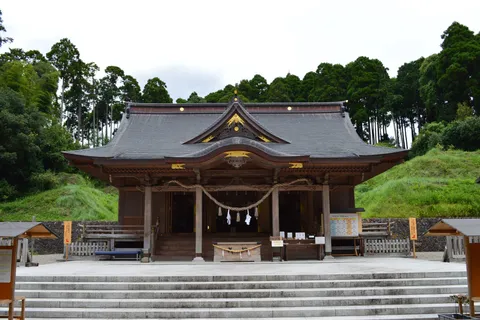
Aoshima Jinja stands near the center of Aoshima, a tiny island only about 860 meters in circumference, ringed by the waters of Hyuga Sea. The shrine is said to mark the site where its principal deity, Hikohohodemi no Mikoto — better known as Yamasachihiko — returned after his stay at the palace of the sea god, though the exact date of its founding remains unknown. A Heian-era provincial survey record, the Hyuga Miyage, notes that “Aoshima Daimyojin” was already venerated during the reign of Emperor Saga, indicating the site has been a center of worship for roughly 1,200 years, since the early Heian period. During the Bunki era of the Muromachi period (1501–1504), the Ito clan, who ruled the Hyuga region at the time, rebuilt and expanded the shrine’s buildings, and it has been maintained by local devotion ever since.
Deep within the island’s palm forest, at its very center, lies Motomiya — a sacred site marking an even older place of worship, where offerings are believed to have been made since the Yayoi period. Along the approach, a tunnel formed by rows of votive ema plaques known as the “Path of Prayer” leads to Motomiya, preserving a glimpse of the shrine’s most ancient layer of faith.
The Myth Connection
Aoshima Jinja’s principal deity, Hikohohodemi no Mikoto, is Yamasachihiko himself, the central figure of the “Umisachi-Yamasachi” myth cycle at the heart of Japan’s founding legends. After losing a fishing hook borrowed from his older brother Umisachihiko, Yamasachihiko wandered the shore in despair until Shiotsutsu no Okami appeared and guided him to the palace of the sea god, Ryugu-jo. There he met and fell in love with the sea god’s daughter, Toyotama-hime, living with her in the undersea palace for a time before returning to the surface world with the recovered hook.
This story of a hero welcomed into a distant palace, wed to its princess, and eventually returning home is widely considered one of the possible origins of the beloved Japanese folktale of Urashima Taro, and Aoshima is counted among the sites traditionally associated with that legend. Because it enshrines Yamasachihiko and Toyotama-hime — the god and goddess who met and were united — Aoshima Jinja has long been revered for blessings of good relationships and marital harmony, making it one of Japan’s most famous “en-musubi” power spots, drawing visitors from across the country.
Highlights
The greatest highlight of Aoshima Jinja is the island itself. Though only about 860 meters around and 4.4 hectares in area, the entire island is designated a Special National Natural Monument as the “Aoshima Subtropical Plant Community,” home to roughly 5,000 Livistona chinensis (birou) palms — some over 350 years old — alongside more than 200 subtropical and tropical plant species. Walking the approach through this dense, jungle-like canopy feels like stepping into a different climate entirely.
Encircling the entire island is the rock formation popularly known as the “Devil’s Washboard.” Formed from alternating layers of hard sandstone and soft mudstone in the ancient Miyazaki Group, deposited on the deep seafloor millions of years ago, the formation was carved into its rippled shape through repeated earthquake uplift and relentless wave erosion. It was designated a National Natural Monument in 1934 as the “Uplifted Seabed and Deformed Wave-Cut Marks of Aoshima.” Visitors can take in the full sweep of the formation from the Yayoi Bridge (completed in 1951) connecting the island to shore, and at low tide can walk out onto the exposed rock shelf itself.
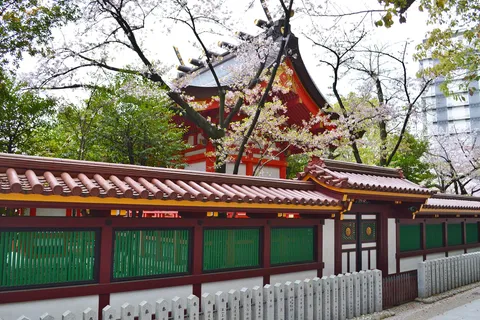
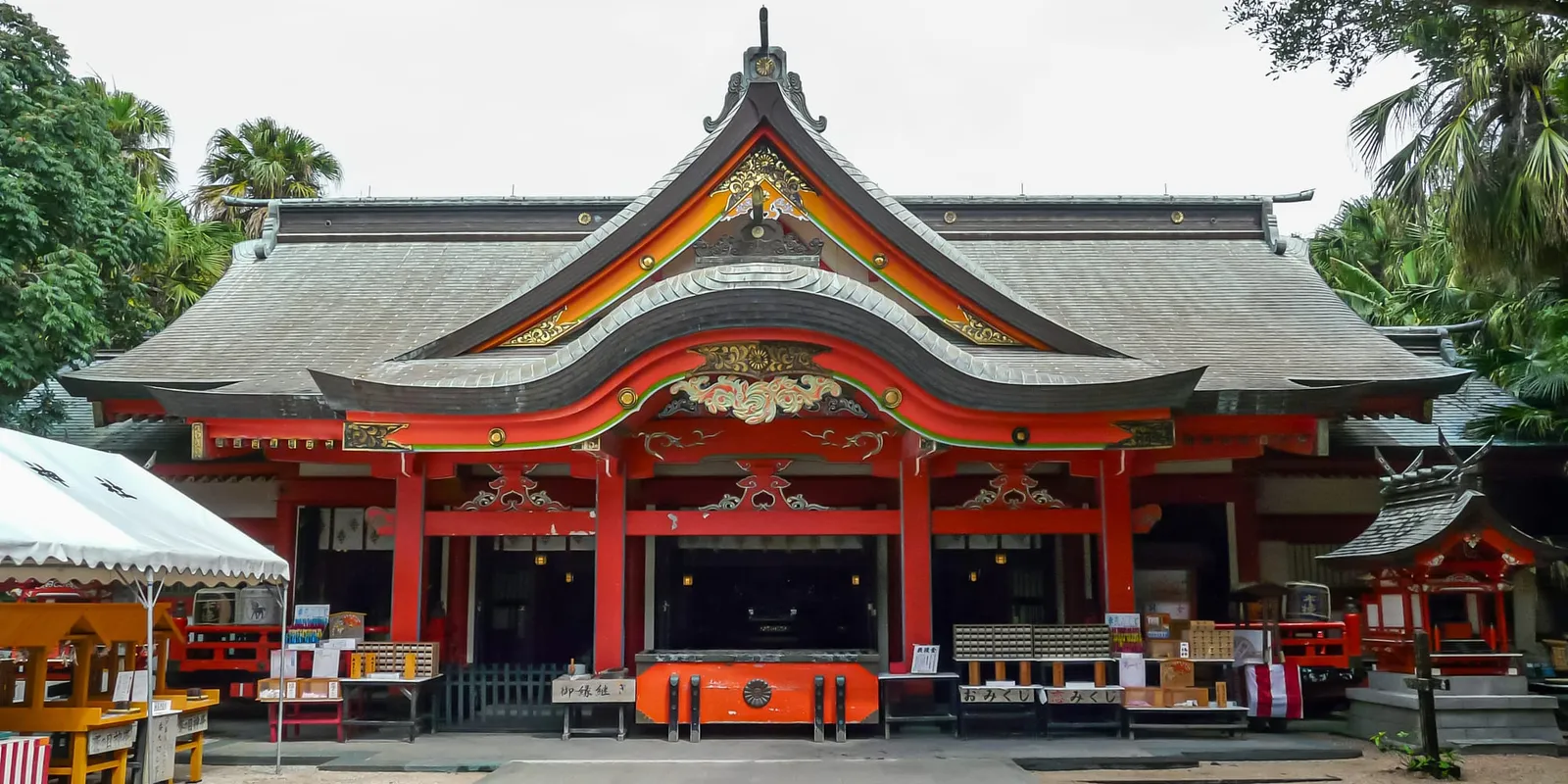
The shrine’s vermillion buildings are striking against the backdrop of subtropical greenery, making the worship hall a popular photo spot. The grounds also include a subsidiary shrine to Benzaiten, one of the Hyuga region’s Seven Lucky Gods, and visitors can receive a two-part goshuin covering both Aoshima Jinja and Benzaiten together.
Visiting Tips
The grounds are open from 6:00 AM until sunset, and the office for goshuin and amulets is open 8:00 AM–5:00 PM. Access is convenient by train, about a 10-minute walk from JR Aoshima Station, or about 15 minutes by car from Miyazaki IC on the Miyazaki Expressway or from Miyazaki Airport. A paid lot at the approach entrance (up to ¥500/day, open 24 hours) is useful for early visits, while free parking near Aoshima Station is available 8:00 AM–5:00 PM.
The Devil’s Washboard is most impressive and easiest to walk on at low tide, so it’s worth checking the tide times before your visit. The wooded paths deeper into the island can be uneven underfoot, so comfortable shoes are recommended if you plan to walk as far as Motomiya. Summers on the island can be hot and humid beneath the dense subtropical canopy, so bring water.
Annual Festivals
- Hadaka Mairi (January, around Coming-of-Age Day): A traditional purification rite in which participants brave the midwinter cold to cleanse themselves in seawater, praying for good health in the year ahead. The ritual is said to commemorate Yamasachihiko’s return from the sea god’s palace, and draws roughly 500 participants from across Japan each year. The 2026 event is scheduled for Sunday, January 18.
- Spring Grand Festival (16th day of the 3rd lunar month): A festival praying for a bountiful harvest and peace throughout the year.
- Summer Grand Festival (17th–18th days of the 6th lunar month): A midsummer rite for good health.
- Autumn Grand Festival (October 18): A festival of thanksgiving for the autumn harvest.
Nearby Food & Sightseeing
- Aoshima Unari-dori Shopping Street: A row of souvenir shops and eateries lining the approach to the island, serving Miyazaki specialties like chicken nanban and dishes made with local seafood.
- Miyako Botanic Garden Aoshima: A subtropical botanical garden right beside the shrine, filled with palms, cycads, and other tropical greenery.
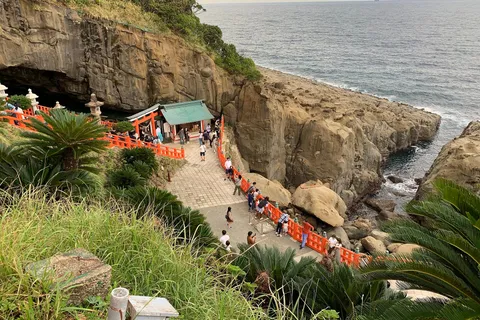
- Udo Jingu: About 30 minutes by car, this celebrated shrine on the Nichinan coast has its vermillion main hall built directly inside a sea cave. Many visitors combine it with a trip to Aoshima Jinja.
Frequently Asked Questions
- Q. Can I get a goshuin here?
- A. Yes, at the shrine office open 8:00 AM–5:00 PM, for ¥600. It comes as a set of two stamps — one for Aoshima Jinja and one for Benzaiten of the Hyuga Seven Lucky Gods — and the two cannot be received separately.
- Q. What are the visiting hours?
- A. The grounds are open from 6:00 AM until sunset. The office where goshuin and amulets are available is open 8:00 AM–5:00 PM.
- Q. How do I get to Aoshima Jinja?
- A. It's about a 10-minute walk from JR Aoshima Station on the Nichinan Line. By car, it's about 15 minutes from Miyazaki IC on the Miyazaki Expressway or from Miyazaki Airport.
- Q. Is parking available?
- A. Yes, there's a paid lot at the approach entrance (up to ¥500/day, open 24 hours), plus free parking at Aoshima Station's east and west exits, open 8:00 AM–5:00 PM.
- Q. What is the "Devil's Washboard"?
- A. It's the popular name for the rippled rock formation that rings the entire island. Geologically known as the "Uplifted Seabed and Deformed Wave-Cut Marks of Aoshima," it formed as alternating layers of hard sandstone and soft mudstone, deposited on the deep seafloor millions of years ago, were repeatedly uplifted by earthquakes and carved by wave erosion. It was designated a National Natural Monument in 1934.