History
Futenmagu is a shrine in Futenma, Ginowan City, Okinawa. The official site gives its name as “Futenmagu” (ふてんまぐう) and also calls it “Futenma Gongen.” The district is written 普天間, while the shrine is written 普天満宮. It is one of the eight shrines of the Ryukyu Kingdom’s “Ryukyu Hassha (Kansha)” system, which gave them special treatment by the royal government, and the official site describes it as the largest sacred site in central Okinawa.
According to the official history, the shrine began in ancient times with the worship of ancient Ryukyuan deities in the Futenma cave. Later, in the reigns of King Shō Kinpuku (尚金福王) to King Shō Taikyū (尚泰久王) (1450–60), Kumano Gongen was enshrined there too, the site says. The official site does not give a formal list of enshrined deities. Japanese Wikipedia says that besides Kumano Gongen (including Izanami), ancient Ryukyuan deities such as the sun deity, the dragon-palace (Niraikanai) deity and the Futenma goddess are worshipped. The same Wikipedia says the shrine buildings were lost in the Battle of Okinawa and rebuilt after the war (we could not confirm this on the official site).
The official history also says that people once made pilgrimages in the 9th lunar month carrying stacked boxed meals, and that royalty, officials and commoners all came, so the grounds were busy throughout that month.
Highlights
The shrine’s best-known feature is Futenmagu Cave, which stretches behind the main hall. According to the official grounds guide, the cave is 280 m long with two entrances and three large open areas, and shows “cave notches” marking where water once flowed. The official site says excavations near the east entrance found artifacts about 3,000 years old from the early-to-middle Okinawan shell-mound period, as well as fossils of the Ryukyu deer, Ryukyu muntjac and wild boar about 20,000 years old. The cave was designated a scenic site (meishō) by Ginowan City on August 1, 1991.
In April 2024, the Ryukyu Shimpo reported that the archaeology laboratory of Okinawa International University announced the discovery in this cave of a Paleolithic hearth dated to roughly 32,000–18,000 years ago. An inner shrine (okumiya) lies deep in the cave, and the official site lists “inner shrine (cave) visits” among its notices.
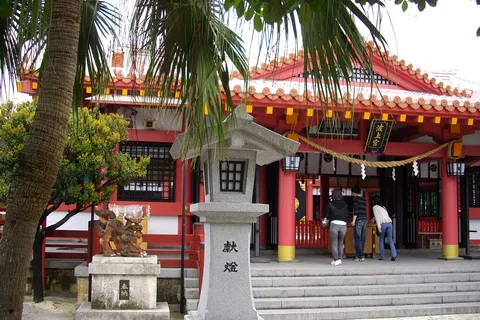
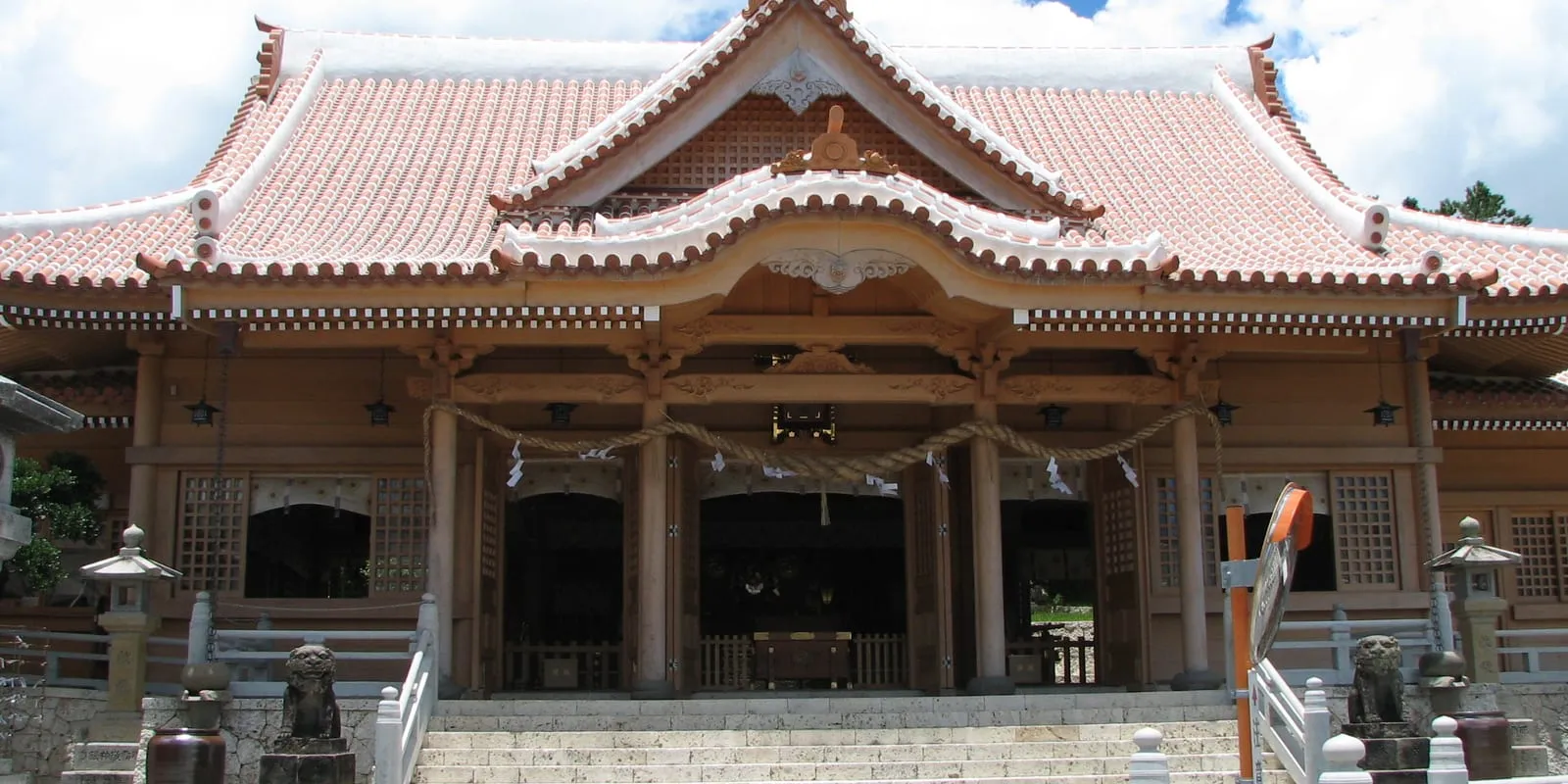
The main and worship halls have the red-tiled roofs typical of Okinawa (as the photos here show), and there is also a collection point for old amulets and charms (furufuda-nōsho). The official grounds guide also carries a photo labeled as the cave crawl during the summer purification rite (Nagoshi no Ōharae).
Visiting Tips
According to the official FAQ, Futenmagu is open every day of the year. From May 2026 (Reiwa 8) the hours are 9:00 AM–5:30 PM for amulets, 9:00 AM–4:30 PM for prayer reception (prayers start at 9:30 AM) and 9:50 AM–4:30 PM for cave visits. Cave visits are free and arranged at the amulet counter, and offerings are made at the main hall, not in the cave. Prayers are normally not by reservation (groups and first shrine visits for newborns can reserve), take about 15 minutes each, and you may have to wait when it is busy.
For anyone receiving a prayer, the official site asks visitors to avoid revealing clothing (tank tops, very short shorts or skirts, beach sandals), to take off hats and sunglasses, to refrain from eating, drinking and talking inside the hall, and to silence phones. Pets are not allowed.
The official site does not mention goshuin. Its “Ofuda, Omamori and more” page lists items such as the zodiac amulets, academic-success amulets, matchmaking amulets and traffic-safety amulets, with no prices given. The safest way to find out whether goshuin are offered is to call the shrine office (098-892-3344).
The official access page is only a map image; guide sites say it is a few minutes’ walk from the “Futenma” bus stop. The official FAQ says parking is available, with the entrance on the right side of the torii gate.
Annual Festivals
- Annual festival (15th day of the 9th lunar month): The official prayer page says no prayers are held on the 15th day of the 9th lunar month, the day of the annual festival. In 2026 the festival was held on October 24 and 25: on the 24th, prayers and cave visits ran 10:00 AM–3:00 PM, and on the 25th neither prayers nor cave visits were offered, the shrine announced.
- Saitan-sai to Joya-sai: According to the official site, from the New Year’s Day ceremony to the year-end ceremony, there are 76 regular ceremonies a year, counting both solar and lunar calendars.
- Nagoshi no Ōharae (summer purification): The official grounds guide has a photo of the cave crawl. The date is not stated on the official site.
- New Year first prayers and the large ema: First prayers for companies and groups for January 2027 (Reiwa 9) were announced with phone reservations from October 1. Students of Futenma High School’s art club also dedicate a large ema; the one for the Year of the Rabbit in 2023 (Reiwa 5) was the 15th, according to the official blog.
- Shichi-Go-San: The official site has posted its 2026 (Reiwa 8) Shichi-Go-San information.
Many festival dates follow the lunar calendar, so check the “news” section of the official site for the latest.
Nearby Food & Sightseeing
- Kakazu Takadai Park: A park that Ginowan City materials describe as built on a Battle of Okinawa battlefield and as a place to learn local war history. The same materials say the globe-themed observation deck overlooks the city.
- Sakima Art Museum: A museum in Uehara, Ginowan. According to reports such as the Ryukyu Shimpo’s, it permanently displays the series 「沖縄戦の図」 by Iri Maruki and Toshi Maruki. Check the museum’s official site for exhibits and visiting conditions.
Frequently Asked Questions
- Q. What are the visiting and amulet hours?
- A. According to the official FAQ, Futenmagu is open every day with no regular closing day. From May 2026 (Reiwa 8), amulets are handed out 9:00 AM–5:30 PM and prayer requests are accepted 9:00 AM–4:30 PM (prayers begin at 9:30 AM). Opening hours for the grounds themselves are not stated on the official site. Hours change during the annual festival and around New Year, so check the official site or call 098-892-3344 beforehand.
- Q. Can I get a goshuin at Futenmagu?
- A. The official site does not mention goshuin that we could find. Its "Ofuda, Omamori and more" page lists only ofuda, omamori and household altars (kamidana), with no goshuin. Whether they are offered, the fee and the hours could not be confirmed, so please ask the shrine office (098-892-3344) before you go.
- Q. Can I visit the cave (inner shrine)?
- A. The official FAQ says cave visits are arranged at the amulet counter and no admission fee is charged. From May 2026 the hours are 9:50 AM–4:30 PM. Offerings are made at the main hall, not inside the cave. On festival days the hours change: for the 2026 annual festival the shrine announced 10:00 AM–3:00 PM on Saturday, October 24 and no cave visits on Sunday, October 25.
- Q. How do I get there, and is there parking?
- A. The official site's access page is only a map image, with no written directions. Guide sites and Japanese Wikipedia put it a few minutes on foot from the "Futenma" bus stop (sources differ between 2 and 5 minutes). By car, the official FAQ says there is parking, with the entrance on the right side of the torii gate. The number of spaces and any fee are not stated.
- Q. When is the annual festival?
- A. The official site announced the 2026 annual festival (Reitaisai) for October 24 and 25. The official prayer page says no prayers are held on the festival day, the 15th day of the 9th lunar month; because the schedule follows the lunar calendar, the date in the solar calendar changes each year. The official site says the shrine holds 76 regular ceremonies a year, counting both solar and lunar calendars.
Plan Your Visit
Before you go, you can book a stay and get your shrine-visit items ready.
Amazon links open Amazon.co.jp (Japan) in English; whether an item ships overseas depends on the product.
※ Contains ads (PR). Links open external sites such as Amazon, Rakuten, Trip.com and Booking.com.