History
Hakozaki-gu is counted, together with Usa Jingu and Iwashimizu Hachimangu, as one of Japan’s “Three Great Hachiman Shrines” (some accounts list Tsurugaoka Hachimangu in Iwashimizu’s place), and it has long been venerated as the Ichinomiya (first shrine) of Chikuzen Province. Its history is traditionally traced to 921 CE, when Emperor Daigo bestowed the imperial calligraphy “Tekikoku Kofuku,” and the shrine is said to have been founded in 923 CE, when it was relocated to its present site from Chikuzen Oita-gu (Honami-gu). Its principal deity is Emperor Ojin, known as Hachiman Okami, enshrined together with his mother Empress Jingu and Tamayori-hime no Mikoto.
Revered from its earliest years as a guardian of the nation, the shrine was ranked a Kanpei-taisha (an Imperial Shrine of the first rank) from the Meiji era until the shrine-ranking system was abolished in 1946. It is also recorded in the Engishiki Jinmyocho, the official register of shrines compiled in 927.
The Mongol Invasions of Japan
Hakozaki-gu has a direct historical connection to the Mongol invasions of Japan — the Bun’ei Campaign of 1274 and the Kōan Campaign of 1281. During the Bun’ei Campaign, the shrine’s buildings are said to have been burned in the fighting. Facing this national crisis, retired Emperor Kameyama personally wrote out the “Tekikoku Kofuku” calligraphy and dedicated it to the shrine, also contributing to the rebuilding of its halls. It is from this history that Hakozaki-gu came to be widely venerated as a deity of protection from misfortune and victory.
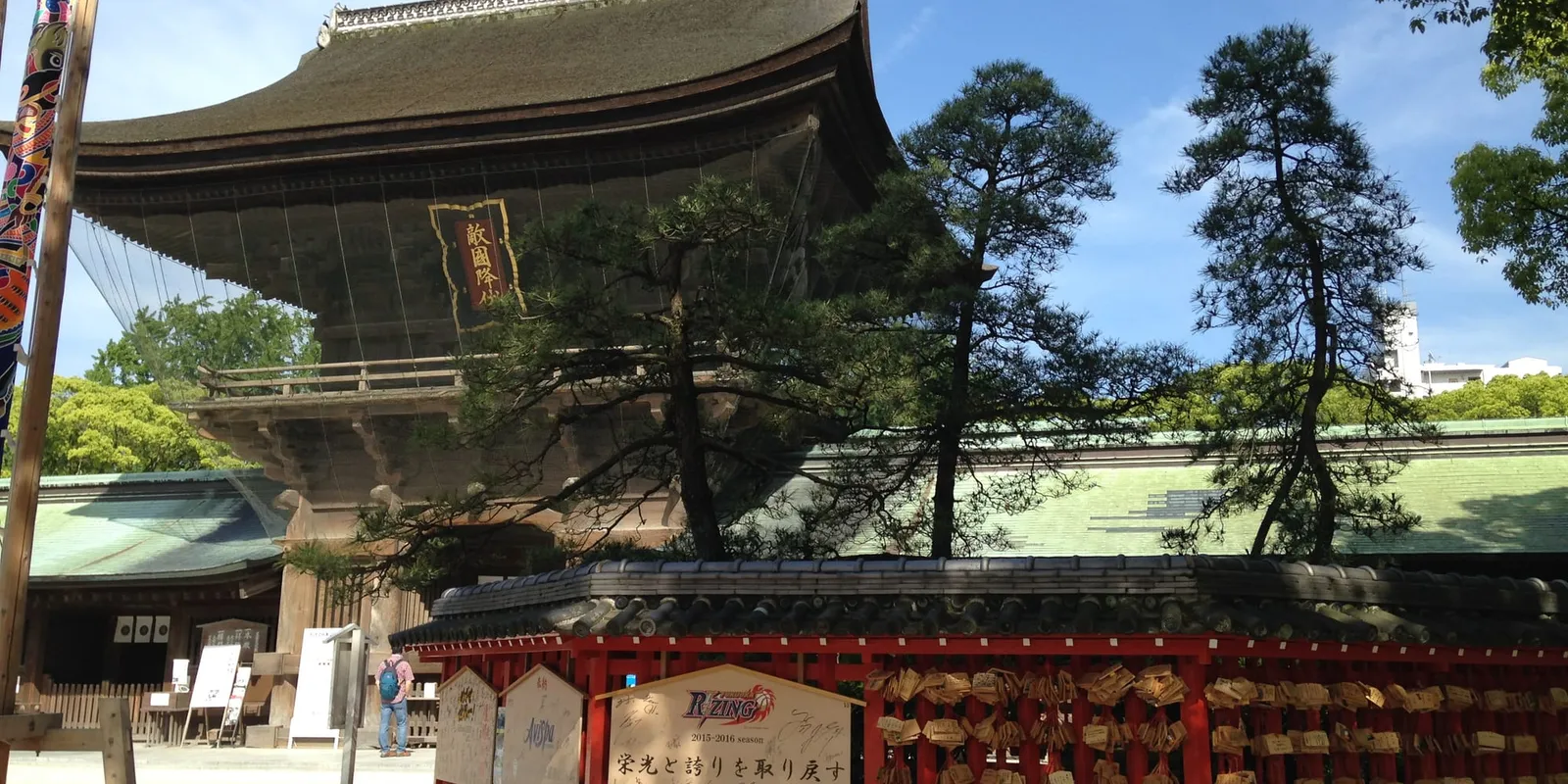
The plaque bearing “Tekikoku Kofuku” seen on the tower gate today is an enlarged copy of Emperor Kameyama’s calligraphy, mounted when the gate was rebuilt in 1594 by Kobayakawa Takakage, lord of Najima Castle. The phrase itself expresses a prayer that an adversary be brought to submission through virtue rather than force. Along the approach to the shrine stand two “Mongol anchor stones” (Genko Ikariishi), stone anchors said to have been used aboard Mongol invasion vessels and now designated a Tangible Cultural Property of Fukuoka Prefecture — a physical trace of that history preserved on the shrine grounds.
Highlights
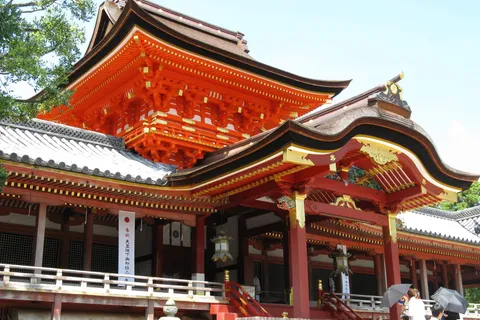
The present tower gate (Romon) was built in 1594 by Kobayakawa Takakage, lord of Najima Castle, and is designated a National Important Cultural Property. Its three-bay, single-story form with a hip-and-gable cypress-bark roof is also known as “Fukuteki-mon” (the Gate of the Subdued Enemy), after the “Tekikoku Kofuku” plaque it carries. The main hall and worship hall, built even earlier in 1546 by Ouchi Yoshitaka, Deputy Governor-General of Dazaifu, are likewise designated a National Important Cultural Property. The first torii gate at the entrance to the approach, erected in 1609 by Kuroda Nagamasa, lord of Fukuoka Domain, is distinguished by its unusually thick pillars — a style known as the “Hakozaki torii” — and is also a National Important Cultural Property.
Within the grounds stands the sacred pine “Hakomatsu,” associated with a legend of repelling the invading fleet during the Mongol invasions, and well worth a visit alongside the shrine’s other landmarks.
Visiting Tips
The shrine grounds are open 6:00–19:00, but the office where goshuin and amulets are available closes earlier, at 17:30, so it’s worth allowing enough time. Access is excellent from Hakozaki-Miyamae Station, about a 3-minute walk, and JR Hakozaki Station is also within walking distance. Two paid parking lots — Miyamae Parking and Gaien Parking — line the approach, making a visit by car straightforward as well.
Annual Festivals
- Tamaseseri (January 3): A vigorous ritual in which loincloth-clad men fight to grab hold of two sacred wooden balls representing yin and yang. Counted among Kyushu’s three great festivals, it is said to forecast the year’s fortune — a good harvest if the “land side” team takes the ball, a good catch at sea if the “shore side” team does — and touching the ball is believed to ward off misfortune and bring good luck.
- Hojoya (September 12–18): The shrine’s largest annual festival and one of Hakata’s three great festivals, a rite of thanksgiving and remembrance for all living things. Stalls line the approach throughout the festival, drawing large crowds of visitors.
Nearby Food & Sightseeing
- Hakozaki Shopping Street — A local shopping street lining the approach to Hakozaki-gu, with restaurants and shops convenient for a stop before or after your visit.
- Komugiji Hakozaki — A udon and soba noodle shop about a 6-minute walk from the shrine, convenient for a meal after paying your respects.
Frequently Asked Questions
- Q. What are the visiting hours?
- A. The shrine grounds are open 6:00–19:00. The amulet and goshuin office is open 8:30–17:30, and prayer service reception runs 9:00–16:30.
- Q. Can I get a goshuin here?
- A. Yes, at the shrine office, open 8:30–17:00, for a fee of ¥500.
- Q. How do I get to Hakozaki-gu?
- A. It's about a 3-minute walk from Exit 1 of Hakozaki-Miyamae Station on the Fukuoka City Subway Hakozaki Line. It's also about a 5-minute walk from JR Hakozaki Station.
- Q. What does the "Tekikoku Kofuku" plaque on the tower gate mean?
- A. "Tekikoku Kofuku" (敵国降伏), meaning roughly "may the enemy nation submit," is a prayer that an adversary be brought to submission through virtue rather than force. The phrase originates from an imperial calligraphy bestowed by Emperor Daigo in 921. During the Mongol invasions of Japan (1274 and 1281), retired Emperor Kameyama personally wrote out the phrase again and dedicated it to the shrine as a prayer for the nation's protection. When the tower gate was rebuilt in 1594, an enlarged copy of Emperor Kameyama's calligraphy was mounted as the plaque seen there today, giving the gate its alternate name, "Fukuteki-mon" (the Gate of the Subdued Enemy).
- Q. What is the Tamaseseri festival?
- A. Held every year on January 3rd, Tamaseseri (also called Tamatori-sai) is a vigorous ritual in which loincloth-clad men fight to grab hold of two wooden balls, representing yin and yang, after they are ritually purified. The contest is split between a "land side" and a "shore side" team; tradition holds that a good harvest follows if the land side takes the ball, and a good catch at sea follows if the shore side does. Touching the ball is said to ward off misfortune and bring good luck. Its exact origins are unclear, but it was already being held by the Muromachi period, and it is counted as one of Kyushu's three great festivals.
Related Shrines
Fukuoka Prefecture, Dazaifu
Dazaifu Tenmangu
Dazaifu Tenmangū
- Academic Success
- Exam Success
- Protection from Misfortune
Oita Prefecture, Usa
Usa Jingu
Usa-jingū
- Victory in Competition
- Protection from Misfortune
- Household Safety
Kyoto Prefecture, Yawata
Iwashimizu Hachimangu
Iwashimizu Hachimangū
- Protection from Misfortune
- Victory in Competition
- Household Safety