History
Imado Shrine stands in the Imado district of Taito Ward, close to the Sumida River. According to the official website, it began in 1063 (Kohei 6, during the reign of Emperor Go-Reizei), when the father and son Minamoto no Yoriyoshi and Yoshiie, who were campaigning against Abe no Sadato and Munetō in the north, invited Iwashimizu Hachimangu of Kyoto to the site and founded Imado Hachiman. In 1081, Yoshiie prayed here for victory before setting out against Kiyohara no Takehira and Iehira, and after winning he repaired the shrine buildings in gratitude.
In the Edo period, the buildings were rebuilt in 1636 (Kan’ei 13) on the orders of Tokugawa Iemitsu. The shrine was destroyed again in the Great Kanto Earthquake of 1923 and the Tokyo air raids of 1945, and was rebuilt each time. In July 1937 it merged with the neighboring Hakusan Shrine and took the name Imado Shrine. The present buildings date from November 1971. It enshrines Emperor Ojin, Izanagi no Mikoto, Izanami no Mikoto, and Fukurokuju, one of the Seven Lucky Gods. The official website explains that Izanagi and Izanami, the divine couple of the creation myths, have long been revered as deities who bind relationships together.
Highlights
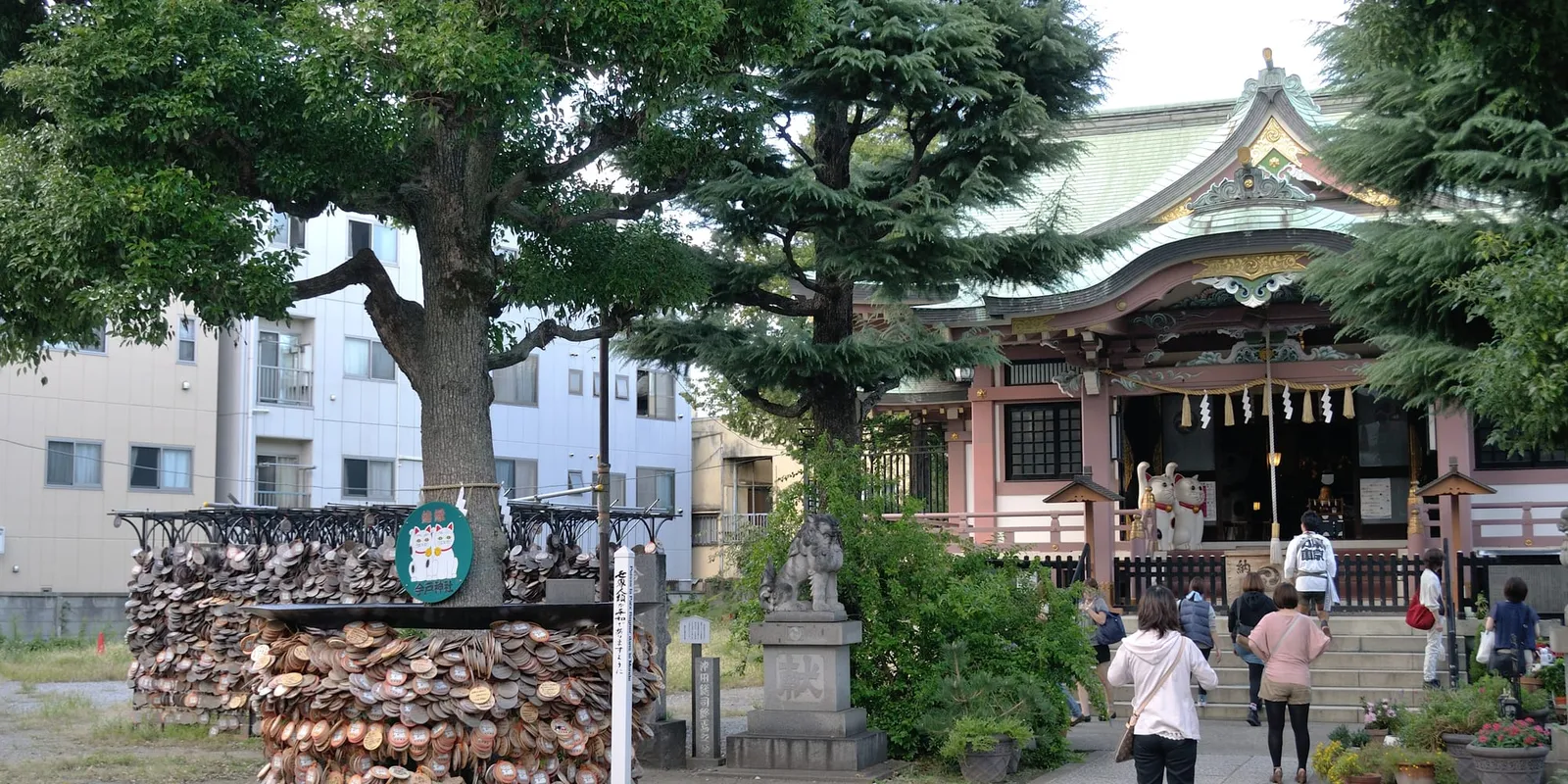
Imado Shrine is known as a shrine for good matchmaking, and it also claims to be one of the birthplaces of the maneki-neko (beckoning cat). Cat figures of all sizes are set out in the grounds and shrine buildings, and beside the main hall sit two “stone-stroking cats” said to be called Izanagi and Izanami after the shrine’s deities (stroking them is said to bring good fortune). The ema (votive plaques) are perfectly round, a play on “go-en” (connection) and “en” (circle), and the en-musubi omamori (¥1,000 according to the official website) is also softly rounded in shape.
The story most often told about the maneki-neko is that, in the late Edo period, a poor old woman gave up her beloved cat, which then appeared in her dream and asked to be made into a figure in its likeness; she made cat dolls from Imado-yaki pottery, sold them, and they became popular. The district was a center of Imado-yaki, and a monument in the grounds marks it as the birthplace of Imado-yaki. However, it has been pointed out that the old record of this tale describes the dolls being sold within the grounds of Sensoji, not a link to Imado Shrine itself, and other places also claim the maneki-neko’s origin. It is best enjoyed as a local tradition of being “one of the birthplaces.”
The grounds also hold a monument marking the “last place of Okita Soji,” the Shinsengumi swordsman. It rests on the fact that Matsumoto Ryojun, the shogunate physician who treated Okita’s tuberculosis, lived here, and the monument records the tradition that Okita died on this spot. A leading alternative account holds that he was later moved to a gardener’s house in Sendagaya and died there, so there are several theories about where he actually died.
Visiting Tips
The shrine office (amulets and goshuin) is open 9:00 AM–4:00 PM every day of the year. The official website states there is no parking and no restroom, so it is best to come by train or bus and use a restroom beforehand. Goshuin are offered as pre-written sheets only, and a recent guide article reports a fee of ¥500, but fees can change, so please confirm at the office. Besides the main goshuin, which includes a maneki-neko and Fukurokuju stamp, there is also reported to be a Fukurokuju goshuin for the Asakusa Seven Lucky Gods pilgrimage.
Prayer services are by reservation, covering matchmaking prayers, household safety, business prosperity, Shichi-Go-San, traffic safety, and more, as well as company and group prayers. The guideline offering is around ¥10,000 (per the official website). The shrine is also one of the stops on the Asakusa Seven Lucky Gods pilgrimage (Fukurokuju) and the “Tokyo Shitamachi Hassha-mairi” circuit of eight shrines. It is about a 15-minute walk from Asakusa Station, so the bus (get off at “Riverside Sports Center-mae,” including the Kita-Meguri loop bus, then walk about 1 minute) can be handy.
Annual Festivals
- Reitaisai grand festival (first Saturday and Sunday of June): The shrine’s grand annual festival, as listed in the official calendar of main annual events.
- Tansai-sai (January 1) and Seijin-sai (January 15): New Year observances (from the official calendar of annual events).
- Setsubun-sai (February 3 or 4), Kigen-sai (February 11), and Toshigoi-sai (February 17): Observances as spring approaches.
- Oharae purification rites (June 30 and December 31): Purification rites; on December 31 the burning of old talismans and the Joya-sai (New Year’s Eve service) are also held.
- Shichi-Go-San-sai (November 15) and Niiname-sai (November 23): Autumn and early-winter observances.
- Tsukinami-sai (the 1st and 15th of each month): Monthly observances.
- En-musubi-kai: A matchmaking event for single men and women, first held on October 26, 2008. Participation requires advance registration and a postcard application, with a lottery; the fee is ¥10,000 (including prayer, tea and sweets) and participants must be aged 25 to 59, according to the official website. Please check the official website for dates and current recruitment details.
Nearby Food & Sightseeing
- Matchiyama Shoden: A temple close to Imado Shrine, known in Asakusa as a Shoden (Kangiten) temple. Together with the shrine, it makes for a quiet walk through the shitamachi streets.
- Sumida Park: A park stretching along the Sumida River, with the Yamaya-bori plaza near Imado Shrine for a riverside stroll.
- Yamaya-bori Park: A long, narrow park of about 700 m laid out on the site of the old Yamaya-bori canal. The surviving pillars of the old Imado Bridge, close to the Sumida River, can still be seen.
- Sensoji: Known as Tokyo’s oldest temple and the center of Asakusa sightseeing, a classic stop to add on after your visit.
Frequently Asked Questions
- Q. What are the shrine office hours?
- A. According to the official website, the shrine office is open from 9:00 AM to 4:00 PM, every day of the year. Prayer services are by reservation, made in person or by phone (03-3872-2703).
- Q. Can I get a goshuin?
- A. The official website says goshuin are offered as pre-written sheets only (except for the Asakusa Seven Lucky Gods shikishi and fuku-e). A recent guide article reports a fee of ¥500, but fees can change, so please confirm at the shrine office.
- Q. Is there parking or a restroom?
- A. The official website states that there is no parking and no restroom. Arriving by train or bus is recommended, and it is wise to use a restroom beforehand.
- Q. Why is it called a birthplace of the maneki-neko?
- A. The area was a center of Imado-yaki pottery, and the tradition says that cat figurines made of Imado-yaki became popular in the late Edo period. Other places also claim the title, so Imado Shrine is known as "one of the birthplaces" of the maneki-neko.
- Q. When is the annual grand festival?
- A. The official annual calendar lists the Reitaisai (grand festival) on the first Saturday and Sunday of June. Other observances include the New Year's Day Tansai-sai on January 1, Setsubun-sai on February 3 (or 4), and Shichi-Go-San-sai on November 15.
Plan Your Visit
Before you go, you can book a stay and get your shrine-visit items ready.
Amazon links open Amazon.co.jp (Japan) in English; whether an item ships overseas depends on the product.
※ Contains ads (PR). Links open external sites such as Amazon, Rakuten, Trip.com and Booking.com.