History
Imizu Jinja stands on the site of the old keep (Honmaru) of Takaoka Castle in the heart of Takaoka Kojo Park, Takaoka, Toyama. Its name is read “Imizu,” and the official site styles it “Etchu Sochinju Ichinomiya” (the chief shrine of Etchu Province). The official site names Futagami no Kami as the enshrined deity and says that since the Meiji era this deity has been worshipped as Ninigi no Mikoto.
According to the official site, the shrine is thought to have begun as a place of worship for the sacred Mt. Futagami itself, with its founding placed in ancient times. It first stood at the foot of Mt. Futagami about 5 km north of its present site, and until the Edo period was revered as “Futagamiyama Daigongen” under the blend of Shinto and Buddhism. The name “Imizu” is said to derive from the “Imizu no Kuni no Miyatsuko” recorded in the early Heian-period “Kokuzo Hongi.” The shrine’s chronology notes that in 905 (Engi 5) the Engishiki register of shrines (Izumo manuscript) lists it as the only Myojin Taisha in Etchu Province, and that in 1163 (Chokan 1) it is recorded as the “Etchu Ichinomiya.”
It was ranked a Kokuhei Chusha (national mid-rank shrine) in 1871 (Meiji 4), and on September 16, 1875 (Meiji 8) it moved from Mt. Futagami to the Honmaru site of Takaoka Castle. The shrine explains that it is the only ichinomiya in Japan whose buildings stand on a castle site from the Edo period. The Great Takaoka Fire of 1900 spread to the shrine, and in 1902 (Meiji 35) the four buildings (main hall, worship hall, offering hall and shrine office) were completed. According to the official site, the present shinmei-style buildings were designed by Ito Chuta and built by Matsui Kakuhei (松井角平). In 2025 (Reiwa 7), to mark 150 years since the relocation, the periodic grand festival events were held from September 13 to 17.
Highlights
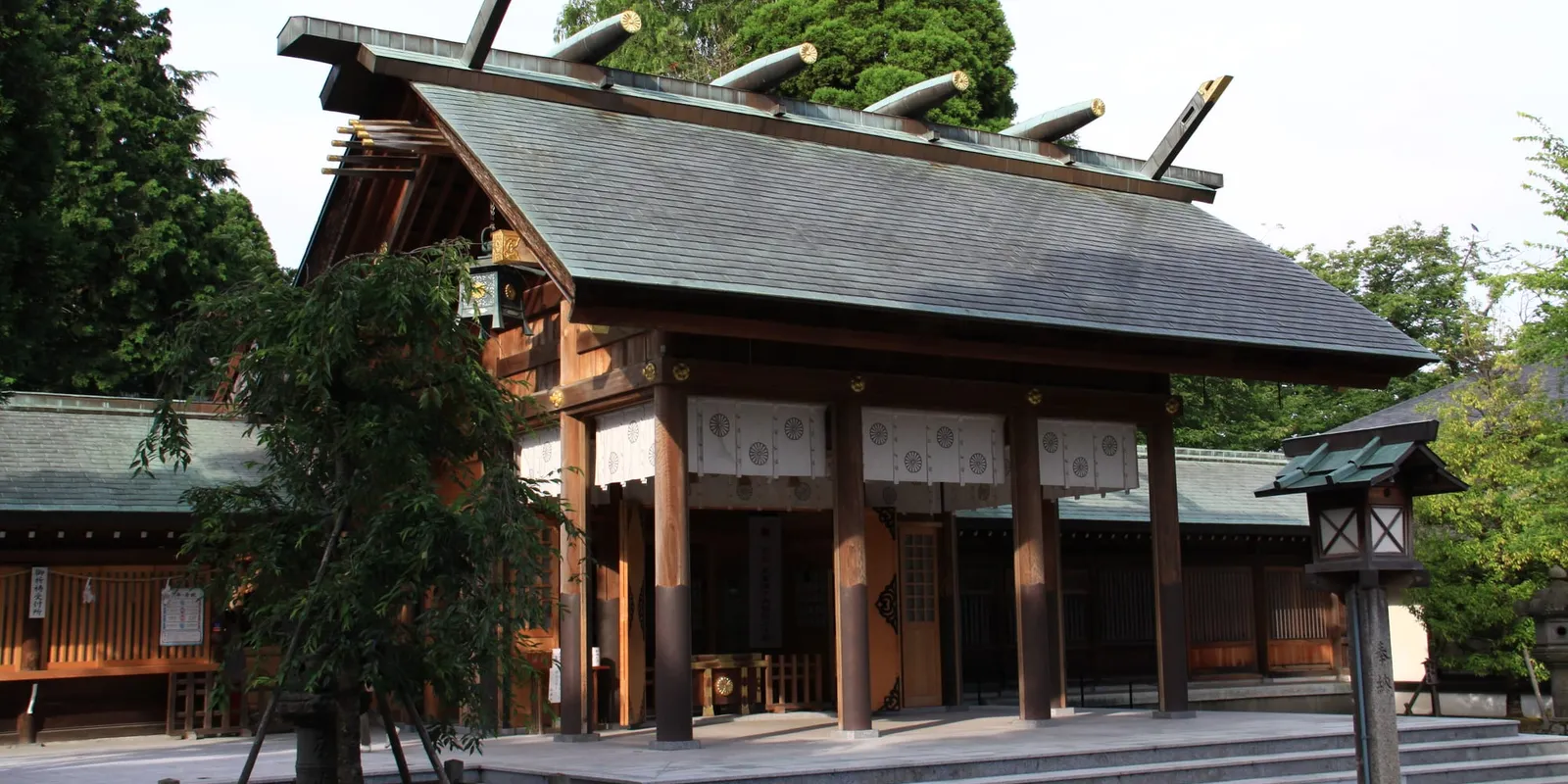
The centerpiece of the grounds is the worship hall and main hall built in 1902. According to the official grounds guide, the main hall has six katsuogi (roof billets) against four on the worship hall. As part of the 150th-anniversary project, the copper roofs of the buildings were re-covered and restored. The plaque on the middle gate is by Prince Arisugawa Taruhito, and the grounds also hold the First Torii of Kiso cypress (about 4.8 m high), given by the Ise Jingu in 2015, and a torii granted in 1929 on the occasion of the Showa Emperor’s enthronement ceremonies.
The sacred red plum tree was donated in 1875 and is said to be over 400 years old (official site); its hollow trunk is described as forming a heart shape. According to the official site, the grounds guide also covers the purification pavilion completed in 2015, the sumo ring that was first built in Kojo Park in 1923 and later moved to its present site, and Chushun Bridge (commonly called Taiko-bashi) over the outer moat of Kojo Park.
The shrine’s home, Takaoka Kojo Park, is the site of Takaoka Castle, associated with Maeda Toshinaga, the first lord of the Kaga domain, and is a nationally designated Historic Site (designated April 2015). The official site says it covers about 210,000 square meters, roughly a third of it water moats, and is a park listed among the “100 Best Cherry Blossom Spots in Japan,” with about 2,700 cherry trees. The shrine also has four auxiliary shrines on and around Mt. Futagami, and the Takaoka City Gokoku Shrine (a massha) stands at Tsubakiyama (椿山) inside Kojo Park.
Visiting Tips
The official site lists the shrine office and amulet counter as open 9:00 AM–5:00 PM and prayer reception as 9:00 AM–4:30 PM, with the first prayer of the day at 9:30 AM. Individuals do not need to book a prayer. The Sanshuden hall is currently being renovated: according to the shrine’s notice dated September 26, 2026, a new amulet counter and a prayer reception and waiting area are to be built facing the purification pavilion (no completion date is given). The shrine office roof is also reported to be re-covered, so counter locations may change during the work. Calling the shrine office at 0766-22-3104 is recommended.
The official site lists a kirie goshuin (¥1,000, limited quantity), a shrine original in pale green (¥1,500), and a gold goshuin available only on Ichiryumanbai days (¥1,500). The kirie design changes by month and season, and the shrine says the latest information is posted on the shrine’s official Instagram. The price of goshuin books and goshuin-only hours are not stated on the official site.
It is about a 10-minute walk from Takaoka Station on the Ainokaze Toyama Railway. By car, a visitors’ lot inside the grounds (in front of the archery range, etc.) is available, but the shrine sits in the middle of Kojo Park, the entrance is hard to find, and car navigation may end its guidance outside the park, the official site warns. During the New Year period (January 1–3) a free temporary parking area opens, and from 11:00 PM on December 31 to 7:00 PM on January 1 traffic is controlled on the surrounding roads and inside the park. A notice dated October 21, 2026 also sets out rules for photographers on the grounds, including collecting a photography permit at the prayer reception and amulet counter before shooting.
Annual Festivals
Main events from the official annual-events page (dates as stated there):
- Tsuitachi-sai (1st of every month): Monthly “tsukitate” sweets themed on the season, Etchu Province or the Manyoshu are offered and then sold after the ritual.
- Sagicho, the Imizu fire festival (January 14): A sacred fire kindled by the ancient friction method called maigiri is used to burn New Year decorations and old amulets.
- Setsubun festival with the grand ceremony for good fortune and warding off misfortune (開運厄除大祭・節分祭) (February 3)
- Reisai, the main spring festival (April 23): The most important ritual of the year, in which two shrine maidens perform the “Urayasu no Mai.” On the same day at 2:00 PM, the Tsukiyama ritual (築山行事, a Toyama Prefecture intangible folk cultural property) is held at Futagami Imizu Jinja at the foot of Mt. Futagami, the shrine’s original site.
- Nagoshi no Oharae (June 30)
- Tanabata-sai (August 1–7)
- Autumn festival (September 16): Held on the anniversary of the relocation, it gives thanks for the deity’s blessings and the harvest.
- Shichi-Go-San visits (October 1–November 30)
- Niiname-sai (November 23)
- Toshikoshi no Oharae (December 29)
- New Year’s visit (January 1–3): The Saitan Daikigan-sai is held on New Year’s Day, and a free temporary parking area opens.
Event dates can change, so check the “Festivals and Annual Events” page on the official site for the latest.
Nearby Food & Sightseeing
- Takaoka Kojo Park: The castle-site park where the shrine stands. According to the official site, it offers scenery through the seasons and about 2,700 cherry trees in spring.
- Zuiryuji Temple: A Soto Zen temple whose Sanmon (main gate), Butsuden (Buddha Hall) and Hodo (Dharma Hall) are National Treasures (designated December 3, 1997, per the temple’s official site). Visiting hours are 9:00 AM–4:30 PM (closing at 4:00 PM from December 10 to January 31), with adult admission listed at ¥500.
- Imizu Saryo: A café inside the Sanshuden hall (stone-milled matcha and more). The official site’s page says reservations are required and it is closed Tuesdays and Wednesdays, and also says it is temporarily closed for rebuilding with the reopening date to be announced, so call (0766-22-0808) before visiting.
- Mt. Futagami: The shrine’s original site, about 5 km to the north and 274 m high. According to the official site, the poet Otomo no Yakamochi wrote many poems about it, and there is an 8-km drive course called the Futagami Manyo Line.
Frequently Asked Questions
- Q. What are the visiting hours?
- A. The official site lists the shrine office and amulet counter as open 9:00 AM–5:00 PM and prayer reception as 9:00 AM–4:30 PM, with the first prayer of the day starting at 9:30 AM. Individuals do not need to book a prayer (groups must reserve in advance). Opening and closing times for the grounds themselves are not stated on the official site. A notice dated September 26, 2026 says the Sanshuden hall is under renovation, with a new amulet counter and a prayer reception and waiting area being built; it says visitors may be inconvenienced until the work is finished. It does not say where the counters operate in the meantime, so it is safest to ask the shrine office (0766-22-3104).
- Q. Can I get a goshuin at Imizu Jinja?
- A. Yes. The official site lists a kirie (paper-cut) goshuin at ¥1,000 (limited quantity, with designs that change by month and season), a shrine original in pale green at ¥1,500, and a gold goshuin at ¥1,500 available only on Ichiryumanbai days. It directs visitors to the shrine's official Instagram for the latest kirie designs. Goshuin-only hours and the price of goshuin books are not stated on the official site, so aim to arrive early, using the 9:00 AM–5:00 PM shrine office and amulet counter hours as a guide.
- Q. How do I get there, and is there parking?
- A. Per the official site, it is about a 10-minute walk (about 3 minutes by car) from Takaoka Station on the Ainokaze Toyama Railway. From Shin-Takaoka Station on the Hokuriku Shinkansen, transfer to the JR Johana Line for the roughly 3-minute ride to Takaoka. By car it is about 15 minutes from Takaoka IC on the Notsu Expressway. A visitors' lot inside the grounds (in front of the archery range, etc.) takes cars and large buses, though the number of spaces and any fee are not stated. The shrine sits in the middle of Takaoka Kojo Park and the entrance is hard to find; car navigation may end its guidance at the edge of the park, so the official site asks visitors to follow the red arrows on its map.
- Q. Which deity is enshrined, and what are the benefits?
- A. According to the official site, the enshrined deity is Futagami no Kami, who dwells on Mt. Futagami and since the Meiji era has been worshipped as Ninigi no Mikoto, the central figure of the myth of the heavenly grandson's descent to earth. The listed blessings are abundant harvests, business prosperity, household safety, matchmaking, good fortune and warding off misfortune, and opening the way forward. The site explains the matchmaking blessing as coming from the myth in which Ninigi united the deities Ame no Uzume and Sarutahiko.
- Q. When are the Sagicho fire festival and the main festival?
- A. According to the official annual-events page, the Sagicho (called the "Imizu fire festival") is held on January 14, the most important annual festival (the spring festival) on April 23, and the autumn festival on September 16. At the Tsuitachi-sai ritual on the 1st of each month, "tsukitate" sweets themed on the season, Etchu Province or the Manyoshu are offered and then sold. Dates can change, so check the official site for the latest.
Plan Your Visit
Before you go, you can book a stay and get your shrine-visit items ready.
Amazon links open Amazon.co.jp (Japan) in English; whether an item ships overseas depends on the product.
※ Contains ads (PR). Links open external sites such as Amazon, Rakuten, Trip.com and Booking.com.