
History
Oyama Jinja is the great shrine of Mount Tateyama worship, venerating Mount Oyama (3,003 meters), the highest peak of the Tateyama range, as its object of worship. According to shrine tradition, in 701 (Taiho 1) a man named Saeki no Ariyori was led into Tateyama’s sacred heights by a white falcon and a bear, and there opened the mountain to religious practice. Ever since, Tateyama has been revered as one of Japan’s three great sacred mountains alongside Mount Fuji and Mount Haku, and Oyama Jinja has taken shape as three linked sites: the Mine-honsha (peak main shrine) at the summit of Mount Oyama itself, the Chugu Kigan-den (middle shrine prayer hall) at Ashikuraji on the mountain’s flank, and this Maetate-shadan (front shrine altar), down on the plains at Iwakuraji.
Because the Mine-honsha sits in the harsh environment of the summit, it can only be visited during the short summer climbing season. For that reason, this Maetate-shadan — set on a river terrace where the Jokanji River fans out onto the plain — has long functioned as the shrine’s effective sato-miya, the site most visitors actually reach. Its deities are Izanagi no Kami (known here as Tateyama Daigongen or Oyama no Kami, whose honji-suijaku Buddhist form is Amida Nyorai) and Amenotajikarao no Kami (known as Tao Tenjin or Tsurugidake no Kami, whose honji form is Fudo Myoo), preserving the syncretic Shinto-Buddhist character that long defined Tateyama worship.
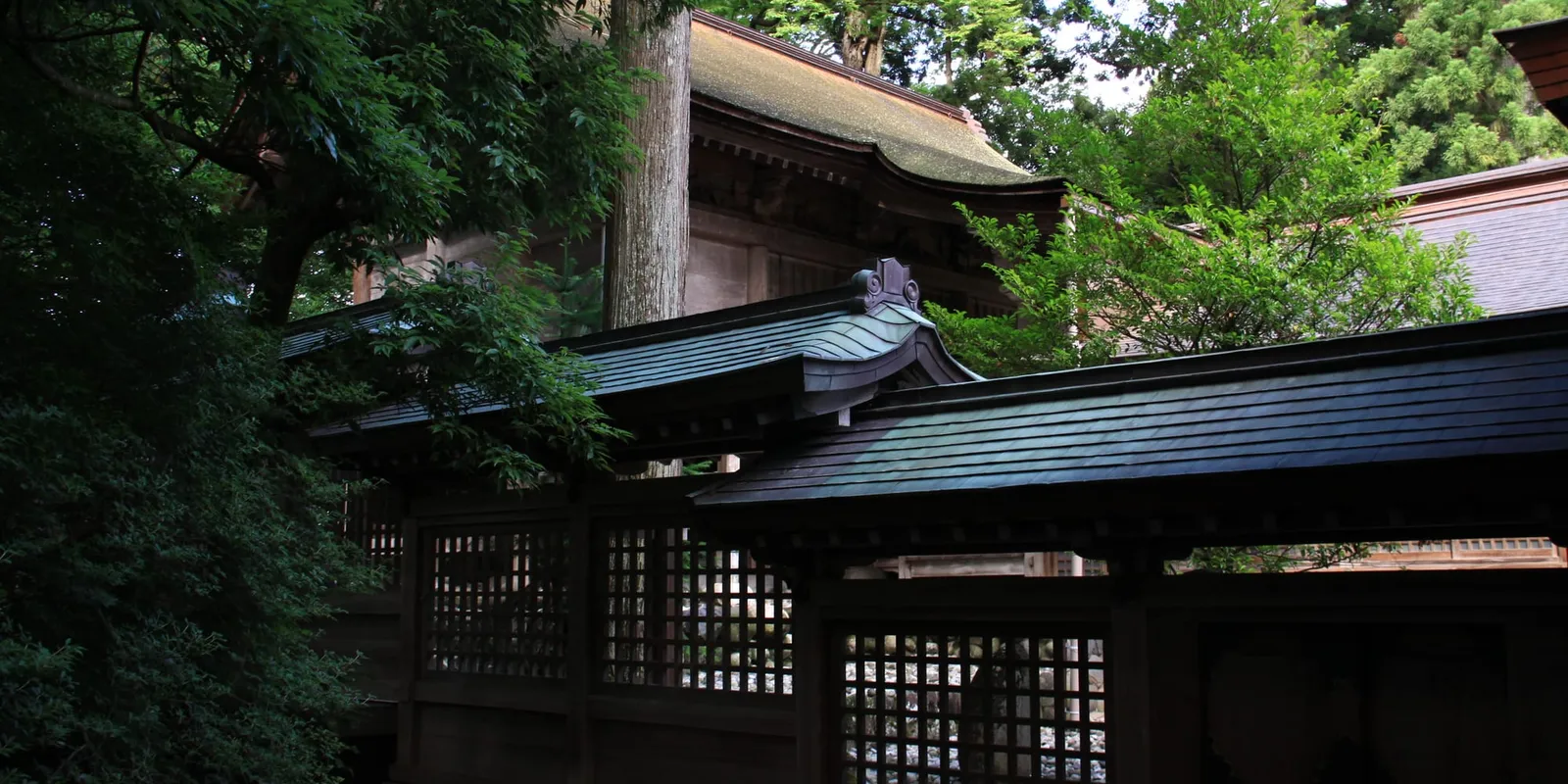
The present honden is believed to date from the Muromachi period and, as the largest surviving shrine main hall in the Hokuriku region, was designated a National Important Cultural Property in 1906. Historical figures including Minamoto no Yoritomo, Ashikaga Yoshitane, and Sassa Narimasa are all said to have venerated the shrine, a testament to the patronage of generations of warlords and rulers who helped maintain its buildings over the centuries.
Highlights
The single greatest highlight of the Maetate-shadan is its honden, built in the five-bay nagare-zukuri style with a cypress-bark roof in the Muromachi tradition. Among surviving shrine main halls in the Hokuriku region, it is one of the largest, its interior finished in red and black lacquer with gilt fittings in a solemn, dignified style. Passing through the Omote-shinmon gate, the sheer weight of history is palpable in the honden standing beyond the haiden.
The grounds themselves occupy a quiet spot on the bank of the Jokanji River, the sound of running water mingling with the greenery of the torii and sacred grove for a calm, contemplative atmosphere. Visiting the Mine-honsha and Chugu Kigan-den as well gives a fuller sense of how Tateyama worship spans from the summit all the way down to the plain.
Visiting Tips
Visiting the Maetate-shadan alone takes about 20–30 minutes, but since goshuin stamps can be received separately at the Mine-honsha, the Chugu Kigan-den, and the Maetate-shadan, visitors wanting the fuller picture of Tateyama worship should also plan to visit the Chugu Kigan-den at Ashikuraji and the Tateyama Museum, both about 20 minutes away by car. Reaching the Mine-honsha at the summit requires proper mountaineering gear and is only possible during the summer climbing season (roughly early July to early September) — a very different undertaking from visiting the Maetate-shadan or Chugu Kigan-den.
Annual Festivals
- Saitan-sai (January 1), Nikku-hajime-sai / Traffic Safety Prayer Rite (January 2), and Gensi-sai (January 3): New Year rites celebrating the year’s arrival and praying for safety and prosperity ahead.
- Autumn Grand Festival (November 3): The Maetate-shadan’s most important festival, featuring a dance designated as an intangible cultural property of the town.
- Oharai and Omisoka Rites (December 31, 4:00 PM and 11:00 PM): Purification rites closing out the year and welcoming in the new one.
- Monthly Festival and Traffic Safety Prayer Rite (1st of every month): A recurring monthly rite praying for the safety and peace of the local community.
Nearby Food & Sightseeing
- Oyama Jinja Chugu Kigan-den: One of the three linked sites making up Oyama Jinja, set among centuries-old Tateyama cedars at Ashikuraji — many visitors combine a visit here with the Maetate-shadan.
- Tateyama Museum: A wide-ranging museum complex at Ashikuraji, including “Mandara Yuen,” an open-air installation that brings the Tateyama Mandala’s world of Tateyama faith to life — an excellent way to learn the history behind the shrine.
- Tateyama Soba (Murodo branch): A popular stand-up soba counter at Murodo, the gateway station of the Tateyama Kurobe Alpine Route, serving local specialties like Tateyama pork soba to hikers and sightseers.
Frequently Asked Questions
- Q. What are the visiting hours?
- A. 8:30–16:30.
- Q. When is the goshuin office open?
- A. 8:30–16:30, for ¥500.
- Q. Is there parking?
- A. Yes, free parking is available along the Jokanji River beside the shrine.
- Q. Can I visit the summit shrine too?
- A. The summit shrine (Mine-honsha) sits atop Mt. Oyama and is only reachable via a full mountain hike, roughly July to September. This shrine, Maetate-shadan, serves as the year-round satoyama shrine for most visitors.
- Q. How do I get there?
- A. About a 10-minute walk from Iwakuraji Station on the Toyama Chiho Railway Tateyama Line.
Related Shrines
Tokyo, Shibuya
Meiji Jingu
Meiji-jingū
- Good Fortune
- Good Relationships
- Household Safety
Osaka Prefecture, Nishi Ward, Osaka
Samuhara Shrine
Samuhara-jinja
- Protection from Misfortune
- Good Fortune
- Good Health
Kyoto Prefecture, Sakyo-ku, Kyoto
Heian Jingu
Heian-jingū
- Good Fortune
- Protection from Misfortune
- Household Safety