History
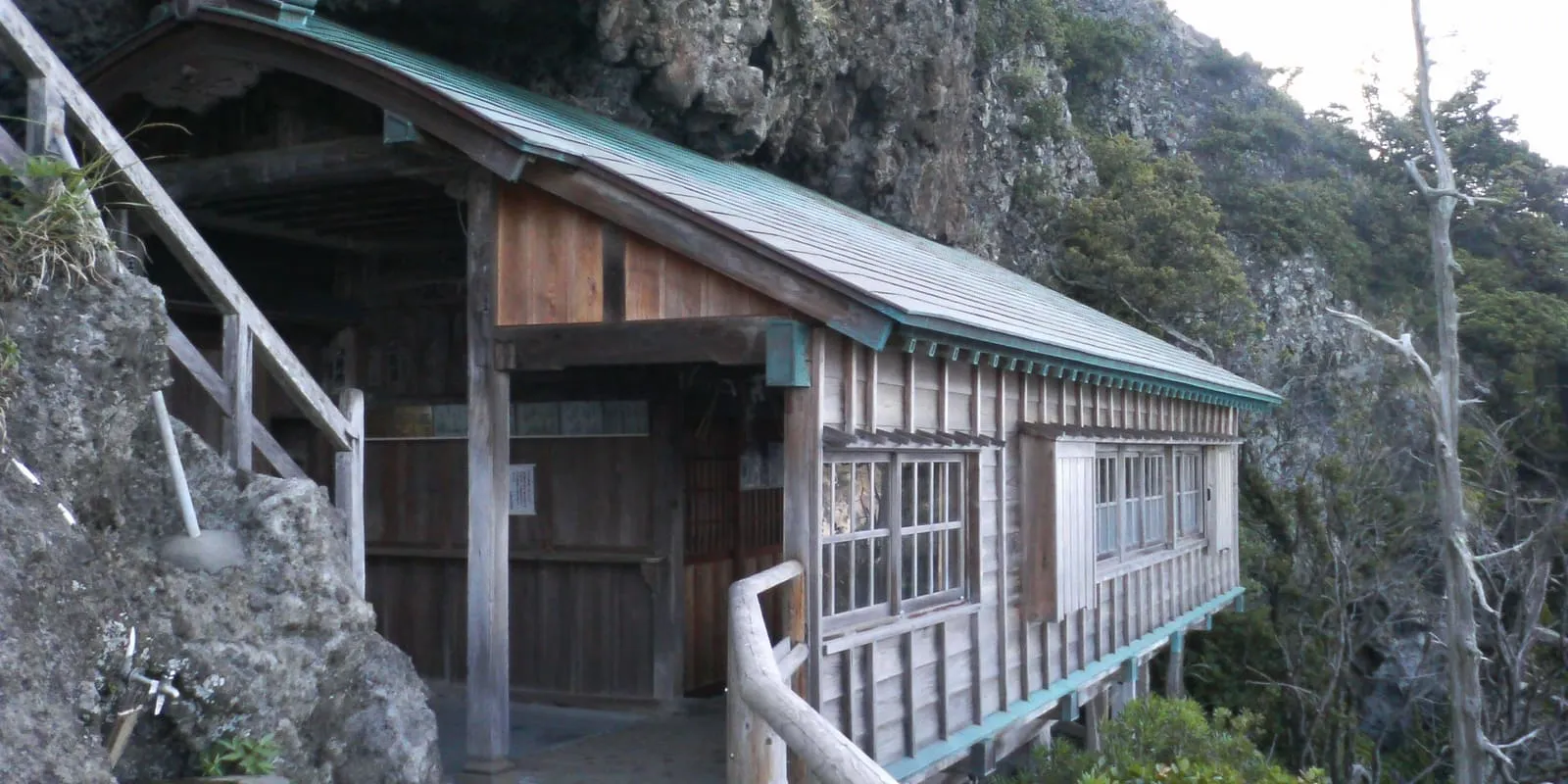
Ishimuro Jinja sits near the tip of Cape Irozaki, the southernmost point of the Izu Peninsula, its shrine building set directly into a rock cavity in a sheer sea cliff. According to shrine tradition, it was founded in 701 CE, during the reign of Emperor Monmu. It is said to have originally been a hall enshrining a statue of Kannon and the deity Dairokuten, until the Nara-period ascetic En no Ozunu — founder of Japan’s Shugendo mountain-worship tradition — received a divine oracle and enshrined the deity now worshipped here, Iware no Mikoto.
The Heian-period Engishiki shrine register, compiled in 927, lists an “Iware no Mikoto Shrine” in Kamo District, Izu Province, making Ishimuro Jinja one of the old, officially recognized shrines from that era. From the medieval period onward it was also known as Iro Gongen or Irozaki Gongen, and given its position on a cape jutting into the Pacific, it has long been venerated by fishermen and sailors as a guardian of safety at sea. The current shrine building, rebuilt in 1901, has watched over Cape Irozaki for more than 1,300 years.
A second shrine, Kumano Jinja (formerly Kumano Gongen), also stands near the tip of the cape. It too was once worshipped as a deity of maritime safety, but later became known as a deity of good relationships as well, and was renamed Kumano Jinja following the separation of Buddhism and Shinto in the early Meiji period. Ishimuro Jinja and Kumano Jinja stand next to each other, and many visitors pay their respects at both.
A Shrine Built Into a Cliff: The Legend of the Ship’s Mast
Ishimuro Jinja’s defining feature is that its main building is set directly into the rock face of a sheer coastal cliff. The rugged rock of Cape Irozaki formed from lava that once erupted from an undersea volcano and cooled rapidly on contact with seawater; salt that seeped into the rock later crystallized and broke it apart from within, a process known as tafoni weathering, carving countless honeycomb-like hollows into the cliff face. Ishimuro Jinja makes use of one of these natural hollows as the setting for its shrine building, creating a scene unlike almost any other — as if the shrine were held in the cliff’s embrace.
Supporting that building is the “mast of Iro Gongen,” one of the canonical Seven Mysteries of Izu (Izu Shichi Fushigi). According to legend, a thousand-koku cargo ship once carried salt from the port of Hamada in Harima Province (present-day Hyogo Prefecture) toward Edo when it was caught in a storm off Cape Irozaki. Its owner prayed to Iro Gongen, vowing to dedicate the ship’s mast if the vessel were spared, and the storm cleared, allowing the ship to reach Edo safely. On the return voyage, however, having entirely forgotten his vow, the owner found his ship mysteriously unable to move as it approached Cape Irozaki again, and the weather turned violent once more. Recalling his earlier promise, he resolved to cut the mast down with an axe — and the roughly 12-meter mast is said to have ridden the waves on its own, up a cliff some 30 meters high, coming to rest near the shrine building as though it were offering itself. At that moment, the storm is said to have subsided at once, and the ship returned safely to Harima.
That very mast still forms part of the foundation beneath the shrine building today, and a glass panel set into part of the floor allows visitors to look down and see it directly. Exactly how such a structure came to be built into the cliff face remains part of its mystique, and the sight has been passed down for generations as one of the Seven Mysteries of Izu.
A Recent TV Spotlight
On September 13, 2026, Ishimuro Jinja was featured on TV Asahi’s variety show Nanikore Chinhyakkei, in a segment titled “Discovered at the Tip of the Izu Peninsula! A Mysterious Structure and Oddly Named Companies.” The show introduced it as a structure standing “at the tip of Minami-Izu, Shizuoka” and “one of the Seven Mysteries of Izu,” whose method of construction remains something of a mystery. The image of a shrine seemingly built straight into a cliffside cavity reached viewers across the country through the broadcast, drawing fresh attention to just how unusual the sight is. That said, this is a shrine with a tradition stretching back to 701 CE, and the recent TV segment is only a brief glimpse of a much longer history.
Visiting Tips
Reaching Ishimuro Jinja means walking in from Irozaki Ocean Park along a coastal footpath. Park in the Ocean Park’s paid lot (¥500 for cars), then walk about 15–20 minutes to reach Cape Irozaki Lighthouse and Ishimuro Jinja. The shrine grounds themselves have no strict visiting hours, but the facility as a whole, including the parking lot, is open from 9:00 to 16:00, and vehicles cannot leave the lot after 16:00 — so it’s best to plan your visit with plenty of time to spare.
The shrine office is generally open from about 10:00 to 15:00, and that’s also where you can request a goshuin (around ¥300). It is staffed only when the priest happens to be present rather than on a strict schedule, so calling ahead is a good idea if getting a goshuin matters to you. The cliffside approach has some uneven footing, and can become slippery in strong wind or wet weather, so comfortable, sturdy footwear is recommended.
Nearby Food & Sightseeing
- Cape Irozaki Lighthouse: A white lighthouse designed by the British engineer Richard Henry Brunton and built in 1871, recognized as one of Japan’s 50 selected lighthouses. It stands right next to Ishimuro Jinja and offers a sweeping panorama of the Pacific Ocean.
- Kumano Jinja: A shrine standing next to Ishimuro Jinja near the tip of Cape Irozaki. Originally worshipped, like Iro Gongen, as a deity of maritime safety, it later also became known as a deity of good relationships.
- Irozaki Ocean Park: The gateway facility for visiting Cape Irozaki, with parking, shops, and a rest area. It’s also a popular viewpoint in its own right, looking out over the cape’s dramatic cliffs.
Frequently Asked Questions
- Q. Who is enshrined at Ishimuro Jinja?
- A. Ishimuro Jinja enshrines Iware no Mikoto. According to shrine tradition, the ascetic En no Ozunu, founder of Japan's Shugendo mountain-worship tradition, received a divine oracle in the Nara period and enshrined this deity here. The Heian-period Engishiki shrine register (927 CE) also lists it as the "Iware no Mikoto Shrine," one of the officially recognized shrines of Izu Province at the time. From the medieval period onward it was also known as Iro Gongen or Irozaki Gongen, and has long been venerated by fishermen and sailors as a guardian of safety at sea.
- Q. Why is Ishimuro Jinja considered one of the Seven Mysteries of Izu?
- A. Ishimuro Jinja's main building stands on a sheer cliff face, built atop the mast of a cargo ship (about 12 meters long) that was once dedicated to the shrine — and this "mast of Iro Gongen" is counted among the Seven Mysteries of Izu (Izu Shichi Fushigi). According to legend, a thousand-koku cargo ship carrying salt from Harima (in present-day Hyogo Prefecture) to Edo was caught in a storm off Cape Irozaki, and its owner vowed to dedicate the ship's mast to Iro Gongen if the ship were spared. The ship reached Edo safely, but on the return voyage, having forgotten his vow, the owner found his ship suddenly unable to move off Cape Irozaki as a storm blew in again. Remembering his promise, he cut down the mast with an axe, and it is said to have ridden the waves on its own, up the roughly 30-meter cliff, coming to rest near the shrine as if offering itself — at which point the storm subsided. Part of the shrine building's floor has a glass panel, so visitors today can still see this mast in place beneath the building.
- Q. I heard Ishimuro Jinja was recently featured on Japanese TV?
- A. On September 13, 2026, Ishimuro Jinja was featured on TV Asahi's variety show Nanikore Chinhyakkei, in a segment titled "Discovered at the Tip of the Izu Peninsula! A Mysterious Structure and Oddly Named Companies." The segment introduced it as a mysterious structure "at the tip of Minami-Izu, Shizuoka" and "one of the Seven Mysteries of Izu," whose method of construction remains unclear. The sight of a shrine built directly into a cliffside cavity, resting on an old ship's mast, drew considerable attention from viewers seeing it for the first time.
- Q. Can I get a goshuin at Ishimuro Jinja?
- A. Yes, goshuin are available. The shrine office is generally open from about 10:00 to 15:00, and the fee is around ¥300. It is staffed only when the priest is present rather than on a fixed schedule, so calling ahead is recommended if you specifically want to be sure of receiving one.
- Q. How do I get to Ishimuro Jinja, and is there parking?
- A. Take a Tokai bus about 40 minutes from Izukyu-Shimoda Station and get off at "Irozaki Ocean Park," then walk about 15–20 minutes along the coastal path from the paid parking area (¥500 for cars). By car, it's about 2 hours 40 minutes from the Numazu interchange on the Tomei Expressway via National Route 414. Visits are effectively limited to Irozaki Ocean Park's opening hours (9:00–16:00), and vehicles cannot leave the parking lot after 16:00, so plan to arrive with time to spare.