History
Kameyama Hachimangu stands in Nakanocho, in the center of Shimonoseki, Yamaguchi, facing the Kanmon Strait. Its name is read “Kameyama Hachimangu,” and it is affectionately called “Seki no Ujigami-sama” and “Kameyama-sama.” According to the official site, the enshrined deities are Emperor Ojin, Empress Jingu, Emperor Chuai and Emperor Nintoku, and the deity was invited here from Usa Hachimangu in 859 (Jogan 1) in the Heian period.
According to the official history, this place was once an island. In 859, while the deity was being invited from Usa Shrine (Oita) to Iwashimizu Hachimangu (Kyoto) to protect the capital, the party moored at the foot of the island. That night an oracle said, “This mountain is pure, and I love it most. Enshrine me here for a while, then continue on your way,” and the imperial envoy is said to have ordered the provincial lord to build a temporary shrine and enshrine the deity before setting out for Kyoto again (as recorded in “Bocho Shaji Yurai” of the Kyoho era). The official site says the name “Kameyama” (Turtle Mountain) is said to come either from the island’s turtle-like shape at the time, or from the fact that the mountain where the Hachiman deity of Usa is enshrined is also called Kameyama.
The official site records the later history as well. When trade with Ming China began in the Muromachi period, Ming-bound ships offered swords to the shrine and prayed for safe voyages. The lord Ouchi Yoshioki is said to have asked the ruler of Korea in 1506 (Eisho 3) for a contribution toward restoring the shrine, and the hall and gate tower were repaired with those funds. His successor Yoshitaka donated a territory of 550 koku, and the Mori lords that followed gave 300 koku and built a Noh stage and other structures. In 1702 (Genroku 15) it was named one of the “Three Shrines of Nagato Province.” It was ranked a gosha in 1874 (Meiji 7) and a prefectural shrine (kensha) in 1901 (Meiji 34), and was listed as a Beppyo Shrine in 1968 (Showa 43). It is revered as the ujigami of Shimonoseki’s 60 neighborhoods.
Highlights
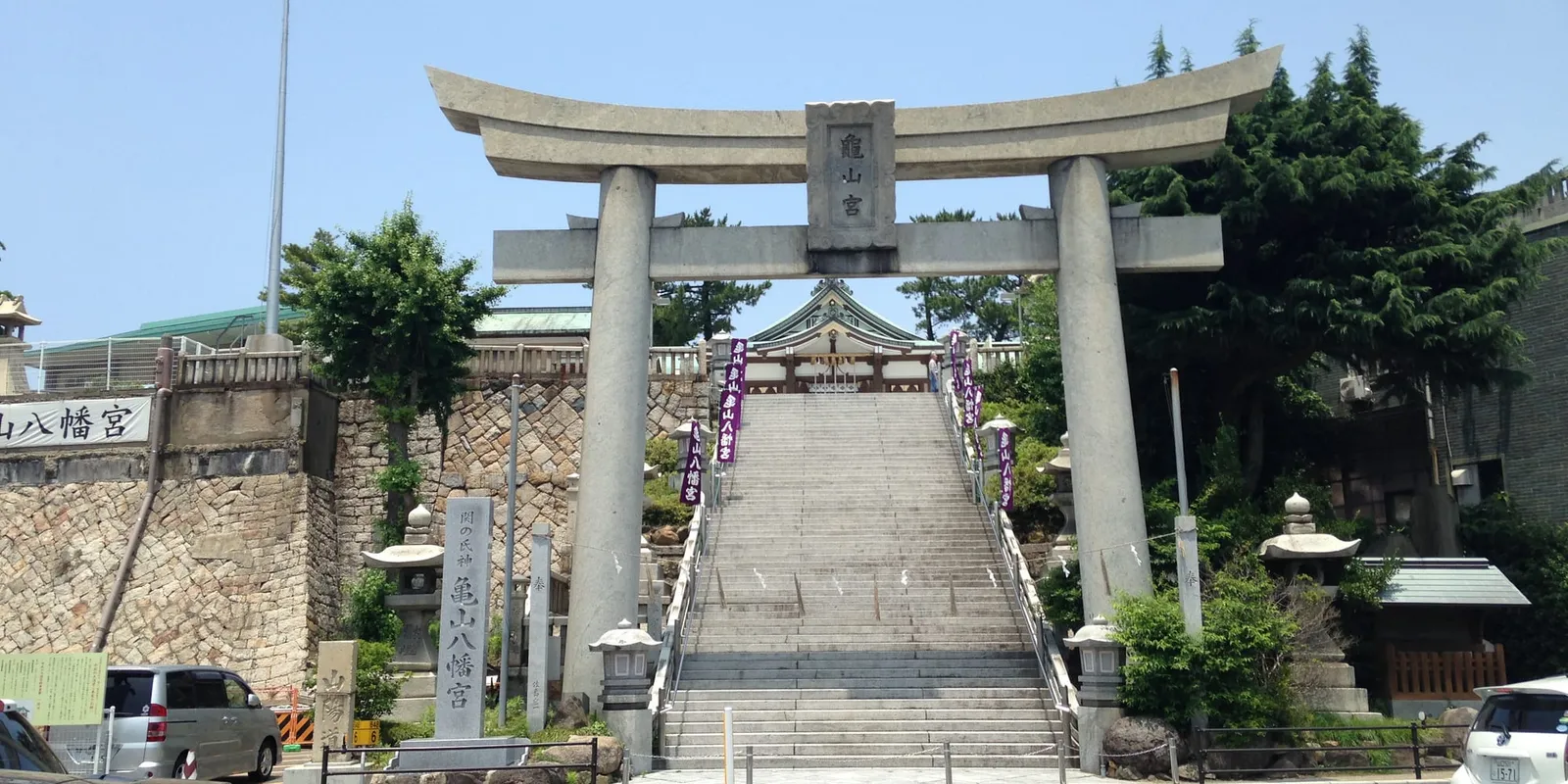
The official guide to the grounds introduces many sights. They include the “Nihon-ichi” (number one in Japan) Great Torii (granite, erected in 1933), the “Nihon-ichi” Fugu Statue (rebuilt in 1990), both labeled this way in the official guide, and “Shinki,” a large granite turtle (erected in 2002). In Shimonoseki, pufferfish is called “fuku,” and the shrine’s amulet guide says it is cherished as a symbol of good fortune.
The sub-shrines are Miyajidake Shrine (the official site lists Okinagatarashihime-no-mikoto and others), Kumataka Inari Shrine (Ukanomitama-no-mikoto), Ebisu Shrine (Kotoshironushi-no-kami and Okuninushi-no-mikoto), and Okame Myojin Shrine. The “Okame Ginkgo” is introduced as a sacred tree linked to “Okame-san,” who is said to have been a human pillar sacrifice for the Shimonoseki land reclamation. The grounds also hold a literary monument to the writer Fumiko Hayashi (erected in 1966), poem monuments to Misuzu Kaneko, a haiku monument to the Muromachi-period linked-verse poet Iio Sogi, the Taiko Cycad said to have been planted by Toyotomi Hideyoshi, a “birthplace of barbers” monument, the “Okame Chaya Ato” site linked to Ito Hirobumi and his wife Umeko, and the “Kameyama Battery Site,” where the first shot heralding the dawn of modern Japan is said to have been fired.
The official site notes that Jippensha Ikku wrote of the view from Kameyama Hachimangu in his “Kanekusa-waraji,” and that the view over the Kanmon Strait has long been praised as “the finest spot in Chinzei” and “the foremost barrier of the western seas.”
Visiting Tips
The gate opens at 8:00 AM and closes at 6:00 PM (from April 1, 2026; it opens at 6:00 AM on the 1st and 15th). Per the official site, prayer requests are accepted 9:00 AM–4:00 PM, and the amulet and goshuin counter is open 9:00 AM–6:00 PM.
Among the amulets, the official site says the “Katsu-mamori” victory charm (¥1,000) is the one the shrine distributes most, described as a charm of the god of martial fortune that the Genji also revered. There are also the “Fuku Fuku-mamori” in the shape of a pufferfish, a “Health and Longevity” charm themed on the turtle, and a turtle traffic-safety sticker. Shichi-Go-San prayers need no reservation, start from ¥5,000 per child, and are accepted all year round.
Regular goshuin are ¥500 each for Kameyama Hachimangu and Okame Myojin Shrine. The monthly flower-and-bird goshuin are based on paintings by a colored-pencil artist who lives near the shrine, and are limited in number and on pre-written paper only. There are also special goshuin on the 29th of every month (“Fuku no Hi,” February 9 in February). Periods and days differ by design, so check the goshuin list on the official site.
From Shimonoseki Station it is about 5 minutes by bus to the “Karato” stop, then a 3-minute walk. The grounds have 30 parking spaces.
Annual Festivals
The following are the main events from the official site’s annual event list (2026). Dates change from year to year, so check the official site for the latest.
- Dondo-yaki bonfire (January 15)
- Setsubun Festival and Bakan Specialty Kite-Flying Contest (February 3): The official site notes that the 73rd kite-flying contest was held in 2026.
- Toka Ebisu Festival (March 10): A festival of the Ebisu Shrine on the grounds.
- Gokoku Festival (May 3–5)
- Tanabata Festival (July 1–7) and Wind Chime Festival (July to early September)
- Nagoshi Festival (July 29–30): According to the shrine’s 2020 diary, a ritual is held in which people pass through a ring of reeds and paper figures and carriage figures are set afloat in the Kanmon Strait.
- Fuku Festival (September 29)
- Autumn Grand Festival (October): The annual event page lists the fish, vegetable and fruit offering ceremonies on the 10th, and the main-hall ritual and the procession of the deity on the 11th. The 2020 diary, however, calls October 15 “the festival day since ancient times,” so the records differ.
- Kanmon Strait Candle Night (November 14–15): In 2026, about 2,000 candles are lit on the front steps and in front of the main hall. Lighting at 5:30 PM, live music from 6:30 PM (official site).
- Shichi-Go-San (November) and Niiname-sai (November 23)
- Soot-sweeping (December 13) and Great Purification (December 30)
Nearby Food & Sightseeing
- Karato Market: According to the official site, the fish offering ceremony at the autumn festival is performed by people connected with the Karato Market. Opening days and hours differ between sources, so check with the market before you go.
- Karato Pier: The pier where the Kanmon Kisen ferry arrives, according to the official access guide, which gives a 3-minute walk to the shrine.
- Mojiko Pier: Per the official site, the ferry to Karato Pier takes about 5 minutes, so you can cross the Kanmon Strait to and from Mojiko on the Fukuoka side.
Frequently Asked Questions
- Q. What are the visiting hours?
- A. The official site lists the gate as opening at 8:00 AM and closing at 6:00 PM (from April 1, 2026; it opens at 6:00 AM on the 1st and 15th). Prayer requests are accepted 9:00 AM–4:00 PM, and Shichi-Go-San prayers need no reservation. The amulet and goshuin counter is open 9:00 AM–6:00 PM.
- Q. Can I get a goshuin at Kameyama Hachimangu?
- A. Yes. According to the official site, the regular goshuin of Kameyama Hachimangu and of the sub-shrine Okame Myojin Shrine are ¥500 each. There are also monthly flower-and-bird goshuin, special goshuin on the 29th of each month ("Fuku no Hi," the pufferfish day), and seasonal designs, priced from ¥500 to ¥1,500, some on pre-written paper only. Many are handed out only in set periods or on set days, so check the goshuin list on the official site. The counter is open 9:00 AM–6:00 PM, and the shrine asks visitors to bring exact change.
- Q. How do I get there, and is there parking?
- A. Per the official site, it is a 5-minute bus ride from Shimonoseki Station to the "Karato" stop, then a 3-minute walk. From Shin-Shimonoseki Station it is about 17 minutes by bus to the same stop and a 3-minute walk, and from Mojiko Pier it is about 5 minutes by Kanmon Kisen ferry to Karato Pier and a 3-minute walk. The grounds have 30 parking spaces, but weekends can be crowded and visitors are asked to follow the attendants' guidance.
- Q. What does "Seki no Ujigami" mean, and who is enshrined?
- A. According to the official site, Kameyama Hachimangu is affectionately called "Seki no Ujigami-sama" and "Kameyama-sama," and is revered as the guardian shrine (ujigami) of Shimonoseki's 60 neighborhoods. The enshrined deities are Emperor Ojin, Empress Jingu, Emperor Chuai and Emperor Nintoku, invited from Usa Hachimangu in 859. Among its amulets, the shrine says the "Katsu-mamori" (victory charm), for winning at sports, exams and life's difficulties, is the one it distributes most.
- Q. What is the Kanmon Strait Candle Night?
- A. According to the official site, in 2026 it takes place at Kameyama Hachimangu on Saturday, November 14 and Sunday, November 15. About 2,000 candles are lit on the front steps and in front of the main hall, with lighting at 5:30 PM, live music from 6:30 PM, and food and shops (5:00–9:00 PM). The shrine says this marks ten years of the event being held at the Shimonoseki-side venue. A candle-night-only goshuin (pre-written paper, ¥1,000) is also handed out on the event days.
Plan Your Visit
Before you go, you can book a stay and get your shrine-visit items ready.
Amazon links open Amazon.co.jp (Japan) in English; whether an item ships overseas depends on the product.
※ Contains ads (PR). Links open external sites such as Amazon, Rakuten, Trip.com and Booking.com.