History
Uesugi Jinja is dedicated to Uesugi Kenshin (1530–1578), one of the great warlords of Japan’s Sengoku period, based in Echigo province. Kenshin died suddenly on March 13, 1578, at age 49 in his home base of Kasugayama Castle (in present-day Joetsu, Niigata). According to tradition, he had left instructions that upon his death he was not to be given a conventional funeral, but rather placed still in his armor within a seated coffin. His remains were accordingly sealed, still clad in armor, inside a jar coated in lacquer, and enshrined in Buddhist fashion at the Fushiki-an hall within Kasugayama Castle.
Kenshin’s adopted heir, Uesugi Kagekatsu, carried this coffin with him through the clan’s later relocations: to Aizu Castle when the Uesugi were transferred there in 1598, and then, after the clan’s holdings were drastically reduced from 1.2 million koku to 300,000 koku in the wake of the Battle of Sekigahara, to Yonezawa Castle in 1601, where the coffin was placed in a memorial hall within the castle grounds and Buddhist rites continued. This hall stood within Yonezawa Castle throughout the Edo period as a Buddhist-Shinto syncretic site honoring Kenshin’s spirit.
With the Meiji government’s policy of separating Buddhism and Shinto (shinbutsu bunri), the hall was converted from Buddhist to Shinto worship in 1872 (Meiji 5), and official recognition was granted for a shrine named “Uesugi Jinja,” enshrining both Kenshin and the 9th lord of the Yonezawa domain, Uesugi Yozan (Harunori), with the rank of prefectural shrine. The following year, 1873, all of Yonezawa Castle’s remaining structures were demolished, and in 1876 (Meiji 9) a new shrine building was erected and the shrine relocated to the former site of the castle’s inner keep — its present location — with Kenshin’s remains transferred at the same time to the Uesugi family mausoleum, which still stands today.
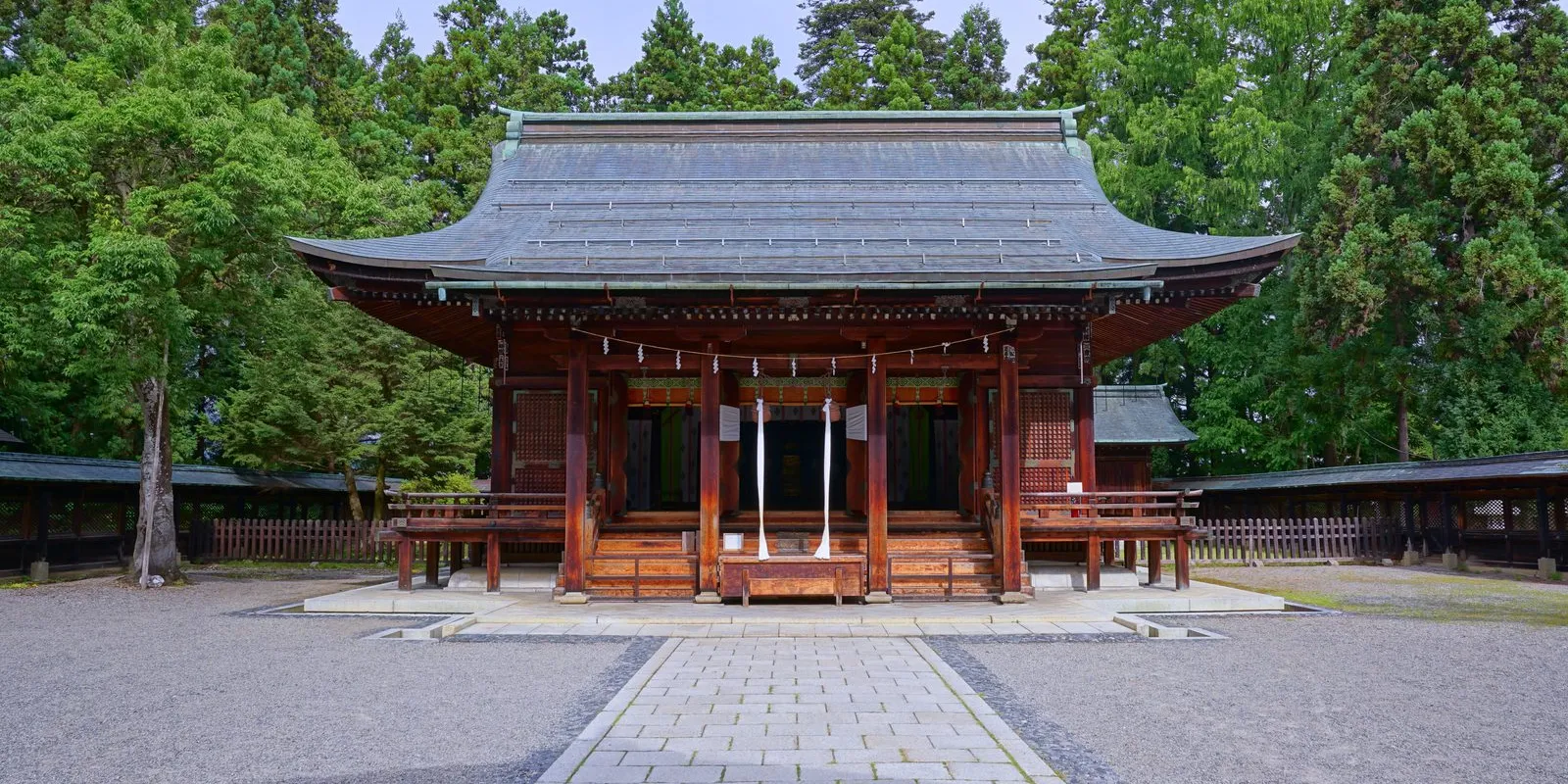
In 1902 (Meiji 35), Uesugi Jinja was elevated to the rank of Bekkaku Kanpeisha (a special category of government-supported shrine). At this point the shrine’s deity was redefined as Kenshin alone, and Uesugi Yozan was moved to a newly established subsidiary shrine within the grounds, Matsugasaki Jinja — a separation that has continued to the present day. Most of the shrine’s buildings were destroyed in the great Yonezawa fire of 1919, and the current sanctuary was rebuilt in 1923, designed by Dr. Ito Chuta, a Yonezawa-born architect and leading authority on shrine and temple design also responsible for Heian Jingu and Meiji Jingu.
Devotion to Bishamonten, God of War
Kenshin was a devout believer in Bishamonten, the Buddhist guardian deity of the north and god of war, and is said to have considered himself an incarnation of the deity. Before battle he flew a war banner bearing the single character “Bi” (毘), taken from Bishamonten’s name, alongside a second banner depicting a coiling dragon and reading “Ryu” (龍). Having fought through his career with remarkably few defeats, he came to be remembered by later generations as a “god of war” and the “Dragon of Echigo.” Both the “Bi” and “Ryu” banners still fly today over Maizuru Bridge, on the approach to the shrine, and it is this legacy that draws worshippers seeking victory in competition and in battle.
Highlights
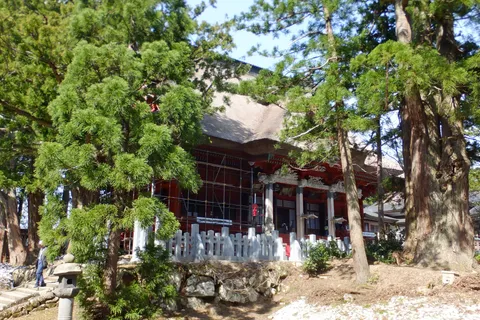
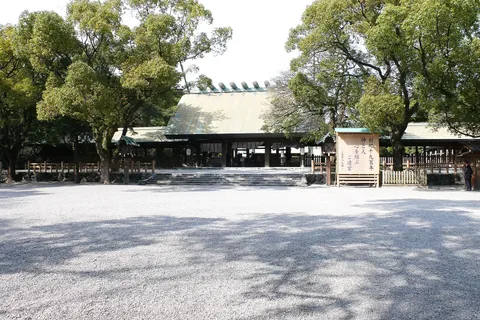
The shrine’s treasure hall, Keisho-den, displays a substantial collection of armor, swords, and documents connected to Kenshin and his successor Kagekatsu. The main sanctuary, designed by Dr. Ito Chuta, is notable for its dignified gabled roof and karahafu-style entrance porch, and together with the shrine’s karamon gate is considered a landmark of early 20th-century Shinto shrine architecture in Yonezawa. The surrounding grounds, now maintained as Matsugasaki Park, retain the moats and stone walls of the former Yonezawa Castle and are also known as a cherry blossom spot, with around 200 trees blooming each spring.
Visiting Tips
A simple visit to the grounds takes about 30 minutes, but allow about an hour if you also want to see the Keisho-den treasure hall. Goshuin are available for both Uesugi Jinja and its subsidiary shrine, Matsugasaki Jinja. The shrine is especially crowded with visitors during the cherry blossom season around mid-April.
Annual Festivals
- Yonezawa Uesugi Festival (April 29–May 3): Yonezawa’s largest historical festival, centered on Uesugi Jinja. On May 2, the “Buteishiki” ritual reenacts the battle-prayer ceremony Kenshin is said to have always performed before going to war, and on May 3 the “Battle of Kawanakajima” is reenacted on the banks of the Matsukawa River, with roughly 700 armored performers from both the Uesugi and Takeda sides taking part.
- Reitaisai Grand Festival (April 29): Uesugi Jinja’s own annual festival honoring Kenshin, forming the core of the Uesugi Festival.
- New Year’s Visits (January 1–3): Crowds come to pray for victory and good fortune in the year ahead.
Nearby Food & Sightseeing
- Uesugi Joshien: A visitor complex right next to Uesugi Jinja, with Yonezawa beef restaurants and souvenir shops, popular with visitors combining a meal with their visit to the shrine.
- Uesugi Family Mausoleum: A quiet, cedar-lined mausoleum where Kenshin and generations of Yonezawa domain lords are laid to rest, about a 10-minute drive from Uesugi Jinja.
- Yonezawa City Uesugi Museum (Denkoku-no-Mori): A museum dedicated to the history of the Uesugi clan and the culture of Yonezawa, including a reproduction of the national treasure “Rakuchu Rakugai-zu” folding screens — a natural stop alongside a visit to Uesugi Jinja.
Frequently Asked Questions
- Q. What are the visiting hours?
- A. The grounds are open 6:00–17:00 (7:00–17:00 in winter).
- Q. When is the goshuin office open?
- A. 8:30–17:00 at the shrine office. Goshuin are available for both Uesugi Jinja and its subsidiary shrine, Matsugasaki Jinja, for ¥500 each.
- Q. Is there parking?
- A. There is no dedicated visitor parking. Please use the municipal 'Omatsuri Hiroba' car park (about 300 spaces) on the north side of the moat.
- Q. What is the connection between Uesugi Kenshin and Takeda Shingen?
- A. The two warlords were among the Sengoku period's fiercest rivals, clashing five times at the battles of Kawanakajima. Takeda Jinja in Kofu, Yamanashi, which enshrines Shingen, is also featured on this site — visiting both lets you trace the two sides of one of the era's most legendary rivalries.
- Q. How do I get there?
- A. About a 10-minute bus ride from JR Yonezawa Station to the Uesugi-jinja-mae (Uesugi Joshien) stop, or about 10 minutes by taxi from the station.