History
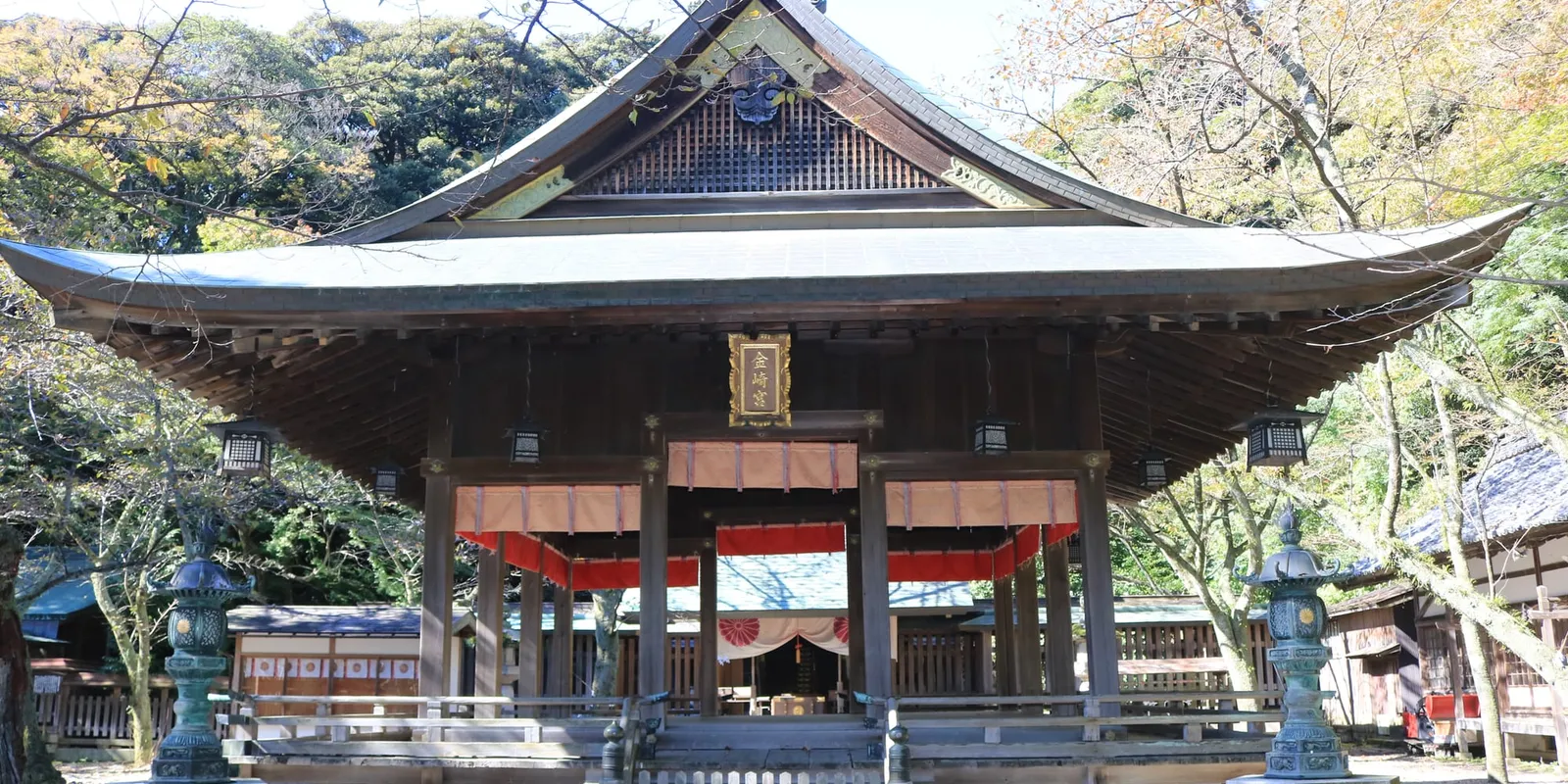
Kanegasaki-gu stands on the hill of Kanegasaki, on the northeast side of Tsuruga in Fukui Prefecture, facing Tsuruga Bay. Its name is read “Kanegasaki-gu,” and the official site calls it the “Koi no Miya” (Shrine of Love). The enshrined deities are two imperial princes: Prince Takanaga, the first son of Emperor Go-Daigo, and Prince Tsunenaga, his crown prince.
According to the history on the official site, in 1336 (Engen 1) Emperor Go-Daigo took refuge on Mount Hiei and sent Nitta Yoshisada and Prince Takanaga to restore the imperial forces. Prince Tsunenaga fled to Tsuruga, but Kanegasaki Castle fell to an attack by the Ashikaga side; Prince Takanaga died, and Prince Tsunenaga was captured at Uryuyama Castle and confined, then poisoned in 1338 (Engen 3) at the age of 15, as recorded in the “Gosaijin-ki” (Record of the Enshrined Deities). This record is the basis of the shrine’s history.
In the Meiji era, at the petition of the people of Tsuruga, it was decided in September 1890 (Meiji 23) that Prince Takanaga would be enshrined and the shrine ranked as a Kanpei-chusha under the name Kanegasaki-gu. Prince Tsunenaga was enshrined with him in November 1892, and the enshrinement ceremony followed in 1893. A fire in 1903 (Meiji 36) destroyed three buildings including the main hall, and when it was rebuilt in 1906 (Meiji 39) the main hall was moved to its present site and its style changed from nagare-zukuri to shinmei-zukuri. In 1982 (Showa 57), with the buildings badly worn, they were rebuilt and the roofs replaced with copper sheeting, according to the official summary of the shrine’s history.
Most of the grounds lie on the former site of Kanegasaki Castle from the Nanbokucho period. The shrine is also known as the setting of the “Kanegasaki Retreat” of 1570 (Genki 1), when Oda Nobunaga withdrew from his campaign against the Asakura, a history mentioned on the official site and by the Tsuruga tourism association.
Highlights
The Kanegasaki Castle ruins on the mountain side of the grounds were designated a national historic site on March 13, 1934 (Showa 9), according to the official site, and are now a city park. The official site explains that the Taiheiki described it as a natural stronghold (“on three sides the cliffs rise from the sea”), and lists the following sites: Kamomegasaki (about 250 m west of the east-side shrine office), Tsukimi Goten (the highest point of the area said to be the main enclosure), Kinukake no Matsu (at Kinukake-no-saki), the gate sites (three), and the site of Prince Takanaga’s death (jijin-mikomichi), on the rise behind the main hall.
In spring it is a cherry-blossom spot. The official site says about 1,000 cherry trees bloom in the grounds, while the Tsuruga tourism association says about 400 Somei-Yoshino trees, so the counts differ by source.
Items given out at the shrine include the “Katsu-mamori” (an azuki-bean-bag amulet for overcoming difficulties and good fortune, ¥1,200), the “Koi no Nankan-toppa-mamori” (a love-hurdle amulet, ¥1,000), the “Kin-un Kin-ga Saki-mamori,” and the keychain-style “Karen-mamori” featuring the character Karen-chan, who was born as a Fukumusume (a festival maiden). The Tsuruga tourism association says a story is told that during Nobunaga’s campaign against the Asakura, his sister Oichi sent him a bag of azuki beans tied at both ends to warn that he was caught between two forces, and that the bean-bag-shaped amulets and ema are associated with it.
Visiting Tips
Because the official site gives no visiting hours or shrine-office hours, it is wise to ask the shrine office (0770-22-0938) in advance if you want an amulet or goshuin. According to the Tsuruga tourism association, parking is free, with 30 spaces for cars and 5 for buses.
The official site says to take the “Gurutto Tsuruga” loop bus from JR Tsuruga Station to “Kanegasaki-gu” and walk about 5 minutes. By car it is about 10 minutes from Tsuruga IC on the Hokuriku Expressway. The way to the castle ruins is up steps, so comfortable shoes are recommended.
Goshuin are given out at the shrine office, and an article on the official site says a new design is given from New Year’s Day. The offering amount is not stated on the official site.
Weddings are also held on the grounds. The official site says the “Hanakae-kon” Shinto ceremony, which also suits Western-style dress, includes the shrine’s own rites, “Toki-musubi no Gi” and “Hanakae no Gi.”
Annual Festivals
- Hanakae Matsuri (spring): According to the official site, centered on the Shinto rite “Hanakae-sai,” it is held as a spring event organized by the Tsuruga tourism association. It is held at cherry-blossom time, usually from late March to early April, and the tourism association page lists April 1–15. Besides the rite there are twig exchanges, matchmaking events, mock weddings and monkey performances.
- Hanakae-kon (during Hanakae Matsuri): The official site’s 2026 announcement says a “Hanakae-kon” wedding for a couple from within the prefecture would be held on April 5.
- Ofuna-asobi Kangensai (October 20): A festival recalling the story that on October 20, 1336 (Engen 1), Prince Takanaga, Prince Tsunenaga and others floated a boat with music on the sea, enjoying the autumn leaves and the moon. According to the official site, in 2025 it was held on Monday, October 20: main hall rite at 10:30 AM, portable shrine departure at 1:00 PM, and the boat rite around 2:15 PM near the Tsuruga Port boardwalk (subject to change in bad weather). A portable shrine is carried by boat around the harbor, with offerings of food by children and a dance by shirabyoshi performers. In the head priest’s address, he said the rite was held in 1893, interrupted, and revived in 1990 (Heisei 2).
- New Year’s Day: Distribution of the new goshuin begins (per an article on the official site).
Festival dates change from year to year, so check “News” and “Annual Events” on the official site for the latest.
Nearby Food & Sightseeing
- Kanegasaki Green Park: A park the shrine’s official site calls a spot with a panoramic view of Tsuruga Bay. The Tsuruga tourism association says a seaside boardwalk and deck offer views of Tsuruga Port.
- Tsuruga Red Brick Warehouse: According to the official site, a historic building with a retro atmosphere that now houses restaurants and galleries.
- Tsuruga Museum (Port of Humanity): Introduced by the official site as a museum where you can learn about the history of Tsuruga’s port and the role Tsuruga played during World War II.
Frequently Asked Questions
- Q. What are the visiting hours?
- A. Neither the official site nor the Tsuruga tourism association's site gives visiting hours or shrine-office hours. If you want an amulet or a goshuin, it is safest to ask the shrine office (0770-22-0938) beforehand. The tourism association page does not list an admission fee.
- Q. Can I get a goshuin at Kanegasaki-gu?
- A. According to an article on the official site, a new goshuin is given out from New Year's Day, and the shrine office writes in the date of your visit. The shrine adds that New Year's Day can be crowded and you may have to wait. The offering amount and hours are not stated on the official site, so please check at the shrine office. Note that the limited-edition "Kanegasaki Castle special goshiro-in (castle stamp)" was handed out only at the Echizen-Wakasa Castle Fest venue in Obama on October 25–26, 2025, not at the shrine.
- Q. How do I get there, and is there parking?
- A. Per the official site, take the "Gurutto Tsuruga" loop bus from JR Tsuruga Station to the "Kanegasaki-gu" stop and walk about 5 minutes. By car it is about 10 minutes from Tsuruga IC on the Hokuriku Expressway, and the Tsuruga tourism association lists free parking for 30 cars and 5 buses.
- Q. Why is it called the "Shrine of Love" (Koi no Miya)?
- A. According to the official site, from around 1907–1912 (the Meiji 40s) a custom spread of offering a cherry twig (a "flower") received at the shrine to someone you liked, saying "Let's exchange flowers," and exchanging twigs if the feeling was mutual. The shrine became a place that brought couples together and came to be called the Shrine of Love. The custom lives on as the spring Hanakae Matsuri; the Tsuruga tourism association lists it as April 1–15 (the official site says it is held at cherry-blossom time, usually from late March to early April). Dates vary by year, so check the latest announcement.
- Q. What is the "Kanegasaki Retreat" (Kanegasaki no Nokiguchi), and does it relate to the shrine?
- A. The Tsuruga tourism association's page introduces it as the episode in which Oda Nobunaga withdrew during his campaign against the Asakura, and the shrine stands at the foot of the Kanegasaki Castle ruins, the setting associated with it. The official site's Hanakae Matsuri notice also describes the shrine as a place with the history of the Sengoku-period "Kanegasaki Retreat." Details such as the roles of individual commanders in the withdrawal are viewed differently depending on the sources and theories, so this page does not state them as fact.
Plan Your Visit
Before you go, you can book a stay and get your shrine-visit items ready.
Amazon links open Amazon.co.jp (Japan) in English; whether an item ships overseas depends on the product.
※ Contains ads (PR). Links open external sites such as Amazon, Rakuten, Trip.com and Booking.com.