History
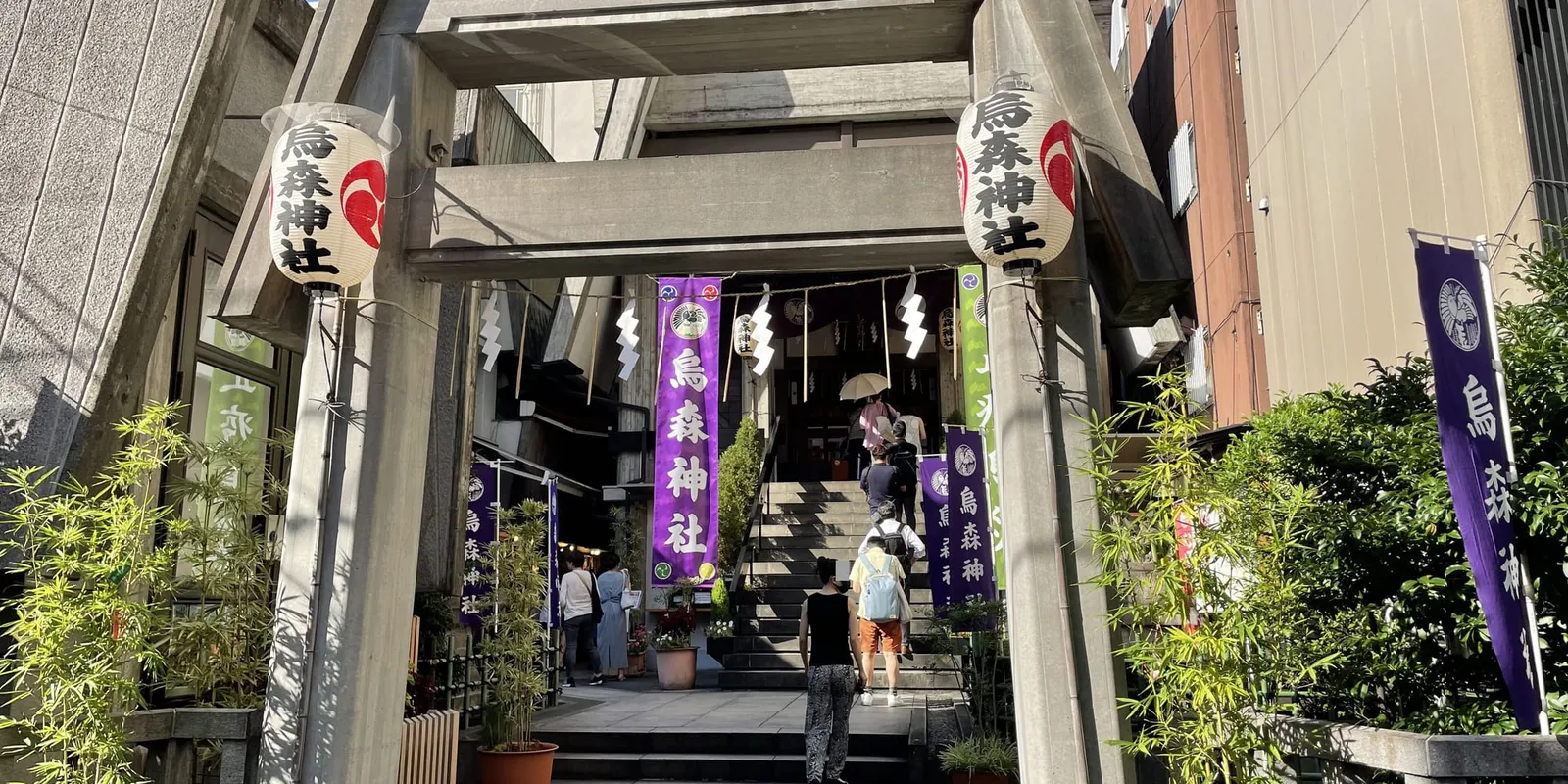
Karasumori Shrine (Karasumori Jinja) stands in Shimbashi, Minato Ward, Tokyo, just by the Karasumori Exit of JR Shimbashi Station. The official site names three deities, Ukanomitama no Mikoto, Ame no Uzume no Mikoto and Ninigi no Mikoto, and lists its divine virtues as prosperous business, improvement in skills and the arts, household safety, fulfillment of prayers for victory, overcoming great difficulty, endless prosperity, harmony in all things, and wealth and honor. The official site also introduces it as one of the few shrines that enshrine Ame no Uzume no Mikoto, revered as a deity of the performing arts.
According to the “founding of the shrine” section of the official site, in 940 (Tengyo 3, Heian period), when Taira no Masakado rose in rebellion in eastern Japan, the Defender-General Fujiwara no Hidesato (Tawara no Tota) prayed for victory at an Inari shrine in Musashi Province, and a white fox appeared and gave him a white-feathered arrow. Hidesato quelled the rebellion with that arrow, and when he set out to found a shrine in thanks, a white fox appeared in his dream and told him that the place where sacred crows gathered was holy ground. When he came to the woods of Sakurada village, crows were gathered just as in the dream, so he built a shrine there. This is said to be the origin of “Karasumori Inari.”
The official site also explains the place name “Karasumori” (crow woods). When the area was known as Sakurada village in Musashi Province, it was a sandy beach on Edo Bay covered with pine woods, called the “Karasu no Mori” (woods of the dry sandbank). Crows nested in large numbers in those pines, and later it came to be written “Karasu no Mori” (crow woods), which is said to be how the name Karasumori began.
According to the official site, when the Great Fire of Meireki (the “Furisode Fire”) reduced the city of Edo to ashes, only Karasumori Inari escaped the flames, which was taken as a sign of divine power, and faith in it grew deeper. Together with Sugimori Shrine (Nihonbashi) and Yanagimori Shrine (Kanda), it has long been revered as one of the “Three Mori of Edo,” and it is also said to have been ranked “East Sekiwake” in the Edo-period ranking of Inari shrines. In 1873 (Meiji 6) the name was changed from Karasumori Inari to Karasumori Shrine, and the present hall was built in 1971 (Showa 46).
Highlights
Up the stone steps, the hall displays the shrine crest: a sacred crow with four-colored tomoe in red, yellow, blue and green. The official site says the goshuin and amulets bear this crest.
One of the shrine’s signature features is the “Shingan-iro Omikuji,” which sorts wishes by color. An amulet of the same color (Negai-dama) and a wish tag (Negai-fuda) are given with the fortune, and you attach the tag to a tying cord and leave it, a style unique to this shrine; a dedicated writing desk is provided on the grounds.
According to the official site, the shrine’s main large mikoshi is the finest work of the mikoshi craftsman Yamamoto Shotaro, known as “Dashi-tetsu” of Kanda, and is an eight-ridged mikoshi commonly called the “Senkan Mikoshi” (thousand-kan mikoshi). It was made in November 1930 and dismantled and repaired in 1982 (Showa 57). It is described as very rare, with birds placed on its finial-like ornaments and a roof with a gable on each of its four faces, and as unmatched in size.
Some of the shrine’s offerings tie in with its history. The “Shingan Michibiki no Shiraha” (white feather charm) draws on the story of the white arrow given by the white fox that quelled the rebellion, and the “Lucky Bell Charm” (Koun no Suzumori) is the shrine’s own amulet inspired by Ame no Uzume no Mikoto. However, according to the official site’s announcement as of August 20, 2026, both were out of stock, the 2026 design of the white feather charm had finished being offered, and no date had been set for the bell charm’s return.
Visiting Tips
You can visit and pray 24 hours a day, and the office for amulets, ofuda and goshuin is open 9:00 AM–4:00 PM (hours may vary) (official site). Changes to hours and the latest information are posted on the shrine’s officially recognized X account, “Koikichi.” Amulets are currently not sent by mail.
Goshuin come in the regular design, with the crest of a sacred crow and four-colored tomoe in red, yellow, blue and green, and in special editions timed to festivals and the seasons. The 2026 announcements include the Hatsuuma festival, the annual festival (mikoshi procession), the Nagoshi purification, summer, Tanabata, autumn (“Seishu Hojo”) and a railway-opening commemoration (from October 14), and the announced special goshuin are ¥500 each. They are handed out as a printed single sheet of washi and cannot be written into your own goshuin book. The fee for the regular goshuin is not stated on the official site. The special goshuin are announced for 9:00 AM–4:30 PM, which differs from the amulet office’s 9:00 AM–4:00 PM (hours may vary), so arriving early is safest.
It is a 2-minute walk from the West Exit / Hibiya Exit of JR Shimbashi Station, 3 minutes from the Karasumori Exit, and 2–3 minutes from the subway station. Parking is not mentioned on the official site, so going by train is recommended.
Annual Festivals
- New Year’s Day service (January 1)
- Setsubun festival (February 1, 2 and 3): “Suzu-harai,” purification with the clear sound of bells.
- Hatsuuma festival (around the first Horse Day of the old calendar): The “Sugi no Ha Mamori” (cedar-leaf charm), handed down since ancient times, is given to parishioners and worshippers, with prayers for household safety, happiness and prosperity, and business success.
- Hinamatsuri (March 3)
- Annual festival (May 4, 5 and 6): In 2026, the 4th was the eve festival (the “mitama-ire” rite at 8:00 PM), the 5th the main shrine’s large mikoshi procession (departure rite at 10:30 AM, Shiraume taiko drumming at 11:00 AM, departure from in front of SL Square at 11:30 AM, return planned for 5:30 PM), and the 6th the main ritual at 2:00 PM. On the 5th, kagura is also performed at the hall all day. The large mikoshi procession is held every other year and is canceled in heavy rain.
- Nagoshi no Oharae (June 30): Worshippers breathe on a paper effigy to transfer half a year of impurity to it, then pass through a ring of reeds and pray for good health for the rest of the year.
- Tanabata festival (July 1–7): Five-colored paper strips are prepared, and prayers are offered for visitors’ wishes to come true.
- Niiname-sai (around November 23, varies by year): A thanksgiving for the harvest, with new rice offered before the deity.
- Toshikoshi no Oharae (December 31): As with the Nagoshi purification, paper effigies are handed out to purify half a year of impurity.
The official “annual events” page also lists a Kinen-sai (prayer festival for the year), but gives no date for it. Dates and times change from year to year, so check the official site for the latest.
Nearby Food & Sightseeing
- SL Square (in front of Shimbashi Station): The square that the official site gives as the place where the large mikoshi’s departure rite is held and from which it sets off during the annual festival.
- Hibiya Shrine: A shrine at 2-1-1 Higashi-Shimbashi, Minato Ward, which the Tokyo Shrine Association lists with the nickname “Saba Inari.” It is an Inari shrine in the same Shimbashi area of Minato Ward as Karasumori Shrine.
- Old Shimbashi Station Railway History Exhibition Room: An exhibition room at 1-5-3 Higashi-Shimbashi, Minato Ward, inside a facility that recreates Shimbashi Station, the original terminus of Japan’s railways. From October 14, 2026 Karasumori Shrine is distributing a “railway-opening commemoration goshuin” jointly with Iseyama Kotai Jingu in Yokohama, so it pairs well with a railway-themed stroll. Check opening hours and closing days before you visit.
Frequently Asked Questions
- Q. What are the visiting hours?
- A. According to the official site, you can visit and pray 24 hours a day. The office for amulets, ofuda and goshuin is open 9:00 AM–4:00 PM (hours may vary), and any changes are announced on the shrine's official X account.
- Q. Can I get a goshuin at Karasumori Shrine?
- A. Yes. The official site says the shrine offers a regular goshuin featuring its crest of a sacred crow and four-colored tomoe (red, yellow, blue and green), along with special goshuin timed to festivals and the seasons. The fee for the regular goshuin is not stated on the official site. The special goshuin announced for 2026 (Hatsuuma festival, annual festival, autumn, the railway-opening commemoration and others) are ¥500 each, and are printed on a single sheet of washi paper, so they are said not to be written into your own goshuin book. Contents and periods change each time, so check the news page or the official X account.
- Q. How do I get there, and is there parking?
- A. It is a 2-minute walk from the West Exit / Hibiya Exit of JR Shimbashi Station, 3 minutes from the Karasumori Exit, and 2–3 minutes from Shimbashi Station on the Tokyo Metro Ginza Line and Toei Asakusa Line (official site). Parking is not mentioned on the official site, so going by train is recommended.
- Q. What is the "Shingan-iro Omikuji"?
- A. According to the official site, it is the shrine's own fortune slip, divided into four colors: red (love and good relationships), yellow (money, good luck and business), blue (warding off misfortune, work, study and the arts) and green (health and family). Along with the fortune you receive an amulet of the same color ("Negai-dama") and a wish tag ("Negai-fuda"); you write your wish at a dedicated desk and attach the tag to a tying cord, and a priest is said to pray for its fulfillment later. Those who draw a "Chodaikichi" (super-great fortune) are said to receive a special amulet and a "Fukuwake set" for sharing the good luck.
- Q. When is the annual festival, and can I see the large mikoshi?
- A. The annual festival is held on May 4, 5 and 6 (official site). In 2026, the 4th was the eve festival, the 5th the procession of the main shrine's large mikoshi (departure rite at 10:30 AM, setting off from in front of SL Square at 11:30 AM, return planned for 5:30 PM) and the 6th the main ritual inside the hall; the 5th was described as the highlight for the general public. The official site says the large mikoshi procession is held every other year, and it is canceled in heavy rain. Times can shift with progress and weather, so check the official site for the latest.
Plan Your Visit
Before you go, you can book a stay and get your shrine-visit items ready.
Amazon links open Amazon.co.jp (Japan) in English; whether an item ships overseas depends on the product.
※ Contains ads (PR). Links open external sites such as Amazon, Rakuten, Trip.com and Booking.com.