History
Asakusa Shrine stands immediately east of the main hall of Sensoji and is affectionately known as “Sanja-sama.” According to tradition, in 628 (the 36th year of Empress Suiko) two brothers, Hinokuma no Hamanari and Takenari, were fishing in the river then known as the Miyato River (now the Sumida) when an image was caught in their net. A local scholar, Haji no Manakachi, recognized it as an image of Sho-Kannon and venerated it, which is the origin of Sensoji. Asakusa Shrine enshrines these three men: Haji no Manakachi no Mikoto, Hinokuma no Hamanari no Mikoto, and Hinokuma no Takenari no Mikoto. (Note that it was the two brothers who found the image; Haji no Manakachi identified it.)
The three were later revered as guardian deities by their descendants and came to be called “Sansha Gongen.” The shrine is said to have taken its form in the late Heian to early Kamakura period, and for centuries it was bound up with Sensoji. After the Meiji government’s order separating Shinto and Buddhism in 1868, it became “Sansha Myojin Shrine,” and later took its present name, Asakusa Shrine. Sensoji next door is a Buddhist temple while this is a Shinto shrine — a pairing that preserves the history of how the two once shared a single sacred site.
Highlights
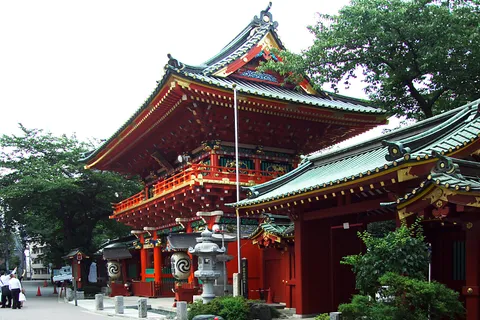
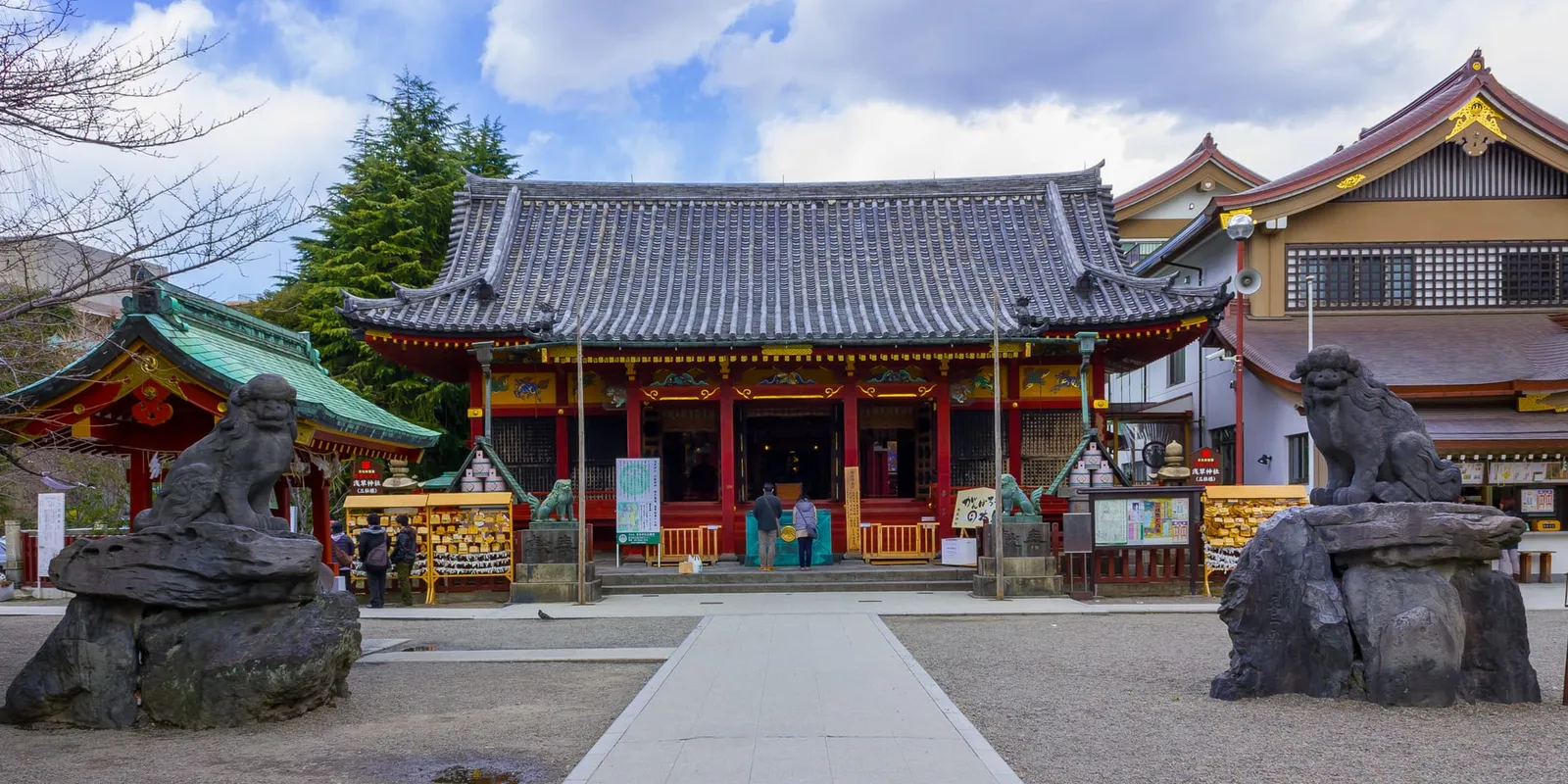
The present buildings were donated by the third shogun, Tokugawa Iemitsu, around 1649 in the early Edo period. The main hall, offering hall (heiden), and worship hall (haiden) are designated Important Cultural Properties of Japan. Linked in the gongen-zukuri style, they are known for their vermilion-lacquered pillars and richly painted and gilded eaves. They survived fires, war, and the Great Kanto Earthquake, and were extensively repainted in 1996.
Within the grounds are also the subsidiary Hikan Inari Shrine and Asakusa Fuji Sengen Shrine. It is a calm place to pray just steps from the crowds of Sensoji.
Visiting Tips
The grounds are free to enter, but the shrine office (amulets and goshuin) closes relatively early — 4:00 PM on weekdays and 4:30 PM on weekends and holidays — so avoid arriving late in the day. Three goshuin are offered: Asakusa Shrine, the Ebisu of the Asakusa Seven Lucky Gods, and Hikan Inari Shrine, each for ¥500. Limited-edition goshuin are offered at the New Year and around Sanja Matsuri. Sensoji’s goshuin are issued separately, so keep that in mind if you want both.
There is no parking for general visitors, so arriving by train is best. It is about a 7-minute walk from Asakusa Station (Tokyo Metro Ginza Line, Toei Asakusa Line, Tobu Line); walk through Nakamise-dori and head to the right of Sensoji’s main hall.
Annual Festivals
- Sanja Matsuri (May; Friday–Sunday based on the third Saturday; May 15–17 in 2026): The shrine’s grand annual festival, counted among Tokyo’s three major festivals, which draws about 1.8 million visitors over three days. Day one features the Grand Procession (Daigyoretsu) and the Binzasara Mai dance, a designated Tokyo Intangible Folk Cultural Property. On day two, about 100 neighborhood mikoshi from the shrine’s 44 parishes parade together in the Machinai Mikoshi Rengo Togyo. On the final day, the shrine’s three main mikoshi (Ichinomiya, Ninomiya, Sannomiya) leave the shrine in the early morning, tour the neighborhoods, and return in the evening.
- New Year’s visit (January): A limited-edition New Year goshuin is offered.
Nearby Food & Sightseeing
- Sensoji: The Buddhist temple immediately west of the shrine, known as Tokyo’s oldest temple. Visiting both lets you see how the Kannon legend connects the temple and the shrine.
- Nakamise-dori: The shopping street of the approach from Kaminarimon to Sensoji, lined with snack stalls and souvenir shops.
- Kaminarimon: The gate with its giant lantern at the entrance to Sensoji, a classic photo spot in Asakusa.
Frequently Asked Questions
- Q. What are the visiting hours and is there an admission fee?
- A. There is no admission fee for the grounds. The shrine office (amulets and goshuin) is open 9:00 AM–4:00 PM on weekdays and 9:00 AM–4:30 PM on weekends and holidays.
- Q. When can I get a goshuin at Asakusa Shrine?
- A. During office hours (9:00 AM–4:00 PM on weekdays, 9:00 AM–4:30 PM on weekends and holidays). There are three types — Asakusa Shrine, Asakusa Seven Lucky Gods Ebisu, and Hikan Inari Shrine — at ¥500 each. Limited-edition goshuin may be offered around Sanja Matsuri and the New Year.
- Q. Is there parking?
- A. There is no parking for general visitors. The few spaces are limited to people receiving prayer services and wedding guests, with permission from the office, so please use nearby paid parking.
- Q. What is the difference between Asakusa Shrine and Sensoji?
- A. Asakusa Shrine is a Shinto shrine that enshrines the two brothers, Hinokuma no Hamanari and Takenari, who pulled the Kannon image from the river, and Haji no Manakachi, who recognized it as Kannon. It stands just east of Sensoji's main hall. It was once part of Sensoji as the syncretic "Sansha Gongen," and separated from the Buddhist temple after the Meiji-era separation of Shinto and Buddhism.
- Q. When is Sanja Matsuri held?
- A. Over three days, Friday to Sunday, based on the third Saturday of May (May 15–17 in 2026). On the final day, the shrine's three main mikoshi leave the shrine in the early morning and return in the evening.