History
Karatsu Shrine stands in Minamijonai, Karatsu, Saga Prefecture, and is known as the shrine of the autumn festival Karatsu Kunchi. The official site gives no reading for the name; this page follows Japanese Wikipedia in reading it “Karatsu-jinja.” The official site lists the enshrined deities as the three Sumiyoshi deities (Sokotsutsu no O no Mikoto, Nakatsutsu no O no Mikoto, Uwatsutsu no O no Mikoto) as Ichi-no-miya, Koda Munetsugu as Ni-no-miya, and Mizuha no Me no Kami enshrined alongside. The official site lists the deities under these “Ichi-no-miya” and “Ni-no-miya” headings.
According to the shrine’s account on its official site, when Empress Jingu was about to cross the sea to the Three Han, she prayed to the three Sumiyoshi deities for a safe voyage, and after returning she hung a treasure mirror on the Matsura shore and enshrined the three deities, which is said to be the origin. Long afterward, when even the location of the shrine buildings had been forgotten, the god is said to have appeared in the dream of the local lord Koda Munetsugu and told him to go to the shore and take the treasure mirror lying on the waves. He found a box in the surf, opened it to find the mirror, and, believing it to be the mirror once offered by Empress Jingu, reported it to the court. The official chronology records that in 755 (Tenpyo-shoho 7) the title “Karatsu Daimyojin” was granted.
In 1186 (Bunji 2), his descendant Koda Hiro rebuilt the shrine buildings and enshrined Munetsugu’s spirit alongside, making it the Ni-no-miya. In 1602 (Keicho 7), when Terasawa Shima-no-kami, the first lord of Karatsu Castle, built the castle, he designated the present site, revered the shrine as the guardian of his domain, and invited Mizuha no Me no Kami to be enshrined alongside for fire protection of the castle town. The official site says the shrine was ranked a village shrine (gosha) and renamed “Karatsu Jinja” in 1873 (Meiji 6), and was raised to prefectural-shrine rank in 1942 (Showa 17) when the grounds were expanded and the buildings entirely rebuilt.
Highlights
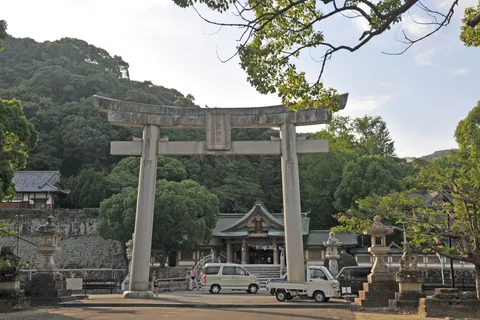
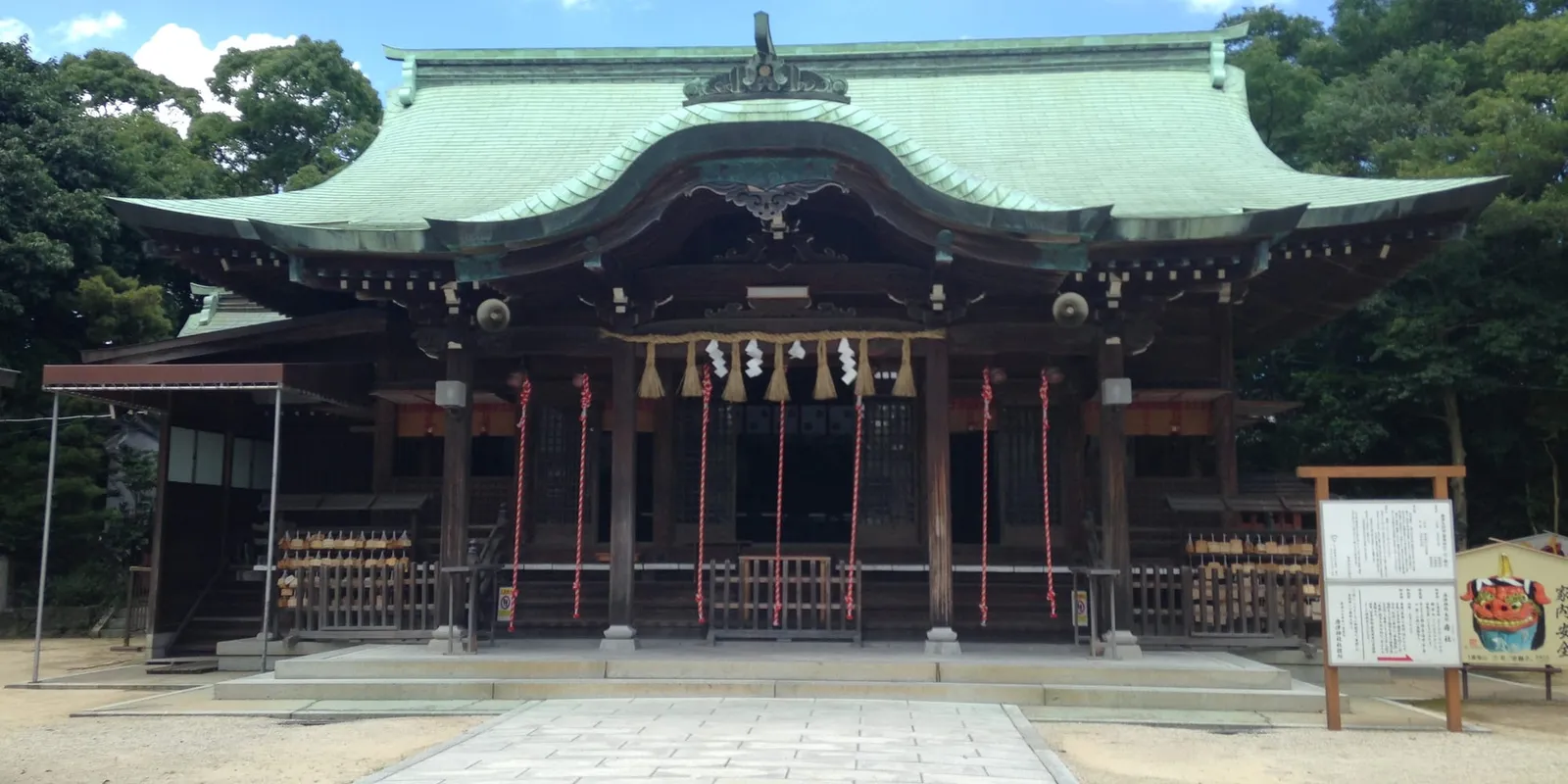
The official grounds guide says the main hall was completed in 1938 (Showa 13), built in the gongen-zukuri style joined to the worship hall by a connecting hall, with a copper-plate roof and a karahafu gable on the front of the worship hall. Beyond the large white torii at the front, the approach leads to the worship hall, and eight subsidiary shrines stand in the grounds. According to the official grounds guide, they include Shirotobi Inari, Shiratama Inari and Hatsuka Ebisu Shrine (business prosperity), Kotobuki-sha (said to answer ailments from the neck up), Torii Tenmangu (academic success), Hibuse Inari (said to protect against fire), Awashima Shrine and Suitengu, each with an explanation of the neighborhood that tends it.
The shrine’s 14 Karatsu Kunchi floats are kept in a float exhibition hall beside the shrine, and the official site says they sleep there until the next year. According to the official site, the 14 surviving floats were designated a Prefectural Important Tangible Folk Cultural Property in 1958 (Showa 33), the “Karatsu Kunchi float events” a national Important Intangible Folk Cultural Property in 1980 (Showa 55), and the “Karatsu Jinsai procession scroll” a city cultural property (important folk material). The site also says the event was designated UNESCO Intangible Cultural Heritage on December 1, 2016 (Heisei 28) as one of the 33 groups of “Yama, Hoko, Yatai float festivals in Japan.” These designations belong to the festival and floats, not to the shrine buildings.
Visiting Tips
The official site gives no hours for visiting the grounds. Prayer services are accepted any time during reception hours, 9:00 AM–4:30 PM (at the on-site reception), and take about 10–15 minutes. The shrine asks you to reserve or check by phone beforehand, and weekend mornings are busy with prayers sometimes held jointly. Prayers include first shrine visits, Shichi-Go-San, protection from misfortune, traffic safety (blessing of a new car), academic success, recovery from illness, household safety and business prosperity, with offerings guided at about ¥5,000 and up.
The official announcements mention a “regular goshuin,” so it appears to be available, but the fee and hours of the regular goshuin are not stated. Limited-edition goshuin shown in the announcements were the 2026 Karatsu Kunchi special goshuin (¥1,500, handed out at the counter November 2–4, pre-written sheets only) and the 2026 Year of the Horse zodiac goshuin (¥1,000). During Kunchi the regular goshuin and hand-written ones are not offered.
It is a 10-minute walk from Karatsu Station and a 5-minute walk from Karatsu Bus Center (Showa Bus). The official access page lists the Minamijonai parking lot, but during Karatsu Kunchi there are traffic restrictions and the shrine’s parking is closed, so public transport is advised.
Annual Festivals
These are the main events listed on the “Grounds and Events” page of the official site.
- Saitan-sai (January 1, from 12:00 AM): Celebrates the new year; the first drum is struck at the midnight time signal.
- Setsubunsai (February 3, from 7:00 PM): A bean-scattering rite to drive away evil spirits.
- Spring grand festival (April 29, from 11:30 AM): Includes an offering of float music (hikiyama bayashi), and the 14 Karatsu floats line up along the approach.
- Nagoshi-sai and chinowa-kuguri (July 29, from 7:00 PM): Passing through a ring of chigaya grass to purify the first half of the year.
- Karatsu Jinsai Honden-sai (October 29, from 11:00 AM): A rite recalling that Karatsu Kunchi was once called “Karatsu Jinsai” and held on October 29 and 30; there is no float parade.
- Autumn grand festival, Karatsu Kunchi (November 2, 3 and 4): According to the official “Origin and History of Karatsu Kunchi,” on November 2 (Yoiyama) the floats set out at 7:00 PM from Oteguchi in Karatsu; on the 3rd, young men from the Koda district offer the Kabu-kabu lion dance at 5:00 AM, the portable shrine leaves the shrine at 9:30 AM, and the Otabisho festival is held at noon. The 4th is the town procession (Machimawari), and in the evening the floats are hauled into the exhibition hall. The announcement of the special goshuin, however, calls November 4 the Otabisho procession, so the wording differs within the official site.
- Shichi-Go-San festival (November 15): Celebrates children’s growth and gives thanks to the local deity.
- Furu-ofuda Shono-sai and Joya-sai (December 31, from 7:00 PM): Burning of old amulets and talismans, and a year-end rite of thanks.
Dates can change by year, so check the announcements on the official site for the latest.
Nearby Food & Sightseeing
- Float Exhibition Hall: According to the official site, it stands beside Karatsu Shrine and holds the Kunchi floats after the festival. Opening hours are not given on the shrine’s official site, so check separately.
- Karatsu Castle: According to the official chronology, when Terasawa Shima-no-kami, the first lord of Karatsu Castle, built it in 1602 (Keicho 7), he designated the present site of Karatsu Shrine.
- Nishinohama Otabisho: According to the official site, this is the festival rest site where the portable shrine and floats go during Kunchi, said to be the birthplace of the enshrined deity, and where the festival’s climactic hauling-in takes place.
Frequently Asked Questions
- Q. What are the visiting hours and prayer hours?
- A. The official site does not state hours for visiting the grounds. Prayer services are accepted at any time during reception hours, 9:00 AM–4:30 PM (at the on-site reception), and take about 10–15 minutes. The shrine asks you to reserve or check by phone beforehand (0955-72-2264); phone reception is 8:30 AM–5:00 PM. Weekend mornings can be crowded, and prayers may be held jointly with other groups.
- Q. Can I get a goshuin at Karatsu Shrine?
- A. The official announcements refer to a "regular goshuin," so it appears to be available, but the fee and hours for the regular goshuin are not stated on the official site. Limited-edition goshuin included the 2026 Karatsu Kunchi special goshuin (¥1,500 per sheet, handed out at the counter only on November 2–4, pre-written sheets) and the 2026 Year of the Horse zodiac goshuin (¥1,000 per sheet). Each has a fixed distribution period, so check the official announcements for current information.
- Q. How do I get there, and is there parking?
- A. Per the official site, it is a 10-minute walk from Karatsu Station on the JR Karatsu and Chikuhi lines, or a 5-minute walk from Karatsu Bus Center (Showa Bus). The access page lists the Minamijonai parking lot (149 spaces; ¥100 for up to 1 hour, ¥300 up to 2 hours, ¥400 beyond 2 hours). During the Karatsu Kunchi festival there are traffic restrictions around the shrine and the shrine's parking is closed, so public transport is advised.
- Q. Which deities are enshrined here?
- A. The official site lists the three Sumiyoshi deities (Sokotsutsu no O no Mikoto, Nakatsutsu no O no Mikoto, Uwatsutsu no O no Mikoto) as Ichi-no-miya, Koda Munetsugu as Ni-no-miya, and Mizuha no Me no Kami enshrined alongside. According to the shrine's legend, it began when Empress Jingu prayed to the three Sumiyoshi deities for a safe voyage before crossing to the Three Han, and the local lord Koda Munetsugu is said to have been granted the title "Karatsu Daimyojin" in 755 (Tenpyo-shoho 7).
- Q. When is the Karatsu Kunchi festival?
- A. The official site gives the festival days of the shrine's autumn grand festival, Karatsu Kunchi, as November 2, 3 and 4 each year, and it was held on those dates in 2026. There are 14 floats (hikiyama); according to the official guide, on November 3 the portable shrine and the floats parade through the town and the floats are hauled in at the Nishinohama Otabisho (festival rest site). The festival's float events are a nationally designated Important Intangible Folk Cultural Property, and the official site also lists them as UNESCO Intangible Cultural Heritage.
Plan Your Visit
Before you go, you can book a stay and get your shrine-visit items ready.
Amazon links open Amazon.co.jp (Japan) in English; whether an item ships overseas depends on the product.
※ Contains ads (PR). Links open external sites such as Amazon, Rakuten, Trip.com and Booking.com.