History
Kojinyama Jinja stands on the summit of Mt. Kojinyama (284 m), on the eastern side of Hikone in Shiga Prefecture, near the east shore of Lake Biwa. Its name is read “Kojinyama Jinja,” and it is affectionately known as “Kojin-san.” According to the official site, the enshrined deities are Homusubi no Kami, Okitsuhiko no Kami and Okitsuhime no Kami, gods of fire and the hearth (kitchen and cooking), with four purification deities (Seoritsuhime, Hayaakitsuhime, Ibukidonushi and Hayasasurahime) co-enshrined. As “Sanpo Kojin,” the deity is regarded as the protector of the hearth, which stands at the center of a home and its livelihood.
The shrine’s history notes (an image on the official site) say that a fire and hearth deity has been enshrined on the summit for about 2,200 years, but that the origin is unclear. They also record that in the reign of Emperor Tenji the summit was designated as the purification site and place of prayer for the four districts of Inukami, Aichi, Kanzaki and Gamo, with a great purification rite held each June. In the Nara period, when the monk Gyoki founded the forty-nine temples, he is said to have climbed Mt. Kojinyama, been struck by the spiritual excellence of the site, invited Sanpo Kojin and built a hall, naming it “Okuyama-dera” as the inner sanctuary of the forty-nine temples. Hikone City’s guide (“Main Shrines and Temples around Mt. Kojinyama”) gives a similar account of Gyoki enshrining Sanpo Kojin and naming the temple Okuyama-dera.
According to the notes, Okuyama-dera, which belonged to the Eizan (Enryaku-ji) school, was burned down by Oda Nobunaga in the Sengoku period, and its treasures and old documents were lost along with its halls. In the Edo period it enjoyed deep reverence from the Hikone domain (the Ii family), which offered 15 koku of rice every year until the domain was abolished in the early Meiji era, about 300 years, along with donations and repairs to its buildings. By the official order separating Shinto and Buddhism in 1868 (Keio 4), Okuyama-dera was abolished and the shrine was built up and named “Kojinyama Jinja,” as it is today. All of the above is the shrine’s own account, and independent records for the founding date or the older traditions could not be confirmed.
Separately, Shiga Prefecture’s 2025 location map for the Netflix series “Ikusagami” lists Kojinyama Jinja as one of 12 filming locations in the prefecture (per the prefecture’s announcement; the scenes used are not stated).
Highlights
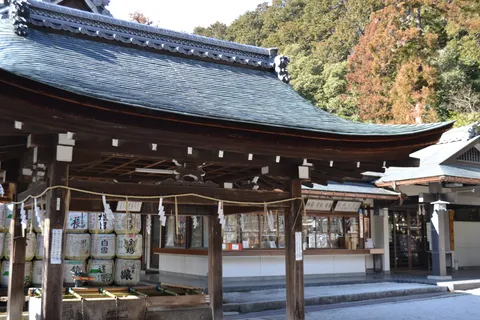
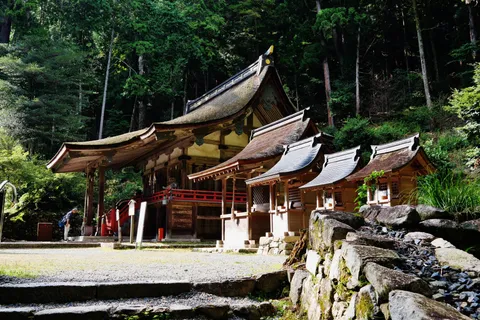
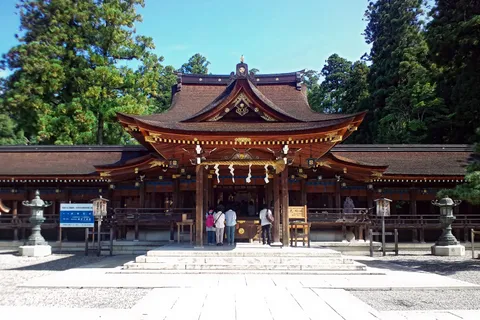
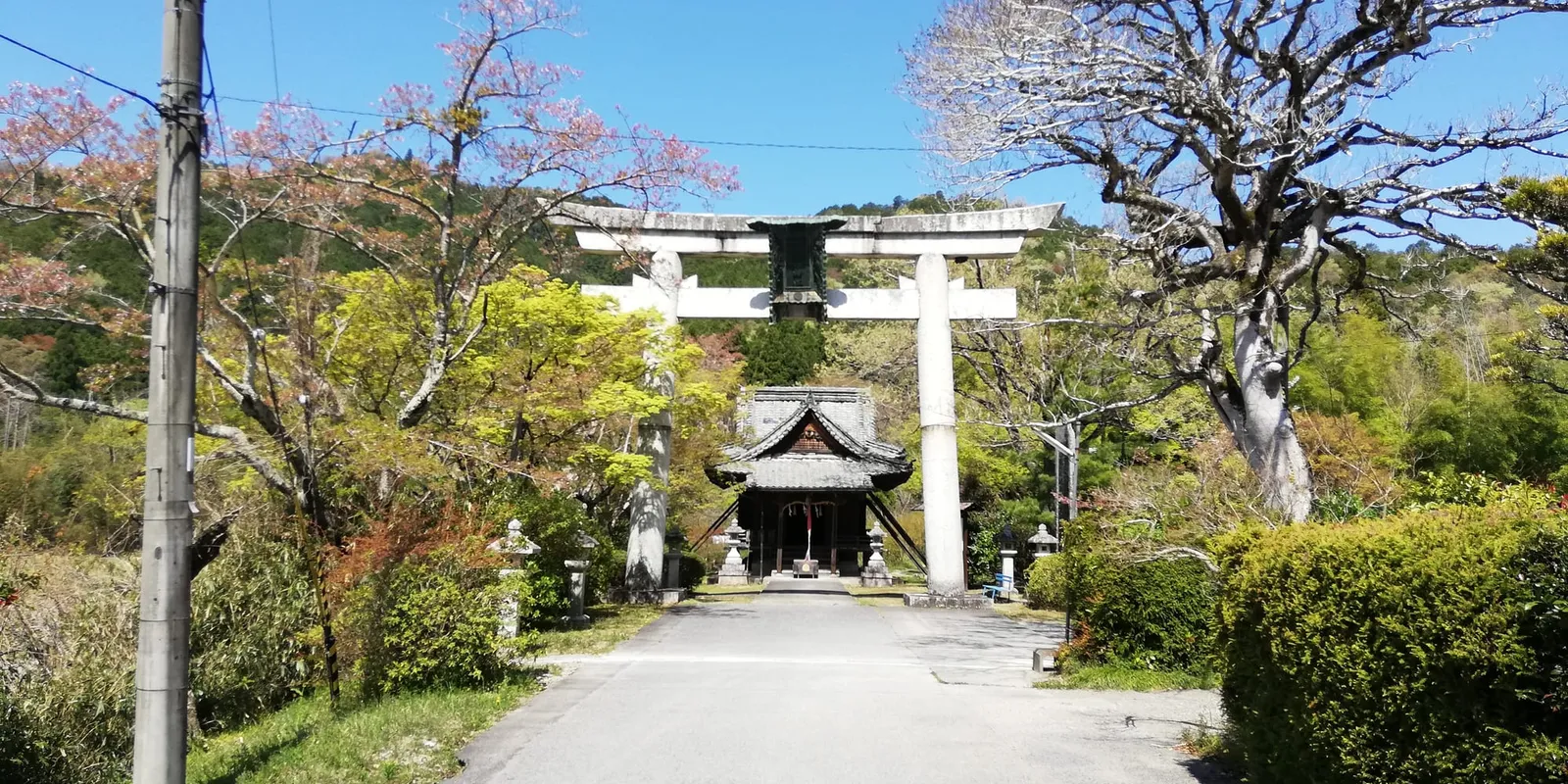
The shrine’s grounds retain a cluster of cultural-property buildings. According to the shrine’s official site, the Hikone City designated cultural properties are the shrine office, the shoin (reception hall) and its middle gate, and the worship hall at the foot of the mountain, while the nationally registered cultural properties are the main hall, heiden, worship hall, kagura hall, offering-preparation hall and the large torii at the foot of the mountain. In Hikone City’s list of designated cultural properties, the shrine office and the shoin and its middle gate (formerly Okuyama-dera) date from the Edo period (Tenpo 12), and the worship hall (formerly the Kantoku-den) from the Edo period (Bunsei 8, 1825), all designated on March 23, 2016 (Heisei 28). The survival of former Okuyama-dera buildings as cultural properties of the shrine is a distinctive feature.
For the worship hall at the foot of the mountain, the official site explains that it was built, in the days before cars, so that people who could not climb to the summit could worship from far below. It stands just beyond the nationally registered large torii, at the entrance to the approach path.
The shrine’s guide says that from near the summit you can see Lake Biwa, the Omi plain and the Suzuka Mountains. Mt. Kojinyama also has the nationally designated historic site “Kojinyama Kofun” (designated February 7, 2011, per the city’s list), which is a separate site from the shrine. The history notes further explain that after Okuyama-dera was completed, Gyoki received seeds (muku and toga-pine) at the Outer Shrine of Ise and planted them at the shrine, and that the present sacred tree is an old tree from those plantings (the shrine’s own explanation).
Visiting Tips
The official site gives no numeric visiting hours, and the shrine office (amulet counter) is not open every day, so it is wise to phone ahead (0749-43-5545). The shrine cannot be visited in snow, typhoons or other bad weather, or at night. Prayer services must be booked in advance by phone, and the shrine also performs purification rites when kitchens, boilers and other fire-related equipment are newly installed, altered or removed.
The offerings are the Kojin-san amulet (¥800, the only type) and a simple household altar that is easy to set up (¥1,000). For those who cannot visit, mail orders are accepted, at ¥1,000 per amulet including postage and handling, according to the official site. The official site says nothing about goshuin.
The nearest station is JR Kawase, about 15 minutes away by taxi. By car, it is about 7 minutes from the mountain roads on the west and east sides to the shrine on the summit, with parking on the summit and just below it. Buses and other large vehicles cannot use the road. If you walk up, the official site says the paved road and mountain paths are used by a growing number of walkers and light hikers. A notice dated September 18, 2026 reports that the approach at the Honzaka trailhead has been paved with stone and decomposed granite.
Annual Festivals
- Minazuki Matsuri (summer purification, June 29–30): The shrine’s main festival, held every year on June 29 (Yoi-Kojin) and June 30 (main festival), which the official site calls the most important of the year. Visitors pray for good health by passing through the chinowa reed ring in front of the worship hall (open to all on both days). There is a “children’s kagura” for children up to about 3 years old (¥5,000 per child), and in 2026 reception ran 10:00 AM–7:00 PM on the 29th and 9:30 AM–3:30 PM on the 30th. From about 4:00 to 9:00 PM on Yoi-Kojin, stalls line the approach in front of the foothill worship hall. The wagashi sweet “minazuki” is also sold on the summit grounds.
- Daidai-sai (spring and autumn): In the shrine’s history notes (an image on the official site), the spring festival is April 29 and the autumn festival is in late October. The Japanese Wikipedia gives late April and late November, so sources differ.
- Tsukinami-sai and Nikku-sai: The notes record the monthly rite on the 1st and 28th of each month and the daily morning rite.
- Talisman distribution ceremony (October): According to the official site’s news, on October 3, 2026 the ceremony to begin distributing the New Year’s amulets was held (with a purification rite and a spirit-infusing rite on October 1). The shrine also says that in some areas, such as the Koto region of Shiga, new amulets are delivered to each town toward the end of the year.
Dates and times of events can change from year to year, so please check “Kojinyama Dayori” (news) on the official site for the latest.
Nearby Food & Sightseeing
- Kojinyama Kofun: A nationally designated historic burial mound on the same mountain (per Hikone City’s list of cultural properties). It lets you trace the history of the mountain itself, apart from the shrine’s own story.
- Senju-ji: A temple on the north foot of Mt. Kojinyama. According to Hikone City it is said to have been opened by Gyoki in 741 (Tenpyo 13), and after being burned in Oda Nobunaga’s campaigns it was rebuilt in 1652 (Keian 5) and converted to the Rinzai sect.
- Inamura Shrine: Introduced in Hikone City’s guide as one of the main shrines around Mt. Kojinyama. It is said to have begun by enshrining a divided spirit of the deity at Inamura in Kuji District, Hitachi Province, and to have been moved to its present mountainside site after the Tenpyo-era fires.
- Tenman Tenjinsha: Another shrine around Mt. Kojinyama in the same Hikone City guide. It was the general shrine of the surrounding area until the An’ei era, and is said to have received a worship hall and torii in 1624 (Kan’ei 1) under the patronage of the Hikone domain lord.
Frequently Asked Questions
- Q. What are the visiting hours?
- A. The official site does not list numeric visiting hours. It says the shrine office (amulet counter) is not open every day and has closed days and hours, and that the shrine cannot be visited in snow, typhoons or other bad weather, or at night. Prayer services must be booked by phone in advance (0749-43-5545).
- Q. Can I get a goshuin at Kojinyama Jinja?
- A. The official site says nothing about goshuin. The offerings it describes are the amulet (¥800) and a simple household altar (¥1,000). To find out whether goshuin are available and when, please contact the shrine office (0749-43-5545) in advance.
- Q. How do I get there, and can I drive to the summit?
- A. Per the official site, the nearest station is JR Kawase, about 15 minutes by taxi. The shrine on the summit is about 7 minutes by car from the mountain roads on the west and east sides, with parking on the summit and just below it (no fee information given). Buses and other large vehicles cannot use the road, and it is narrow, so watch for oncoming cars. Mt. Kojinyama (284 m) also has paved roads and mountain paths, and the site says some people walk up.
- Q. When is the Kojinyama Jinja main festival, Minazuki Matsuri?
- A. On the official site, the Minazuki Matsuri (a summer purification festival) is held every year on June 29 (Yoi-Kojin) and June 30 (main festival), and is described as the shrine's most important festival of the year. Passing through the chinowa reed ring in front of the worship hall is open to all on both days. In 2026, kagura reception hours were 10:00 AM–7:00 PM on the 29th (Mon) and 9:30 AM–3:30 PM on the 30th (Tue).
- Q. Was the shrine a filming location for the Netflix series "Ikusagami" (イクサガミ)?
- A. Shiga Prefecture's page of November 14, 2025, "Netflix series 'Ikusagami' x Shiga Prefecture: location map, poster and digital stamp rally" (イクサガミ), lists Kojinyama Jinja (Hikone) as one of 12 filming locations in the prefecture. The page does not say which scenes were shot there.
Plan Your Visit
Before you go, you can book a stay and get your shrine-visit items ready.
Amazon links open Amazon.co.jp (Japan) in English; whether an item ships overseas depends on the product.
※ Contains ads (PR). Links open external sites such as Amazon, Rakuten, Trip.com and Booking.com.