
History
While its precise founding date is unknown, Taga Taisha is an ancient shrine whose name already appears in documents from the Nara period. It enshrines Izanagi no Okami and Izanami no Okami, the primal creator couple who, according to the Kojiki, gave birth to the Japanese archipelago and its many gods. As the parents of Amaterasu Omikami and the rest of the divine pantheon, they have long been venerated alongside the deities of Ise, giving rise to the old saying: “If you visit Ise, visit Taga too — for Ise and Taga are parent and child.”
The shrine received strong patronage from warlords during the Sengoku and Edo periods. Most famously, in 1588, Toyotomi Hideyoshi prayed at Taga Taisha for the recovery of his mother, Omandokoro, from illness; when she recovered, he donated 10,000 koku of rice in thanks — a gift on the scale given to a feudal lord. This donation funded a major reconstruction of the shrine buildings, and the Taiko Bridge that arches over the approach path is likewise said to have been built with Hideyoshi’s patronage.
Known affectionately across Japan as “Otaga-san,” Taga Taisha is revered as the “oyagami” — the parent deities of all life — and continues to draw worshippers from Shiga and well beyond for its blessings of longevity, good relationships, and protection from misfortune.
Highlights
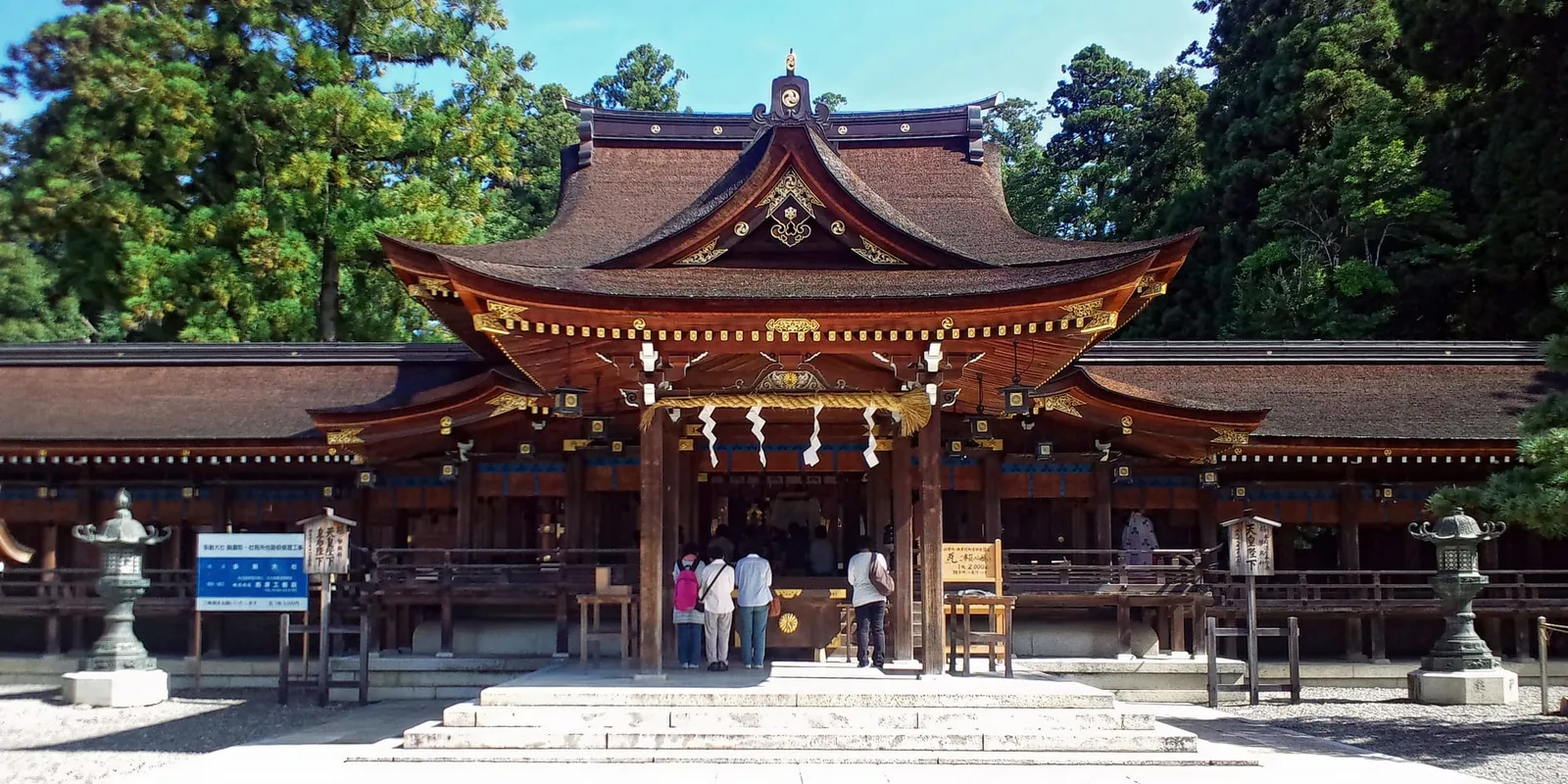
One of the shrine’s most eye-catching features is the vermillion-lacquered Taiko Bridge (also called Sorihashi) arching steeply over the main approach. Said to have been built through Hideyoshi’s donation, this dramatically curved bridge is believed to purify those who cross it and forms one of the shrine’s most iconic views. Beyond the bridge, the worship hall and main sanctuary, roofed in cypress bark, convey the weight of centuries of continuous devotion.
Among Taga Taisha’s amulets, the most famous is the rice-paddle-shaped charm known as “Otaga-jakushi.” According to legend, during the Nara period, priests offered steamed rice to the ailing Empress Gensho on such a ladle, and she recovered; the name “Otaga-jakushi” is said to have gradually shifted to “Otama-jakushi,” which in turn gave its name to the tadpole (“otamajakushi”) for its similar shape. The Okushoin Garden deep within the grounds — a Momoyama-period garden designated a Place of Scenic Beauty — is also well worth seeing, and the shrine occasionally holds special exhibitions of its treasures in spring and autumn.
Visiting Tips
Both visiting hours and goshuin reception run 8:30 AM to 5:00 PM. From Taga-Taishamae Station on the Omi Railway, it’s about a 10-minute walk through the shrine’s old approach town, lined with long-established itokirimochi shops worth browsing along the way. Visitors arriving by car will find several parking lots around the main approach — choose based on crowding. During the Mantosai lantern festival in August the grounds fill with visitors, so it’s best to allow extra time if visiting then.
Annual Festivals
- Koreitaisai Grand Festival (April 22): Taga Taisha’s most important annual festival, conducted with time-honored ritual.
- Mantosai Lantern Festival (August 3–5): The shrine’s signature summer event, in which more than 10,000 lanterns donated by worshippers from across Japan fill the grounds, beginning with a rite carrying sacred fire down from Mount Sugisaka.
- Otaue Rice-Planting Festival (early June): A ceremony praying for a bountiful harvest.
- Setsubun Festival (February 3): A rite to invite good fortune and drive away misfortune, drawing large crowds.
- New Year’s Day Festival (January 1): A ceremony celebrating the start of the year, drawing many visitors for their first shrine visit.
Nearby Food & Sightseeing
- Itokirimochi Sohonke Tagaya: A long-established shop on the shrine’s main approach dating to the Edo period. Its namesake “itokirimochi” — sweet bean paste wrapped in mochi and sliced with thread into three-striped pieces — is the classic souvenir of a Taga pilgrimage.
- Jumyo Soba (Sobasha): A soba restaurant inside the shrine’s Sanshuden guest hall, serving the signature “Jumyo Soba” (“longevity soba”), named in honor of the shrine’s blessing of long life.
- Shinnyo-ji: A Buddhist temple in the shrine’s old approach town, home to a wooden seated Amida Nyorai statue and treasures from the late Edo period — a good stop while strolling the approach.
Frequently Asked Questions
- Q. What are the visiting hours?
- A. 8:30 AM–5:00 PM.
- Q. When is the goshuin office open?
- A. 8:30 AM–5:00 PM, for ¥300 (¥500 for the cut-paper goshuin).
- Q. Is there parking?
- A. Yes, several parking lots are available around the main approach (some paid).
- Q. Is the word 'tadpole' (otamajakushi) really connected to Taga Taisha?
- A. According to legend, it comes from the shrine's rice-paddle-shaped charm 'Otaga-jakushi,' whose name is said to have shifted to 'Otama-jakushi' and then given its name to the tadpole for its similar shape.
- Q. How do I get there?
- A. 10 minutes on foot from Taga-Taishamae Station on the Omi Railway Main Line; about 15 minutes by car from Hikone IC on the Meishin Expressway.
Related Shrines
Shiga, Takashima
Shirahige Jinja
Shirahige Jinja
- Longevity
- Good Relationships
- Blessing of Children
Shiga, Otsu
Hiyoshi Taisha
Hiyoshi Taisha
- Protection from Bad Directions
- Protection from Misfortune
- Good Fortune
Nara Prefecture, Nara
Kasuga Taisha
Kasuga-taisha
- Protection from Misfortune
- Good Fortune
- Good Relationships