History
Kumano Taisha stands in Miyauchi, Nanyo, Yamagata Prefecture. It is read “Kumano Taisha,” and the official site’s English page spells it “Kumanotaisha Shrine.” The official history says locals call it “Okuman-sama” and have long regarded it as the chief guardian shrine of the Hojo district. The official site also calls itself “the Ise of Tohoku,” and explains that the shrine is counted as one of the “Three Great Kumano” shrines of Japan and is a sacred place that carries on Kumano faith in Tohoku. A shrine of the same name, Kumano Taisha, also stands in Matsue, Shimane, but it is a different shrine.
The official history reads “rebuilt in 806 (Daido 1) by imperial order of Emperor Heizei,” and says nothing about the date of the original founding. The official site says thirty deities are enshrined in all. The main hall’s deity is Kumano Fusumi no Okami (Izanami no Mikoto, whose original Buddhist form is Kannon Bosatsu), and the top page introduces Izanagi and Izanami as the deities who were the first couple to be united in Japan, presenting the shrine as one for matchmaking. The official site explains Kumano no Okami as a god of “musuhi,” the power by which things are born.
Highlights
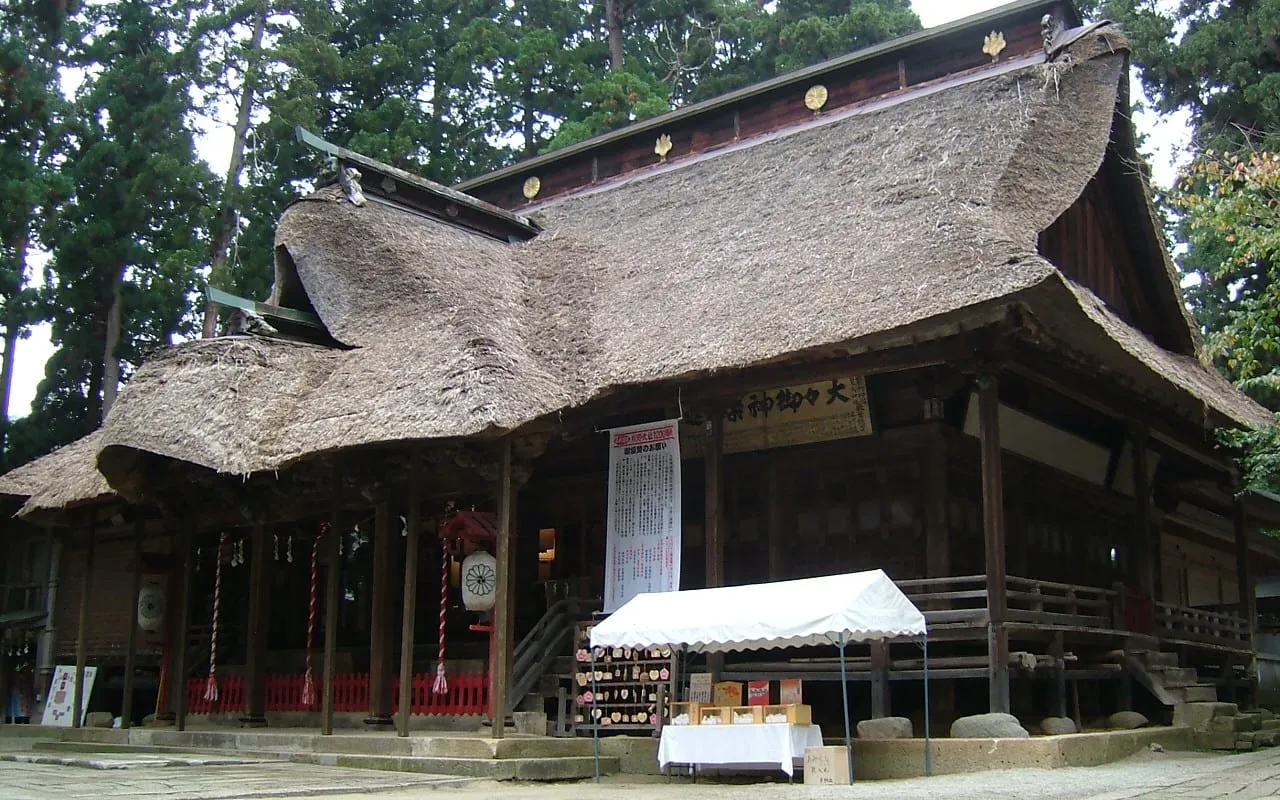
The shrine’s best-known feature is its thatched worship hall. According to the official site, an ink inscription dated 1787 (Tenmei 7) was found during the 2006 roof repair, showing the hall was built before that year. In Nanyo City’s cultural property list, the “Kumano Jinja worship hall” appears under prefecture-designated cultural properties (buildings), with the Edo period noted in the remarks column. City documents use both “Kumano Jinja” and “Kumano Taisha” for the name.
The official site says three rabbits are hidden in the carvings on the back of the main hall, and that finding all three brings good relationships. The grounds guide includes a route that goes around the back of the main hall. There are also goshuin books decorated with rabbits and the moon. The great ginkgo on the grounds is a Yamagata Prefecture-designated natural monument (designated November 24, 1956), which the prefecture’s cultural property database describes as one of the prefecture’s largest trees, estimated at 850 years old. A news post on the official site calls it “over 900 years old,” so the age differs by source.
The official grounds guide also lists a large stone torii (built to commemorate the 1,200th anniversary of the rebuilding), the 46 steps of the Omisaka, the Mirror Pond and Imperial Envoy Bridge (said to mark where an imperial envoy stayed during the Mongol invasions of the Kamakura period), a bell tower with a bell donated in 1626, and a museum for the shrine’s cultural properties. The children’s dances (bugaku and chigo-mai) and the lion-head ritual of the summer annual festival are designated intangible folk cultural properties of Nanyo City.
Visiting Tips
Visiting hours and amulet-office hours are not stated on the official site, and one travel guide site gives 9:00 AM–5:00 PM. That is not official, so it is a good idea to call (0238-47-7777) first. The official site says prayer services can be received except on days with special festivals, and are held at set times. You can book online, and the amulet office also takes requests.
The goshuin is received at the amulet office after worshipping. The Tsukimusubi limited edition, Yatagarasu and Ōko no Kumano Ichizan goshuin are ¥500, and the Nagi-leaf goshuin is ¥1,000. Goshuin books are ¥2,300 for the rice-weave and Kumano Taisha designs and ¥3,000 (stamp included) for the Three Rabbits designs in white or vermilion (official site). Charms include the “Yuwai Usagi” (with a fortune slip) at ¥500 and a wind-sound charm.
The nearest station is Miyauchi on the Yamagata Railway Flower Nagai Line, and the official access page shows the change at Akayu Station. A travel guide site gives about 15 minutes on foot from the station. Parking holds 200 regular cars, with attendants on weekends and holidays. Over the New Year, temporary lots about a 5-minute walk away are used.
Annual Festivals
- Monthly Festival (1st of each month): A festival praying for the nation’s prosperity and the safety of the parishioners’ area (official site).
- Tsukimusubi (monthly, on the night of the full moon): A matchmaking prayer rite held on full-moon nights. Check the official site for dates and booking.
- Spring Festival (May): A festival praying for a good harvest and prosperity in commerce and industry.
- Annual Festival / Shishi Matsuri (summer): Children’s dances (Ennen Chigo-mai) are offered at the Kagura hall from July 23 up to the main festival on July 25 (official site). According to Nanyo City, the lion-head rite is known to have been held at least by 1586 (Tensho 14).
- Shiman-hassen-nichi Festival (August 10): Listed in the official grounds guide.
- Ginkgo and Autumn Leaves Festival (November 14): In 2026 the ritual begins at 7:00 PM and anyone may attend.
- Autumn Dai-dai Kagura (autumn): In 2026 on Sunday, October 18 at 12:00 PM, Sunday, November 8 at 2:00 PM and Saturday, November 28 at 2:00 PM (offering ¥5,000). The official site calls the Dai-dai Kagura “Japan’s oldest kagura.”
- Great Purification (December 31): Sins and impurities of the year are transferred to a paper doll and purified.
Dates change from year to year, so check the “Festivals” page and news on the official site for the latest.
Nearby Food & Sightseeing
- Eboshiyama Park: A park overlooking the Akayu hot-spring town. A travel guide site describes it as a stand of Edo-higan cherry trees, with the best viewing from mid-April to early May.
- Akayu Onsen: A hot-spring town around Akayu Station, a Yamagata Shinkansen stop. A travel guide site says inns gather at the foot of Eboshiyama Park and that the town is also known for wine. A good stop after visiting the shrine.
Frequently Asked Questions
- Q. What are the visiting hours?
- A. I could not find visiting hours or amulet-office hours on the official site. Some travel guide sites list 9:00 AM–5:00 PM, but that is not official information. Prayer services are held at set times; you can book online through the official site, and the amulet office also takes requests. It is safest to call ahead (0238-47-7777).
- Q. Can I get a goshuin at Kumano Taisha?
- A. Yes. According to the official site, you receive it at the amulet office after worshipping. The Tsukimusubi limited edition, Yatagarasu and Ōko no Kumano Ichizan goshuin are ¥500 each, and the Nagi-leaf goshuin is ¥1,000. Goshuin books are ¥2,300 each for the rice-weave and Kumano Taisha designs, and ¥3,000 (stamp included) for the Three Rabbits designs in white or vermilion, which show three rabbits and the moon. The official site does not state goshuin hours or whether pre-written ones are available.
- Q. How do I get there, and is there parking?
- A. The official access page lists Miyauchi Station on the Yamagata Railway Flower Nagai Line as the nearest station (change at Akayu Station). It gives no walking time, and one travel guide site says about 15 minutes on foot. By car it is about 15 minutes from Nanyo-Takahata IC on the Tohoku-Chuo Expressway and about 5 minutes from Akayu Station (per a Tohoku tourism information site). Parking holds 200 regular cars (no fee information given), with attendants on weekends and holidays.
- Q. What are the highlights of the worship hall and grounds?
- A. The thatched-roof worship hall is a Yamagata Prefecture-designated tangible cultural property (buildings), according to the Nanyo City cultural property list. The official site says an ink inscription dated 1787 (Tenmei 7) was found during the 2006 roof repair, showing the hall was built before that year. Three rabbits are hidden in the carvings on the back of the main hall, and the official site says finding all three brings good relationships. The great ginkgo on the grounds is a prefecture-designated natural monument.
- Q. When is the annual festival?
- A. The official site presents the summer annual festival as the "Shishi Matsuri" (lion festival): children's dances (Ennen Chigo-mai) are offered at the Kagura hall from July 23 up to the main festival day on July 25. There is also a monthly festival on the 1st and the full-moon matchmaking prayer rite "Tsukimusubi." For 2026, the Ginkgo and Autumn Leaves Festival begins with a ritual at 7:00 PM on November 14. Dates change each year, so check the official site.
Plan Your Visit
Before you go, you can book a stay and get your shrine-visit items ready.
Amazon links open Amazon.co.jp (Japan) in English; whether an item ships overseas depends on the product.
※ Contains ads (PR). Links open external sites such as Amazon, Rakuten, Trip.com and Booking.com.