History
Kumano Taisha is the Ichinomiya (chief shrine) of Izumo Province, standing in the hills of Yakumo-cho in Matsue, Shimane Prefecture. It appears as “Kumano Taisha” in the Izumo no Kuni Fudoki (733) and as “Kumano-ni-masu Jinja” in the Engishiki shrine register (927), and since ancient times it has been treated as one of the great shrines of Izumo, on a par with Kizuki Taisha (today’s Izumo Taisha). It is said to have received the court rank of Junior Third Rank in 851 and Senior Second Rank in 867. In the modern era it was ranked a national middle shrine (Kokuhei Chusha) in 1871 and a national grand shrine (Kokuhei Taisha) in 1916. Today it is a Beppyo shrine of the Association of Shinto Shrines, and it is said to have taken the name “Kumano Taisha” in 1977.
According to the shrine’s official website, the deity is Izanagi no Himanako Kaburogi Kumano no Okami Kushimikeno no Mikoto, regarded as another name of Susanoo no Mikoto. The shrine explains “Izanagi no Himanako” as meaning the beloved child of Izanagi and Izanami, and “Kaburogi” as a sacred ancestral deity. The deity is revered as one who imparts spiritual power to food and brings abundant harvests, prosperity in people’s livelihoods, and good relationships.
The shrine is also called “Hinomoto Hidezome no Yashiro,” the shrine where fire first began in Japan. By long-standing custom, a new chief priest of Izumo Taisha begins his tenure by receiving the sacred fire-making tools, the hikiri-usu and hikiri-gine, from this shrine, and the official website says this is still carried on today.
Note that this is a different shrine from the Kumano Hongu Taisha, Kumano Hayatama Taisha, and Kumano Nachi Taisha of Wakayama (the Kumano Sanzan). Their relationship is debated: one theory holds that they were founded by transferring a divided spirit from here, while another holds that they are separate lineages.
Highlights
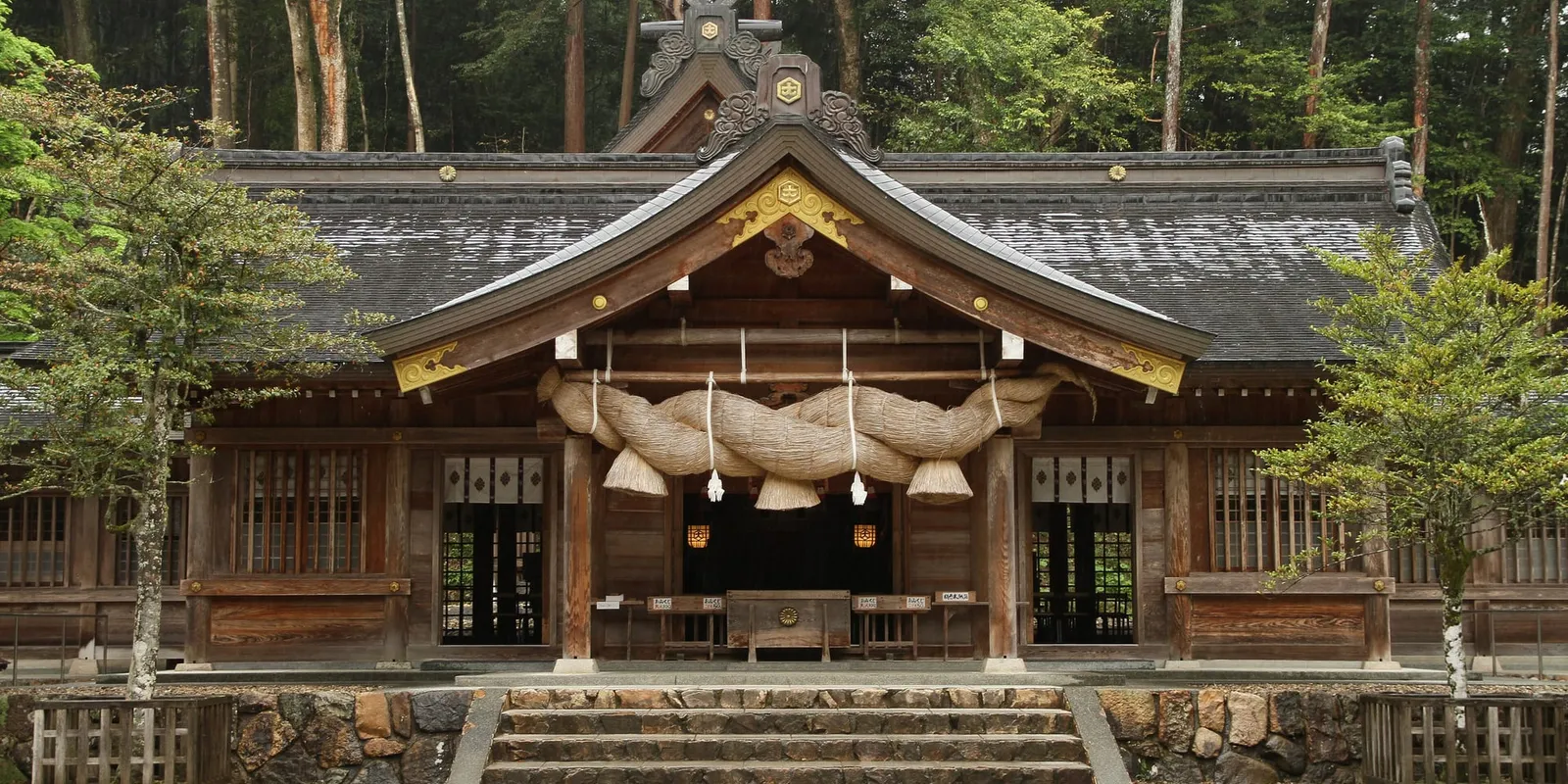
Climbing the stone steps, you are met by the Zuishinmon gate with its large shimenawa rope (rebuilt in 1886 and 1928). The main hall is in the taisha-zukuri style; the present building dates from 1948, its roof was changed from cypress bark to copper plate in 1978, and the heiden and haiden (offering and worship halls) were added the same year. The quiet grounds, surrounded by deep woods, include the worship hall with its large shimenawa, the Maidono dance hall, and the rest house Kansuitei with its koi pond.
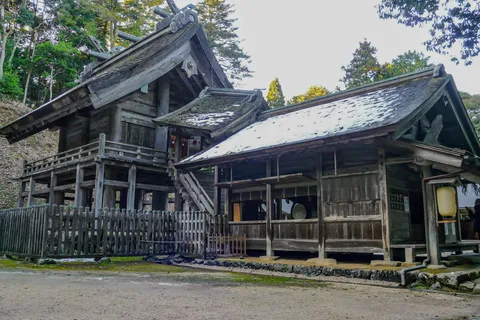
The shrine’s most distinctive building is the Sankaden. A thatched-roof hall with walls covered in cypress bark, it stores the hikiri-usu and hikiri-gine and serves as the stage of the Sanka-sai festival. According to the official website, the present building was newly built in 1991 and is also used for the Izumo Kokuso’s “Hitsugi-shiki” succession rite. It is described as a facility rarely found at other shrines.
Within the grounds stand Inada Shrine (dedicated to Kushinada-hime and others, Susanoo’s consort), Izanami Shrine (his mother, Izanami no Mikoto), Kojin Shrine, and Inari Shrine. Izanami Shrine was originally enshrined at the “Kami no Miya” about 400 m away, and in the medieval period the shrine is said to have been divided into the Kami no Miya (enshrining the three Kumano deities) and the Shimo no Miya (the Ise shrine). Beside Kojin Shrine, sacred spring water (goshinsui) wells up, set up so that visitors can drink it.
The shrine’s origin is said to lie in a huge sacred rock (iwakura) near the summit of present-day Mt. Tengu, a site called “Genguga-nari.” Cultural properties such as the prefecture-designated old documents “Kumano Jinja Monjo” and the city-designated Kumano dotaku (bronze bell) are also known, but they are on deposit at museums.
Visiting Tips
The grounds are open at any time and free to enter. The shrine office is open 8:30 AM–4:30 PM and prayer services are accepted 9:00 AM–3:30 PM, so it closes relatively early in the day. The proper way to pray is two bows, two claps, and one bow. The goshuin is said to cost ¥300, but the official website does not mention goshuin and this comes from visitor-guide sites; if you particularly want one, please call ahead (0852-54-0087).
Public transport is infrequent and requires a transfer. The route is by Ichibata Bus from JR Matsue Station to the Yakumo Bus Terminal, then the Matsue City community bus or the reservation-based AI on-demand bus to “Kumano Taisha-mae,” but these are said not to run on some days, such as weekends and holidays. By car, free parking (about 100 spaces) is available, about 30–40 minutes from JR Matsue Station.
Annual Festivals
- Sanka-sai / Kametayu Shinji (October 15, from 10:00 AM): The shrine’s most famous festival. The chief priest of Izumo Taisha visits to receive the hikiri-usu and hikiri-gine used in Izumo Taisha’s Koden Shinjo-sai, and the handing-over ceremony is called the Kametayu Shinji. It is a unique rite in which complaints are loudly raised about the rice cakes Izumo Taisha brings. Afterwards, the Izumo Taisha priest performs the “Hyakuban no Mai” dance.
- Grand Autumn Festival (Reitaisai) (October 14, from 10:00 AM): Also called “Omi Matsuri,” this is the largest autumn festival at Kumano Taisha. Rice cakes are thrown to the crowd at the Maidono in the afternoon after the ceremony.
- Migushi-sai (April 13): A festival based on the tale that after slaying the Yamata no Orochi, Susanoo gave a comb (migushi) to Kushinada-hime as a betrothal gift. At 10:00 AM a comb is placed in the main hall, a norito prayer is recited, and the comb is then offered at Inada Shrine. From 3:00 PM, local junior-high girls serve as saotome rice-planting maidens in the Otaue Shinji ritual.
- Genguu-sai (fourth Sunday of May, from 9:00 AM): Once held with worshippers climbing to the original shrine site on Mt. Tengu, it is now performed with the priests praying toward the sacred rock from the Kami no Miya worship site.
- Kamiari-sai (10th lunar month, 11th day, from 2:00 PM): A revival of a festival recorded in Edo-period documents, held in the form of a prayer service.
- Setsubun-sai (February 3): Beans are thrown at the Maidono.
Dates and access to the grounds may change. Please check the official website or similar sources for the latest information before visiting.
Nearby Food & Sightseeing
- Yuai Kumano-kan: A Yakumo Onsen inn that the shrine’s official website recommends for meals and lodging near the shrine. Please check in advance whether day-use bathing is available.
- Kamosu Shrine: An ancient shrine with a National Treasure main hall. Like Kumano Taisha, it is counted among the “Ou Six Shrines” of the Ou area, the center of ancient Izumo.
- Yaegaki Shrine: An ancient shrine known for matchmaking, enshrining Susanoo and Inada-hime, connected to the myth of the slaying of the Yamata no Orochi.
Frequently Asked Questions
- Q. What are the visiting hours and is there an admission fee?
- A. The grounds are open to visitors at any time and there is no admission fee. The shrine office is open 8:30 AM–4:30 PM, and prayer services are accepted 9:00 AM–3:30 PM.
- Q. Can I get a goshuin at Kumano Taisha?
- A. It is said to be available during shrine office hours (8:30 AM–4:30 PM) for ¥300. The official website does not mention goshuin and this comes from several visitor-guide sites, so if you especially want one, it is safest to call ahead (0852-54-0087).
- Q. Is there parking?
- A. Yes. There is free parking for visitors, said to hold about 100 cars (sources vary between 90 and 100).
- Q. What is the Sanka-sai (Kametayu Shinji) festival?
- A. It is held every year on October 15, starting at 10:00 AM, and is Kumano Taisha's most famous festival. The chief priest of Izumo Taisha visits to receive the fire-making mortar (hikiri-usu) and pestle (hikiri-gine) used in Izumo Taisha's Koden Shinjo-sai. The handing-over ceremony is called the Kametayu Shinji, an unusual rite in which complaints are loudly raised about the quality of the rice cakes Izumo Taisha brings. The Izumo Taisha priest then performs the "Hyakuban no Mai" dance.
- Q. Is this the same as the Kumano shrines in Wakayama?
- A. No, it is a different shrine. Kumano Taisha in Matsue, Shimane is the Ichinomiya (chief shrine) of Izumo Province, ranked alongside Izumo Taisha, and enshrines Kushimikeno no Mikoto, regarded as another name of Susanoo no Mikoto. Its relationship to the Kumano Sanzan in Wakayama is debated: one theory holds that the Wakayama shrines were founded by transferring a divided spirit from here, while another holds that they are entirely separate lineages.
Plan Your Visit
Before you go, you can book a stay and get your shrine-visit items ready.
Amazon links open Amazon.co.jp (Japan) in English; whether an item ships overseas depends on the product.
※ Contains ads (PR). Links open external sites such as Amazon, Rakuten, Trip.com and Booking.com.