History
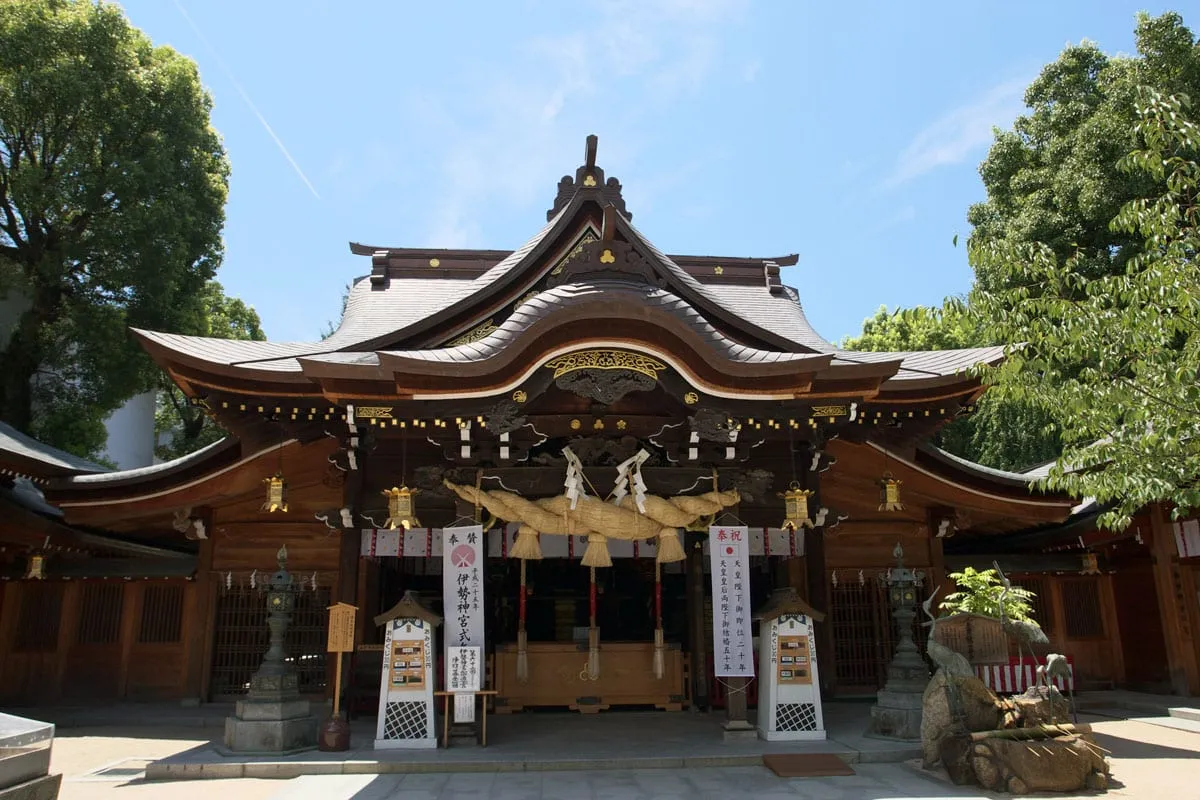
Kushida Shrine stands in the old merchant quarter of Hakata, in Fukuoka’s Hakata Ward, and is the guardian shrine of the whole of Hakata, affectionately called “O-Kushida-san.” According to shrine tradition, it began in 757 (the first year of Tenpyo-hoji), when the deity Ohatanushi no Okami was invited from Kushida Shrine in Matsusaka, Ise Province. Today the three deities are enshrined in three halls: Ohatanushi no Okami in the central hall (Kushida-gu), Amaterasu Sume Okami in the left hall (Daijingu), and Susanoo no Okami in the right hall (Gion-gu).
Susanoo no Okami is said to have been invited from the Gion shrine in Kyoto in 941 by Ono no Yoshifuru, who prayed for divine help while putting down the rebellion of Fujiwara no Sumitomo. Amaterasu’s enshrinement is considered so ancient that no record of it survives. The shrine was repeatedly ruined by warfare in the medieval period, but in 1587 (Tensho 15) Toyotomi Hideyoshi built and donated the present shrine buildings when he restored Hakata’s town layout. Long revered for business prosperity and longevity, it was ranked as a prefectural shrine (kensha) in 1891.
Highlights
The grounds are full of things that bring Hakata’s history and festivals to life.
- Kazari Yamakasa: A permanent decorative Yamakasa float, about 13 m tall, stands on the grounds. It can be seen all year round except June, when Yamakasa preparations take place, and at night a coin dropped in the box lights it up. It is made by Hakata doll craftsmen and is said to have started as a permanent display in 1964.
- Kushida no Ginnan (Kushida’s ginkgo): A sacred tree said to be around 1,000 years old and designated a natural monument by Fukuoka Prefecture. It is regarded as a symbol of long life.
- Mongol anchor stones (Moko Ikariishi): Two stones kept on the grounds, designated archaeological materials of Fukuoka Prefecture. These square-section stone anchors are found in Hakata Bay, and it has been suggested that they could have been used during the Mongol invasions of 1274 and 1281.
- Zodiac direction board in the Romon gate: Passing through the front gate, you will see a colorful zodiac direction board (eto ehoban), made by a Hakata doll craftsman, hanging from the ceiling.
- Reisen Tsuru no Ido: A well known for the spring water drawn from beneath the main hall.
- Hakata History Museum: An exhibition facility on the grounds displaying Yamakasa folding screens, a large Oi-yama votive plaque, and a vermilion-seal document of Toyotomi Hideyoshi (a Fukuoka City designated cultural property), among other items. Its facilities and exhibits were renewed in 2025.
The main hall and worship hall were renovated and a covered corridor was added during the 48th Shikinen Sengu (periodic rebuilding) in 2000, and the 49th, held once every 25 years, fell in 2025 (the main ceremony took place that autumn alongside Hakata Okunchi). Note that the shrine buildings themselves are not designated cultural properties; the designations apply to the grounds’ ginkgo tree and Mongol anchor stones, and to the Hakata Gion Yamakasa festival dedicated at the shrine (a nationally designated Important Intangible Folk Cultural Property).
Visiting Tips
The grounds are open from 4:00 AM to 10:00 PM and free to enter, but the shrine office (goshuin and amulets) is open only 9:00 AM–5:00 PM. Goshuin are issued at the office to the right as you face the worship hall, for roughly ¥300 (based on visitor reports, so please confirm on the day). Three original goshuin books are offered: Niwaka (¥1,000), Yamakasa blue (¥1,000), and Yamakasa red, large size (¥1,500).
The Hakata History Museum is open 10:00 AM–4:30 PM, closed Mondays (the next day if Monday is a holiday), with adult admission of ¥300; photography is not allowed inside. Pairing it with your visit to the grounds gives a deeper understanding of Yamakasa history.
The nearest station is Kushida Shrine-mae on the Fukuoka Subway Nanakuma Line, about a 2-minute walk. Gion and Nakasu-Kawabata stations on the Airport Line are also about 6 minutes away, so the shrine is easy to reach by train. A paid parking lot for worshippers is available too (listed as about 100 spaces and ¥100 per 20 minutes, but the number of spaces and the free-time services vary by source, so please confirm when you use it).
Annual Festivals
- Hakata Gion Yamakasa (July 1–15): A ritual offering by the shrine’s parishioners to the shrine’s Gion deity (Susanoo), designated a nationally Important Intangible Folk Cultural Property and inscribed on UNESCO’s Intangible Cultural Heritage list in 2016. On July 1, the Gojin-ire ceremony opens the Kazari Yamakasa decorative floats to the public; on the 9th every Nagare team performs Oshioi-tori and, on the way home, prays at Hakozaki Shrine and Kushida Shrine. After the Oi-Yamakasa Narashi rehearsal on the 12th (3:59 PM) and the Shudan Yamamise on the 13th (3:30 PM), the climactic Oi-Yamakasa begins at 4:59 AM on July 15 at the signal of the big drum, with each float performing the "Kushida-iri" in turn starting with the first float. After the Kushida-iri, the floats leave the grounds and race a course of about 5 km. The same day, the "Shizume no No" Noh performance is staged on the shrine’s Noh stage from 6:00 AM. For tiered-seating tickets and viewing inquiries, contact Kushida Shrine (tel. 092-291-2951).
- Hakata Okunchi (October 23–24): The shrine’s autumn grand festival, in which a mikoshi pulled by an ox cart leads a divine procession through Hakata. It is counted as one of Japan’s three great Kunchi festivals, alongside Nagasaki Kunchi and Karatsu Kunchi.
- Setsubun Festival (February 3): Around Setsubun, giant “Otafuku” masks are set up on the grounds and a bean-scattering ritual is held.
- New Year’s visit (January): One of Hakata’s best-known hatsumode spots, expecting about 150,000 worshippers over the first three days.
Nearby Food & Sightseeing
- Kawabata-dori Shopping Street: One of Hakata’s oldest shopping streets, which grew up as the town at the shrine’s gate. A fully covered arcade runs about 400 m, and it is also known for the zenzai sweets at "Kawabata Zenzai Hiroba."
- Jotenji: A Zen temple known as the birthplace of Hakata Gion Yamakasa and of udon, soba, and manju. A stone monument marking the birthplace of udon and soba stands on its grounds.
- Shofukuji: A temple said to be Japan’s first full-fledged Zen temple, founded by Zen master Eisai in 1195 (Kenkyu 6). Easy to combine with a stroll through Hakata’s temple district.
Frequently Asked Questions
- Q. What are the visiting hours and is there an admission fee?
- A. The grounds are open from 4:00 AM to 10:00 PM and there is no admission fee. The shrine office (goshuin and amulets) is open 9:00 AM–5:00 PM. The Hakata History Museum on the grounds is separate: 10:00 AM–4:30 PM, closed Mondays, adults ¥300.
- Q. When can I get a goshuin at Kushida Shrine?
- A. At the shrine office, on the right as you face the worship hall, from 9:00 AM to 5:00 PM. The fee is roughly ¥300 (based on visitor reports, so please confirm on the day). Original goshuin books come in three types: Niwaka (¥1,000), Yamakasa blue (¥1,000), and Yamakasa red, large size (¥1,500).
- Q. Is there parking?
- A. Yes, there is a paid parking lot for worshippers. Fukuoka tourism sites list about 100 spaces, ¥100 per 20 minutes from 8:00 AM to midnight and ¥100 per hour from midnight to 8:00 AM. Some sources also mention 30 free minutes for worshippers and 60 for those receiving a prayer service, so please confirm when you use it.
- Q. When can I see the Kazari Yamakasa decorative float?
- A. The Kazari Yamakasa on the grounds is a permanent display, viewable all year round except June, when Yamakasa preparations take place. It stands about 13 m tall and, at night, putting a coin in the box lights it up and plays an introductory announcement.
- Q. What time does Oi-Yamakasa start, and where can I watch?
- A. Oi-Yamakasa starts at 4:59 AM on July 15 at the signal of the big drum. The floats enter the shrine grounds one by one in the "Kushida-iri," beginning with the first float, and then race out along a course of about 5 km. For tiered-seating tickets and viewing inquiries, contact Kushida Shrine (tel. 092-291-2951).
Plan Your Visit
Before you go, you can book a stay and get your shrine-visit items ready.
Amazon links open Amazon.co.jp (Japan) in English; whether an item ships overseas depends on the product.
※ Contains ads (PR). Links open external sites such as Amazon, Rakuten, Trip.com and Booking.com.