History
Munakata Taisha is made up of three linked shrines enshrining the Three Munakata Goddesses, said to have been born from a ritual pact (ukei) between the sun goddess Amaterasu and her brother Susanoo. Okitsumiya, on the remote island of Okinoshima in the Genkai Sea, enshrines Tagorihime no Kami; Nakatsumiya, on Oshima island, enshrines Tagitsuhime no Kami; and Hetsumiya, here on the Kyushu mainland, enshrines Ichikishimahime no Kami. This page focuses on Hetsumiya, the only one of the three shrines that ordinary visitors can readily reach.
Since ancient times, the Munakata deities have been revered as protectors of the sea route the Yamato court relied on for diplomacy with the Korean peninsula and mainland China. Okinoshima itself is worshipped as a sacred island in its entirety, subject to strict purification rituals for anyone landing there, and is now closed to the general public. Excavations on the island have yielded roughly 80,000 votive objects offered between the 4th and 9th centuries — a trove so extraordinary in quality and scale that it has earned Okinoshima the nickname “Shosoin of the Sea.” In 2017, Munakata Taisha’s three shrines and their associated sites were together inscribed as the UNESCO World Heritage Site “Sacred Island of Okinoshima and Associated Sites in the Munakata Region.”
Highlights
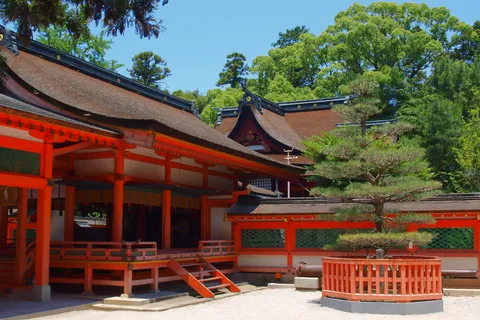
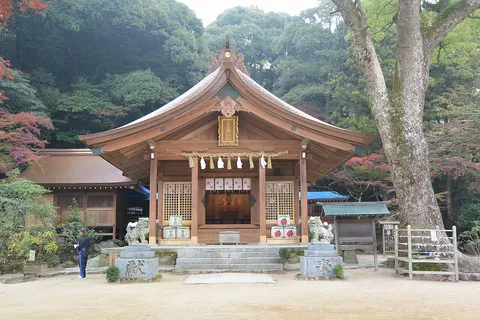
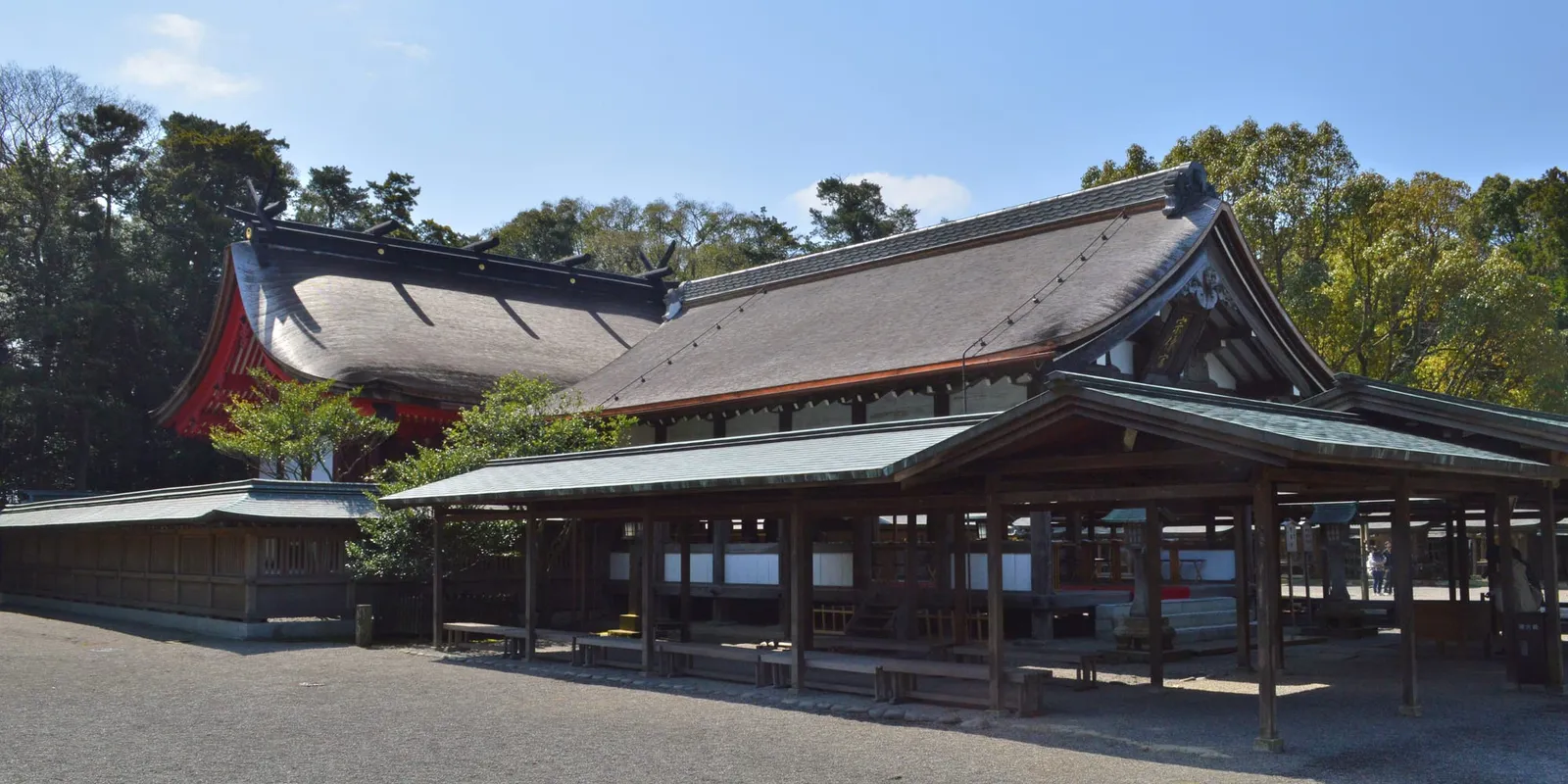
Hetsumiya’s present main hall dates to 1578 and its worship hall to 1590, both designated nationally as Important Cultural Properties. Deep within the grounds lies the Takamiya Saijo, an ancient ritual site said to mark the spot where Ichikishimahime no Kami first descended — a place with no shrine building at all, where the hushed, tree-ringed clearing itself forms the sacred precinct, preserving one of Japan’s few remaining examples of this most primal form of Shinto worship.
The Shinpokan museum on the grounds houses and displays roughly 80,000 National Treasure-designated objects excavated from Okinoshima — mirrors, curved beads, gold rings, and other first-rate artifacts that testify to ancient exchange with the Asian continent. It is an essential stop for understanding the Okinoshima faith that ordinary visitors otherwise cannot witness firsthand.
Visiting Tips
Visiting the main hall and worship hall alone takes about 30 minutes, but allow about an hour if you also tour the Shinpokan museum. Museum admission is ¥800 for adults, and it is open 9:00–16:30 (last entry 16:00). Prayers and goshuin stamps are handled at the Kiganden hall on the grounds.
Annual Festivals
- Autumn Grand Festival “Miare-sai” (October 1–3): A festival that welcomes the deities of Okitsumiya and Nakatsumiya to Hetsumiya once a year. On October 1, a grand fleet of fishing boats from Munakata’s seven coastal communities forms a dramatic sea procession from Oshima to Konominato harbor.
- Yabusame Horseback Archery Rite (October 2): A traditional rite performed as part of the Miare-sai festival.
- Takamiya Kannabi-sai (October 3): A mystical night kagura dance performed at the Takamiya Saijo, closing out the Miare-sai festival.
- New Year’s Rite (January 1): A rite praying for peace in the year ahead, held on the first day of the new year.
Nearby Food & Sightseeing
- Munakata Taisha Shinpokan: The museum on the shrine grounds, housing and displaying about 80,000 National Treasure objects excavated from Okinoshima — an essential stop for grasping the scale of the “Shosoin of the Sea.”
- Michi-no-Eki Munakata: A roadside market just minutes from the shrine by car, among the most popular in Kyushu, known for fresh catch from Munakata’s four fishing ports and its hearty seafood rice bowls.
- Chinkokuji Temple: A venerable Shingon-sect temple close to Munakata Taisha, said to have been founded by the monk Kukai on his return voyage from Tang-dynasty China, with deep historical ties to the Munakata goddesses.
Frequently Asked Questions
- Q. What are the visiting hours?
- A. The grounds are open to visitors at all times. Prayer services at the Kiganden hall run 9:00–17:00.
- Q. When is the goshuin office open?
- A. 9:00–17:00, for ¥500.
- Q. Is there parking?
- A. Yes, free parking is available (about 1,000 spaces).
- Q. I heard Munakata Taisha is made up of three shrines — is Hetsumiya one of them?
- A. Yes. Munakata Taisha comprises three linked shrines: Okitsumiya on the remote island of Okinoshima, Nakatsumiya on Oshima island, and Hetsumiya on the Kyushu mainland — the shrine described on this page, and the only one of the three that ordinary visitors can reach. Landing on Okinoshima, where Okitsumiya stands, is heavily restricted and closed to the general public.
- Q. How do I get there?
- A. About a 12-minute bus ride on the Nishitetsu Bus from JR Togo Station to the Munakata-Taisha-mae stop, then about a 2-minute walk.