History
Chikuzen-no-kuni Ichinomiya Sumiyoshi Shrine stands in Sumiyoshi, Hakata Ward, Fukuoka, about an 8-minute walk from JR Hakata Station. The official site says it has long been affectionately called “Sumiyoshi-san” by local people. (A Fukuoka City tourist-information site gives the reading as “Chikuzen-kuni Ichinomiya Sumiyoshi Jinja.”) Many shrines across Japan use the Sumiyoshi name — the official site counts 2,129 of them — so be careful not to confuse this one with a namesake elsewhere.
According to the official site, the enshrined deities are the three Sumiyoshi deities Sokotsutsu-no-o, Nakatsutsu-no-o and Uwatsutsu-no-o, who the Kojiki records were born when Izanagi no Okami performed purification at Oto no Awagihara in Himuka in Tsukushi. Amaterasu Sume-Okami and Empress Jingu are enshrined alongside them, and together the five are also called “Sumiyoshi Gosho Okami.” The shrine explains that its deity is widely revered for protecting people from all calamity through “purity of body and mind,” and that because “tsutsu” is said to mean “star,” it is also deeply venerated as a guardian of sea voyages.
On its history, the official site says it goes back about 1,800 years or more and is said to be the first of the 2,129 Sumiyoshi shrines in Japan, with old texts calling it “Sumiyoshi Honsha” and “Nihon Daiichi Sumiyoshi-gu.” That it is counted, with Sumiyoshi Taisha in Osaka and Sumiyoshi Shrine in Shimonoseki, as one of the “Three Great Sumiyoshi of Japan” is also the shrine’s own explanation. The official site says the present main hall was rebuilt in 1623 (Genna 9) with a donation of 2,000 ryo of silver and timber from Kuroda Nagamasa.
Highlights
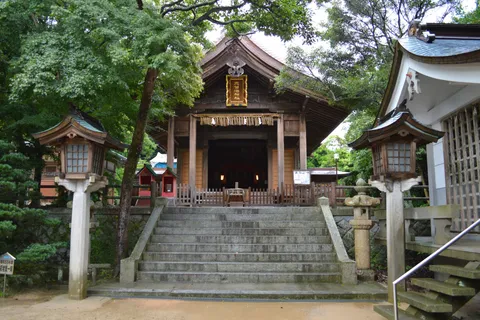
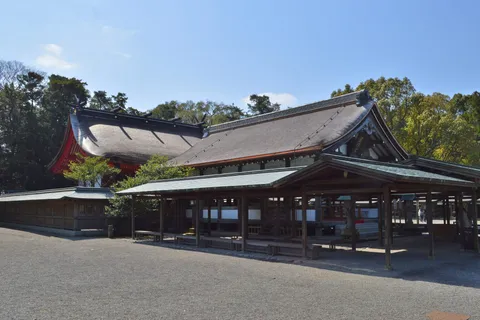
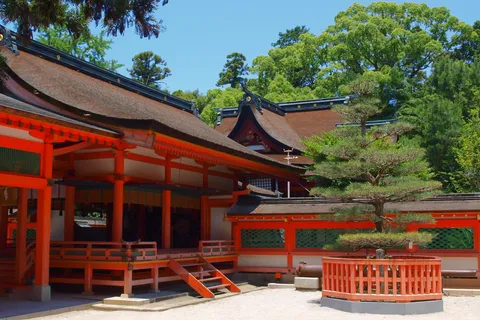
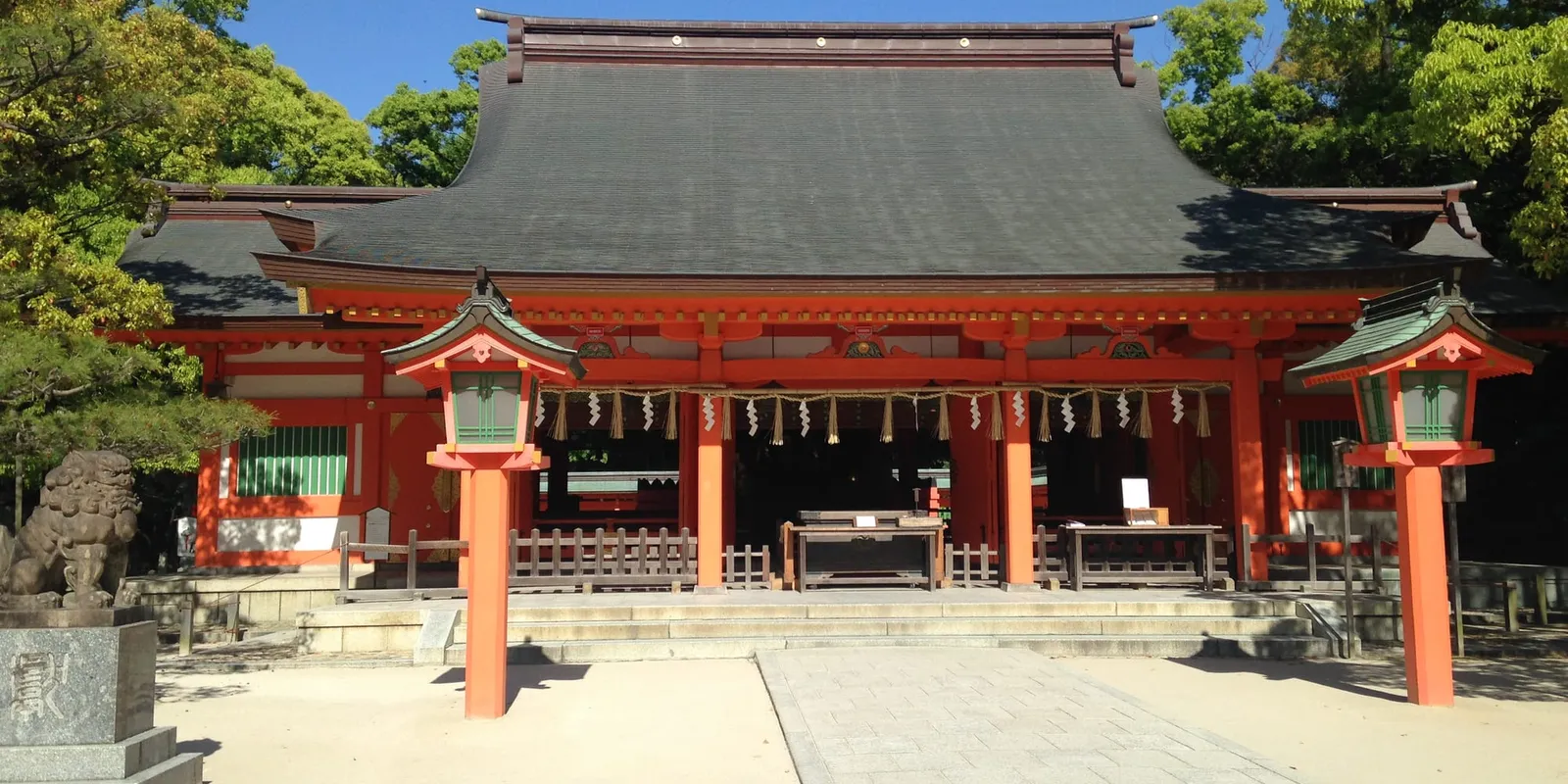
According to the official site, the main hall is a nationally designated Important Cultural Property. It is in the style called “Sumiyoshi-zukuri,” characterized by vermilion-painted pillars, rafters and bargeboards, white-plastered (gofun) wall panels, a straight gabled roof, and a straight gable-end entrance. The shrine says the hall is renewed or repaired through a ceremony called Gosengu (御遷宮) every 25 years. The grounds cover 8,107 tsubo and include the Noh stage (a Fukuoka City tangible cultural property), the Karamon gate (a city-designated cultural property), Tenryu Pond and the Kudoku pond (功徳池).
Auxiliary and subsidiary shrines are scattered through the grounds. The official site’s map lists Arakuma-Shirohige Inari Shrine (荒熊・白髭稲荷神社), Mikka Ebisu Shrine, Funadama, Shiga, Hitomaru and Sugawara Shrines, Sukunahikona Shrine, and Amatsu Shrine.
The official site’s recommended spots are the sacred tree “Ichiya Matsu,” the Ancient Wrestler statue, the Ebisu statue, the Shiga Shrine “Fukubun” gold coin (福分小判), and Nozoki Inari. Ichiya Matsu is a tree with a legend that, in the era the site calls Eikyo, a pine leaning over the hall was about to be cut down because it got in the way of construction, but overnight it grew straight. The Ancient Wrestler statue is a joint work of the Hakata doll makers 中村信喬 and his son 弘峰 (Nakamura), and it is said that touching the right hand, whose wrinkles look like the character 力 (“strength”), gives you strength. The Ebisu statue is said to bring different blessings depending on where you touch it: face for household safety, belly for recovery from illness, the sea bream for money luck, and arm for skill.
Visiting Tips
The official site does not state opening or closing times for the grounds. The shrine office is open for reception 9:00 AM–5:00 PM, and prayer services are accepted 9:00 AM–4:30 PM (held at :00 and :30 each hour). Prayers start from ¥7,000, are accepted on the day, and up to 10 people including the person praying may enter the main hall. The listed prayers include safe childbirth, first shrine visit for a baby, Shichi-Go-San, yakubarai (misfortune purification) and traffic safety; for traffic-safety prayers the car is purified afterward, so the shrine asks you to park at the main approach (west gate).
Goshuin are handled at the shrine office for ¥500 (9:00 AM–5:00 PM). New Year’s and major festivals can be crowded and take longer. Goshuin books are not sold on their own; they are provided after you write your name in the register (¥3,000). Amulets include the strength charm (力守), star charm (星守), travel-safety, and safe-childbirth charms, priced from ¥1,000 to ¥1,800, and there is also a recovery-from-illness charm, which the shrine ties to the “god of medicine” it enshrines (all per the official site).
It is about 8 minutes on foot from JR Hakata Station or Hakata Station (subway), or a Nishitetsu bus to “Sumiyoshi” and about 2 minutes on foot. The official site gives about 30 parking spaces with no fee stated. One tourist-information site lists about 50 spaces, so the figure differs by source; public transport is the safer choice during busy periods.
Annual Festivals
Main events from the official site’s annual list (dates as given there; they may change by year).
- Tsuina-sai with Oni-sube and Uso-kae (January 7): After the demon-driving tsuina rite, the Uso-kae ritual exchanges “lies” for “truth.”
- Setsubun-sai (February 3): A four-eyed golden “Hososhi” drives away demons in a tsuina rite, followed by bean-throwing at the kagura hall.
- Onda-sai (March 7): A rite praying for a bountiful harvest of the five grains, including a seed-sowing ceremony. The official site says the Fukuoka Prefecture-designated intangible cultural property “Iwato Kagura” is offered.
- Shiohi Festival, 潮干祭 (April 3): A festival praying for safe voyages, good catches and traffic safety.
- Baby Sumo Ring Entrance (mid-May): Babies in ceremonial aprons are carried into the ring by sumo wrestlers (the date differs by year).
- Nagoshi Taisai (July 30–August 1): On July 31, the main-hall rite with the chinowa reed-ring crossing is at 10:00 AM, and the riverbank paper-doll rite (川岸祭) is at 7:00 PM.
- Annual festival, Sumo-e Taisai (October 12–14): A children’s procession, yabusame and boys’ sumo.
- Hosha Festival, 歩射祭 (November 7): A rite said to have its origin in 878 (Gangyo 2).
- Shichi-Go-San Children’s Festival (November 15): The official site says Shichi-Go-San prayers are held throughout November.
- New Rice Thanksgiving Grand Festival, 新穀感謝大祭 (November 23): Listed in the official site’s annual list.
In addition, the official site says a Yokozuna ring-entering ceremony is held every year before the Kyushu Grand Sumo Tournament as an official event of the Japan Sumo Association. Check the official site for the latest dates.
Nearby Food & Sightseeing
- Canal City Hakata: A commercial complex also in Sumiyoshi, Hakata Ward. The Fukuoka City tourist-information site CROSSROAD FUKUOKA describes it as one of Kyushu’s largest complexes, with a canal of about 180 m running through the center.
- Hakata Station: About an 8-minute walk from the shrine (official site), and a base for meals and shopping before or after your visit.
Frequently Asked Questions
- Q. What are the visiting hours?
- A. The official site does not state opening or closing times for the grounds. It does list the shrine office reception (9:00 AM–5:00 PM) and prayer-service reception (9:00 AM–4:30 PM, held at :00 and :30 each hour). Prayers start from ¥7,000, are accepted on the day, and up to 10 people including the person praying may enter the main hall.
- Q. Can I get a goshuin at Sumiyoshi Shrine?
- A. Yes. According to the official site, goshuin are handled at the shrine office for ¥500, 9:00 AM–5:00 PM. Goshuin books are not sold on their own; they are provided after you write your name in the register (¥3,000). It can be crowded at New Year's and during major festivals, and it may take longer than usual.
- Q. How do I get there, and is there parking?
- A. The official site gives about 8 minutes on foot from JR Hakata Station or Hakata Station (subway), or a Nishitetsu bus to "Sumiyoshi" and about 2 minutes on foot. Parking is about 30 spaces per the official site, with no fee stated (one tourist-information site lists about 50, so the figure differs by source).
- Q. Which building is a national Important Cultural Property?
- A. According to the official site, the main hall is a nationally designated Important Cultural Property. It is built in the style called "Sumiyoshi-zukuri," which the official site describes as the oldest special style in the history of shrine architecture. The present hall was rebuilt in 1623 (Genna 9) with a donation of 2,000 ryo of silver and timber from Kuroda Nagamasa. The official site also lists the Noh stage as a Fukuoka City tangible cultural property and the Karamon gate as a city-designated cultural property.
- Q. What is the connection with sumo?
- A. According to the official site, the autumn annual festival, also called the "Sumo-e Taisai," is held October 12–14 and features a children's procession, yabusame (horseback archery) and boys' sumo. It is said to originate from Empress Jingu giving thanks, through sumo and yabusame, for her safe return thanks to the virtue of the Sumiyoshi deities. The grounds hold a statue of an ancient wrestler and a sumo ring, and the official site says a Yokozuna ring-entering ceremony is held every year before the Kyushu Grand Sumo Tournament as an official event of the Japan Sumo Association (check the official site for the date).
Plan Your Visit
Before you go, you can book a stay and get your shrine-visit items ready.
Amazon links open Amazon.co.jp (Japan) in English; whether an item ships overseas depends on the product.
※ Contains ads (PR). Links open external sites such as Amazon, Rakuten, Trip.com and Booking.com.