History
Nunakuma Shrine (Nunakuma-jinja) stands in Tomonoura in Fukuyama, Hiroshima Prefecture. According to the official site, it is also called Tomo Gion-gu and is affectionately known as “Tomo no Gion-san.” It enshrines Owatatsumi no Mikoto and Susanoo no Mikoto; its former rank was Kokuhei Shosha (a minor national shrine), it is an Engishiki-listed shrine, and today it belongs to the Association of Shinto Shrines as a Bekkaku Honsha.
According to the official history, in the 2nd year of Emperor Chuai, Empress Jingu stopped at this bay on her way west, found there was no shrine, set up a place of worship, enshrined the sea deity Watatsumi with a sacred stone that had welled up from the sea, and prayed for safe voyages; this is said to be the origin of the shrine. The official site describes this as “over 1,800 years ago.” When the Empress returned, she stopped here again and offered an “Izu no Takatomo,” a type of archery equipment, before the deity in thanks, and this is said to be how the place came to be called “Tomo.”
Susanoo is worshipped as Tomo Gion-gu. It originally stood in Sekimachi within Tomo, was destroyed by fire in Keicho 4, and was moved to Kusatani (the present site). In Meiji 9, the deity Watatsumi was enshrined together with it, and the two are now worshipped as co-enshrined deities. The official site notes that the founding of the Gion-gu is unknown. It lists blessings for maritime safety, prosperous fishing, household safety, recovery from illness, academic success and safe childbirth.
Highlights
The main attraction is the Noh stage, a national Important Cultural Property. According to the official site, it was a favorite of Toyotomi Hideyoshi and stood inside Fushimi Castle in Kyoto. When the castle was dismantled in Genna 6, the lord of Fukuyama Castle, Mizuno Katsunari, received it from the second Tokugawa shogun, Hidetada, and it was donated to the shrine during the Manji era. It is described as the only assembly-type Noh stage in Japan and was designated an Important Cultural Property in 1953. The structure is single-story with a gabled roof, 5.45 m by 5.45 m, with a shingle roof (kokera-buki). On its era, the Agency for Cultural Affairs database says “early Edo period,” while the Japan Heritage portal says it retains features of the early Momoyama period; the sources differ. According to the Japan Heritage portal, it is still used as a Noh stage, and conservation work including a full re-roofing has been under way since Reiwa 2 (2020).
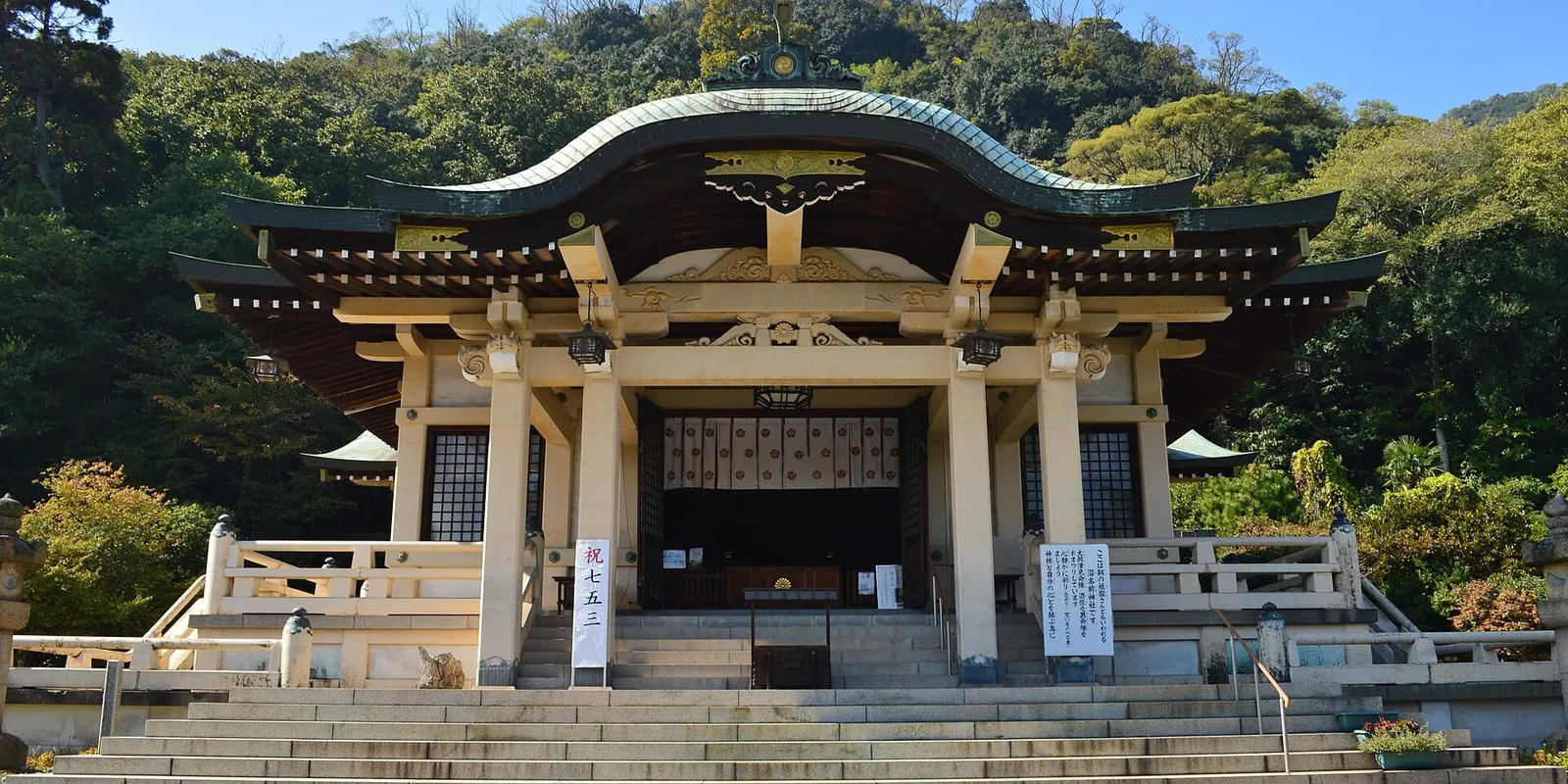
The official site also introduces the “torii-busuma-style” second torii donated in 1625 by Mizuno Katsushige (a Hiroshima Prefecture Important Cultural Property), the stone lanterns on either side in front of the worship hall (offered in 1651; Fukuyama City designated), and the strength stones (chikara-ishi) that harbor porters of Tomo offered after contests of strength between the Edo and Meiji periods (Fukuyama City designated). Noh masks, guardian dogs, ema and other items exist but are not open to the public. A grand stone staircase of 45 steps leads from the Zuishin Gate toward the worship hall.
Visiting Tips
Prayer services are offered daily from 9:00 AM to 4:00 PM (official site). They may be unavailable during festivals and other events, so it is safest to call ahead. Visiting hours for the grounds themselves are not stated on the official site; the Fukuyama City guide page lists 9:00 AM–4:00 PM, open every day, free.
For goshuin, the official site’s news page gives the amulet counter’s New Year hours and says they are “pre-written sheets only” at that time, but regular-season hours and the fee are not given. Please ask at the shrine office.
It takes about 30 minutes by Tomotetsu bus from the bus stop in front of JR Fukuyama Station (stop no. 5) to “Tomo no Ura,” then about a 5-minute walk (official site; the Fukuyama City guide page says 10 minutes, so the two differ). There is no parking within the grounds, and the official site says vehicles cannot enter the grounds on festival days. Please use a public parking lot in Tomonoura.
Annual Festivals
Dates are as given on the official site.
- Oyumi Shinji (second Sunday of February): A Fukuyama City intangible cultural property. The official site describes it as a rite of the Hachiman Shrine, a sub-shrine on the grounds (its news page labels it “Tomo Hachimangu”). The seven districts of old Tomo take turns serving, and on the day a shrine ceremony and an archery ritual take place from 2:00 PM. In 2026 (Reiwa 8) it was announced for Sunday, February 15.
- Kinensai (February 17), annual festival (May 2), Oharae (June 30), Niiname-sai (November 23) and New Year’s Day festival (January 1): Listed as the main regular festivals on the official site.
- Ote-bi Shinji (the night before the second Sunday of July): A Fukuyama City intangible cultural property, also called “Otebi,” “Mikoshi-arai” or “Oide.” Drums sound from 6:00 PM, and three large torches (Ote-bi), each about 200 kg and about 4 m long, are carried up the great stone staircase by about a hundred young men of the parishioner districts. It ends around midnight, and visitors have the custom of transferring the sacred fire to small torches to take home. In 2026 it was held on Saturday, July 11.
- Summer festival (Jingu-sai on the second Sunday of July, Kangyo-sai on the third): The mikoshi procession takes place the day after the Ote-bi Shinji.
- Autumn festival (annual festival of Watasu Shrine, Friday to Sunday before the third Monday of September): Announced for September 18 (Friday) to 20 (Sunday) in 2026.
Prayer services may be unavailable on festival days. Please check the news page of the official site for the latest schedule.
Nearby Food & Sightseeing
- Tomonoura Jōyatō (Stone Lantern): According to Fukuyama City’s tourism site, this symbol of Tomonoura stands south of the gangi steps on the west side of Tomo Port. It was built in 1859 and measures 12.1 m from its base in the sea to the finial, described as among the largest surviving Edo-period lighthouse lanterns.
- Fukuzen-ji Taichoro: According to the Fukuyama Tourism & Convention Association, this guest hall next to the Fukuzen-ji main hall is a nationally designated Historic Site (admission is ¥300 for adults per the association).
- Tomonoura Historical and Folk Museum: A Fukuyama City facility; the shrine’s official site quotes its publication 「鞆の浦の自然と歴史」 (Tomonoura no Shizen to Rekishi) when describing the autumn festival. A good stop for learning about Tomonoura’s history.
Frequently Asked Questions
- Q. What are the visiting hours and prayer hours?
- A. The official site says prayer services are offered daily from 9:00 AM to 4:00 PM (offerings of ¥5,000, ¥8,000 or ¥10,000 and up). Because festivals and other events can make services unavailable, it advises calling ahead (084-982-2050). Visiting hours for the grounds themselves are not given on the official site; the Fukuyama City guide page lists 9:00 AM–4:00 PM, open every day, free admission.
- Q. Can I get a goshuin at Nunakuma Shrine?
- A. The news page of the official site gives the New Year amulet-counter hours and says goshuin are provided as pre-written sheets only, so goshuin do appear to be available. Regular-season hours and the fee are not stated on the official site, so please check at the shrine office.
- Q. How do I get there, and is there parking?
- A. According to the official site, take a Tomotetsu bus from the bus stop in front of JR Fukuyama Station (stop no. 5) for about 30 minutes, get off at "Tomo no Ura," and walk about 5 minutes (the Fukuyama City guide page says a 10-minute walk, so the two differ). There is no parking within the grounds; use the public lots in Tomonoura. The official site says vehicles cannot enter the grounds on festival days. The town's streets are narrow, so allow extra time.
- Q. What is special about the Noh stage?
- A. The official site says it was a favorite of Toyotomi Hideyoshi and stood inside Fushimi Castle in Kyoto; the lord of Fukuyama Castle, Mizuno Katsunari, received it from the second Tokugawa shogun, Hidetada, and it was later donated to the shrine during the Manji era. It is described as the only assembly-type Noh stage in Japan and was designated a national Important Cultural Property in 1953 (the designation date in the Agency for Cultural Affairs database is November 14, 1953). Sources differ in how they place its era.
- Q. What is the Ote-bi Shinji festival?
- A. According to the official site, it is held on the night before the second Sunday of July (a Saturday), ahead of the summer festival of Susanoo (Tomo Gion-gu), and is a Fukuyama City intangible cultural property. Three large torches (Ote-bi), each about 200 kg and about 4 m long, are carried up the great stone staircase (45 steps) by young men of the parishioner districts. The official site's 2026 schedule gave July 11 (Saturday).
Plan Your Visit
Before you go, you can book a stay and get your shrine-visit items ready.
Amazon links open Amazon.co.jp (Japan) in English; whether an item ships overseas depends on the product.
※ Contains ads (PR). Links open external sites such as Amazon, Rakuten, Trip.com and Booking.com.