History
Oji Inari Shrine stands in Kishi-cho in Tokyo’s Kita Ward. Its enshrined deities are Ukanomitama no Kami, Ukemochi no Kami and Wakumusubi no Kami, and its main festival is held on the day of the first Horse in February (Hatsuuma), according to the Tokyo Shrine Association. The year of its founding is not clear, but the Association’s introduction says that during the Kōhei era the shogunate general Minamoto no Yoriyoshi is said to have granted it the title “Kanto Inari Sōji,” and that it was later designated a prayer shrine by the Odawara Hojo clan and then by successive Tokugawa shoguns. The present main building was newly donated by the 11th shogun, Tokugawa Ienari.
On the title “Kanto Inari Sōji,” the Kita Ward tourism site describes the shrine as having the standing of the head Inari shrine of the Kanto region, loved by ordinary people since the Edo period. These are traditions recorded in the shrine’s and the ward’s introductions. An encyclopedia also notes that the Edo-period gazetteer Shinpen Musashi Fudokiko records an offering by Minamoto no Yoritomo in 1180.
The Tokyo Shrine Association also describes the shrine as the setting of the rakugo story “Oji no Kitsune” (The Fox of Oji), and the Kita Ward tourism site says the “fox hole site” in the grounds is the setting of the same story.
Highlights
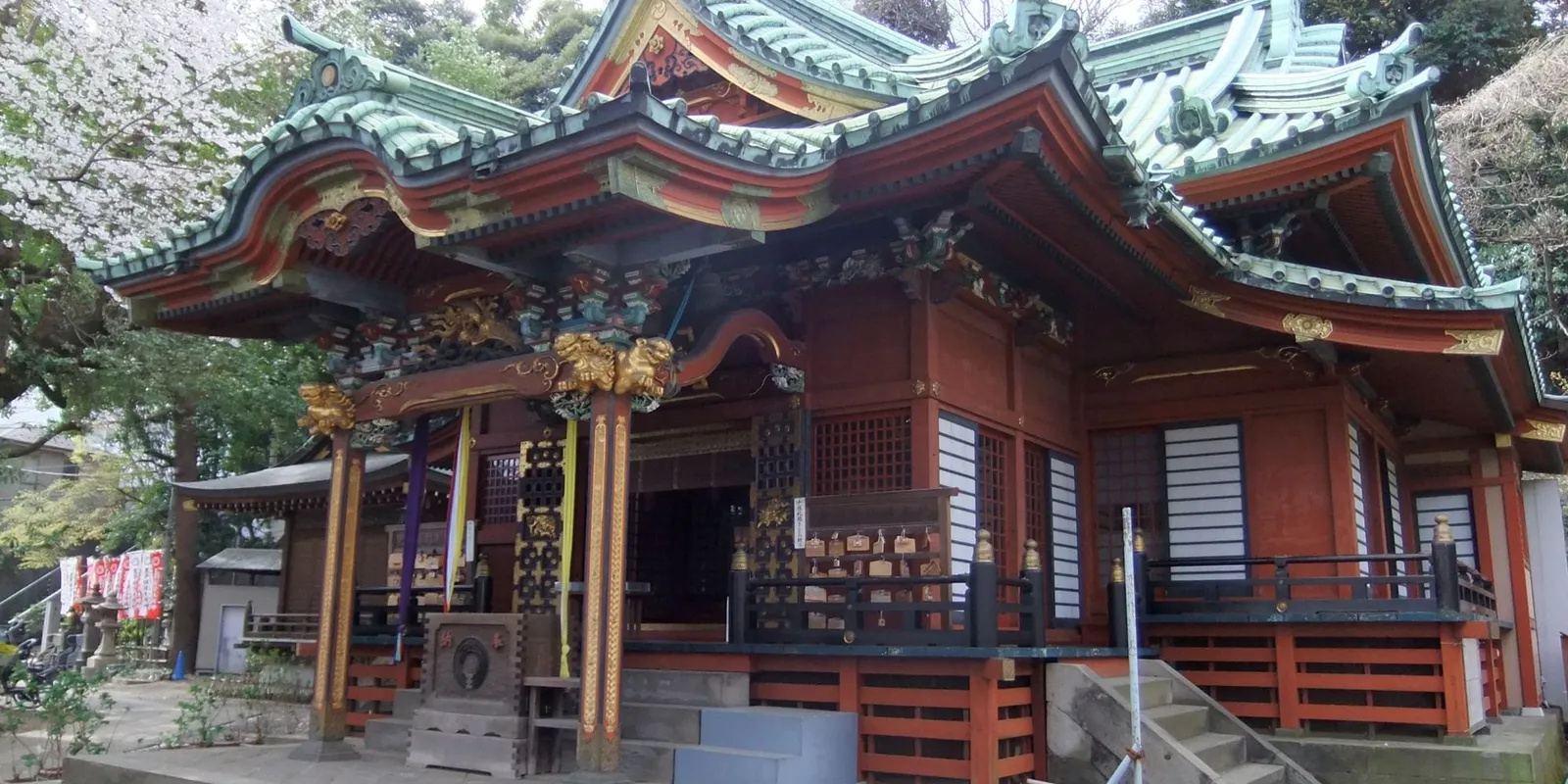
The vermilion main hall stands up a flight of stone steps, with curved roofs and detailed carving worth looking at. Stone fox statues stand along the approach and the steps, and a visitor account says many were dedicated in the Edo period.
Behind the main hall is the “Oana-sama,” a place where foxes are said to have lived once (the place the Kita Ward tourism site calls the “fox hole site”). Beside the Hongu (rear shrine) is a stone called “Oishi-sama”: you make a wish, lift it, and the weight you feel is said to tell you whether the wish will come true. The Oana-sama and the Oishi-sama are based on visitor accounts and guide articles, as we could not find an official explanation from the shrine itself.
According to the Kita Ward tourism site, the shrine holds a painted plaque, “Gakumen Chakushoku Kijo-zu” (a demon woman), which is certified as an Important Art Object by the national government, and a dragon painting by Tani Bunchō. The ema plaque is displayed from January 1 to 3 and on Horse days in February, 10:00 AM–4:00 PM.
The shrine has also appeared on TV Tokyo’s “Shutsubotsu! Ad-machic Tengoku” in its “Asukayama” episodes, together with the foxes of Oji and the New Year’s Eve procession. In the broadcast of May 15, 2021, “Oji no Kitsune” was No. 9, and the program page describes Oji Inari Shrine as a shrine said to be the head of the Kanto Inari shrines and the “fox procession” as a fixture of the town (per the program’s official page). It also appeared at No. 10 in the broadcast of March 27, 2010.
Visiting Tips
Goshuin: The shrine office is to the right of the main hall. According to visitor accounts, the regular goshuin is ¥500 (one article gives ¥400 for a pre-written sheet). A special goshuin is said to be issued on the February Hatsuuma day, listed at ¥800 in a visitor account. Hours are given as about 9:00 AM–4:00 PM in some accounts and until 5:00 PM in others, and we could not confirm an official announcement. If no one is in the office, visitors say you can call someone with the intercom.
Entrances and footing: According to visitor accounts, the Shinmon gate on the main approach is often closed on weekdays, and on weekdays you enter by the sloped road at the side. The approach has stone steps, and as a kindergarten stands in the grounds, please pass quietly on weekdays.
Access: It is about a 5-minute walk from the north exit of Oji Station (JR Keihin-Tohoku Line / Tokyo Metro Namboku Line), per the Tokyo Shrine Association (visitor accounts say 6–7 minutes). It is also within walking distance of the Oji-ekimae stop on the Toden Arakawa Line (Tokyo Sakura Tram). Information on parking is conflicting and we could not confirm it from an official source, so if you are driving, please contact the shrine office (03-3907-3032) in advance.
We could not find an official website for the shrine. For the latest hours and event details, a phone call is recommended.
Annual Festivals
- Hatsuuma festival and Kite Market (Horse days in February): The Hatsuuma festival is the shrine’s main festival. The kite market is held on the Horse days of February each year, from 10:00 AM to 6:00 PM (per the Kita Ward tourism site). It is said to come from Edo residents, hit again and again by great fires, taking “a kite cuts the wind” as a charm against fire; the shrine gives out “fire-prevention kite charms” and kite sellers set up in the grounds. In 2026 it was reported, based on a sign in the grounds, to be held on February 1 (Sun) and 13 (Fri). By the cycle of Horse days, 2027 would fall on February 8 (Mon) and 20 (Sat), but this is a calculation, not a confirmed schedule.
- Display of the ema plaque (January 1–3 and Horse days in February, 10:00 AM–4:00 PM): The “Kijo-zu” (demon woman) plaque is shown (per the Kita Ward tourism site).
- Oji Fox Procession (the night of December 31 into the early hours of New Year’s Day): Organized by local people, this event began on New Year’s Eve in 1993 (Heisei 5). It recreates the legend that on New Year’s Eve the messenger foxes of the Inari shrines of the Kanto region gathered under a tree to change into their costumes and then made their first shrine visit at Oji Inari Shrine, and the organizing committee says it is inspired by a Utagawa Hiroshige woodblock print. Participants dress in kimono with fox masks or fox face paint and walk from the sister shrine, Shozoku Inari Shrine, to Oji Inari Shrine. The 34th procession is scheduled for New Year’s Eve 2026. Participation is by advance registration only, and the official site now shows that applications for participants have closed. The Kita Ward tourism site lists December 31, 11:00 PM–0:30 AM, but in the official timetable for the previous (33rd) procession, the mirror-breaking ceremony was at 11:00 PM, the procession left after a midnight countdown, and arrival at Oji Inari Shrine was expected around 1:30 AM. We could not find a timetable for the 34th, so please check the procession’s official site (kitsune.tokyo-oji.jp) for times. The event may be cancelled in rain or snow.
Nearby Food & Sightseeing
- Shozoku Inari Shrine: Known as the sister shrine of Oji Inari Shrine and the starting point of the New Year’s Eve fox procession. It stands at a separate location and is said to have been built on the site of the old Shozoku Enoki tree (per an encyclopedia).
- Asukayama Park: A park on the south side of Oji Station, known as a cherry blossom spot. A good addition to a walk around Oji along with the shrine.
- Oji Shrine: A different shrine in Oji, Kita Ward, not the same as Oji Inari Shrine (the Tokyo Shrine Association’s Kita Ward listing also gives it as “Oji Gongen”).
Frequently Asked Questions
- Q. What does "Kanto Inari Sōji" mean?
- A. According to the Tokyo Shrine Association, the shrine is said to have received the title "Kanto Inari Sōji" from the shogunate general Minamoto no Yoriyoshi during the Kōhei era. The Kita Ward tourism site likewise describes it as having the standing of the head Inari shrine of the Kanto region and as a shrine loved by ordinary people since the Edo period. Both are traditions recorded in the shrine's and the ward's own introductions.
- Q. Can anyone take part in the New Year's Eve Oji Fox Procession?
- A. Participants must register in advance, and there is no same-day sign-up, according to the official site of the organizing committee (from the application guidelines for the previous procession). The 34th procession is scheduled for New Year's Eve 2026, but the official site shows that applications for participants have already closed, and we could not find a timetable for the 34th. The site does not say whether people may simply watch, and it warns that once the lineup begins, some areas are closed to the general public. Please check the official site for the latest information.
- Q. When is the kite market held?
- A. According to the Kita Ward tourism site, it is held on the Horse days (Uma no hi) of February each year, from 10:00 AM to 6:00 PM. It is the fair day of the Hatsuuma festival: the shrine hands out "fire-prevention kite charms," and kite sellers set up stalls in the grounds. In 2026 it was reported, based on a sign in the grounds, to take place on February 1 (Sun) and 13 (Fri). By the cycle of Horse days, 2027 would fall on February 8 (Mon) and 20 (Sat), but this is a calculation, not something confirmed by the shrine or the ward, so please check with the shrine office (03-3907-3032) before you go.
- Q. Can I get a goshuin?
- A. It is said to be available at the shrine office. We could not confirm an official announcement from the shrine; according to visitor accounts, the regular goshuin is ¥500 (one article says ¥400 for a pre-written sheet), and it is given from about 9:00 AM to 4:00 PM (some say until 5:00 PM). A special goshuin is said to be issued on the February Hatsuuma day, listed at ¥800 in a visitor account. Details can change, so it is safest to call the shrine office (03-3907-3032) beforehand.
- Q. Has the shrine been featured on TV?
- A. Yes. TV Tokyo's program "Shutsubotsu! Ad-machic Tengoku" (Adomachi) featured it in its "Asukayama" episodes, at No. 10 in the broadcast of March 27, 2010 and at No. 9 in the broadcast of May 15, 2021, both under the entry "Oji no Kitsune" (the Foxes of Oji), alongside the New Year's Eve fox procession (per the program's official pages). The 2021 page describes Oji Inari Shrine as a shrine said to be the head of the Kanto Inari shrines.
Plan Your Visit
Before you go, you can book a stay and get your shrine-visit items ready.
Amazon links open Amazon.co.jp (Japan) in English; whether an item ships overseas depends on the product.
※ Contains ads (PR). Links open external sites such as Amazon, Rakuten, Trip.com and Booking.com.